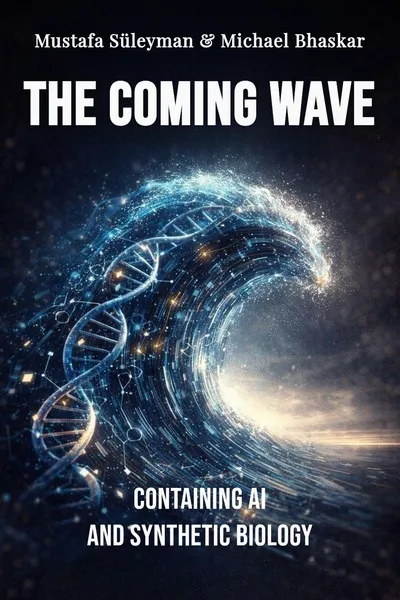
The Coming Wave
Containing AI and synthetic biology
Description
Mustafa Suleyman co-founded DeepMind in 2010, sold it to Google in 2014, and spent the following decade close enough to the frontier of artificial intelligence to watch it accelerate past the timelines almost everyone had predicted. In 2023, with the writer Michael Bhaskar, he published The Coming Wave — a book written not as a triumphant insider's tour but as something closer to a warning issued from inside the building. The people making the technology, Suleyman argues, are the ones who should be most nervous about it. He would know: he now runs Microsoft's AI division.
The book's central image is a wave. Not a single invention but a cluster of technologies arriving together — large language models, cheap gene-editing, autonomous systems, robotics — each amplifying the others, each getting cheaper and more accessible every year. Suleyman's claim is that waves like this have never, in the whole history of technology, been stopped. Gunpowder spread. The printing press spread. The car, the plane, the transistor, the internet — all of them diffused outward from a handful of inventors to the entire species, whatever anyone in charge wanted. The coming wave, he says, will be no different, except that it arrives faster, cheaper, and with far more destructive reach.
That is the trap the book sets for itself and for us. If a wave cannot be stopped, and this one is too dangerous to let run free, what exactly is left to do? Suleyman refuses the two easy exits — the optimist's shrug that it will all work out, and the doomer's certainty that it won't. What he reaches for instead is a word borrowed from an older era of dangerous technology, and a problem he admits he cannot fully solve.
The question we’re asking : If no powerful technology has ever been contained, what could it possibly mean to contain this one?What we’ll see : How two of the most disruptive technologies of the century arrive as a single force, why every instinct we have for controlling it comes up short, and where the book looks for a way through.
Table of contents
01Chapter 1 — The wave that has never asked permission
Suleyman's history is blunt: general-purpose technologies do not stay bottled up. The steam engine did not remain a British curiosity, and nuclear knowledge did not stay in Los Alamos. Once a technology proves useful and can be copied, it diffuses — across borders, down the cost curve, into hands its inventors never imagined. He calls this the great proliferation, and treats it less as a policy failure than as a near-law of how tools move through the world. The people who build a thing rarely get to decide who uses it, or for what.
What makes the coming wave distinct is not novelty but convergence and speed. Suleyman groups the front-runners under two headings that keep colliding: artificial intelligence and synthetic biology. AI is becoming a kind of universal engine — able to write, reason, plan, and increasingly to act on its own. Synthetic biology is turning the reading and writing of DNA into something closer to software, cheap enough that garage labs can now attempt what only states could a generation ago. Put an AI that can design proteins next to a lab that can print them, and the two technologies stop being separate stories.

02Chapter 2 — Why containment keeps failing
The word Suleyman keeps returning to is containment — the ability to control, curtail, or if necessary stop a technology at any stage of its life. It is borrowed deliberately from the Cold War, where it meant holding a threat within bounds rather than defeating it. Applied to technology, containment would mean keeping meaningful human oversight over tools that are becoming faster, more capable, and more autonomous than the people meant to supervise them. The uncomfortable admission at the heart of the book is that we have almost never managed it, and the wave makes the old tricks harder still.
Consider the standard responses and watch each one fail. Regulation moves at the speed of committees; the technology moves at the speed of compute. National bans simply push development elsewhere — if one country forbids a line of research, the work relocates to a jurisdiction that welcomes it, and the knowledge leaks back anyway. Voluntary restraint by companies runs into competition: no firm wants to slow down while rivals sprint ahead, and no country wants to disarm while adversaries build. Suleyman knows this intimately, because he has sat in the rooms where these calculations get made.
03Chapter 3 — The narrow path between catastrophe and dystopia
Suleyman frames the future as a squeeze between two failures. On one side is catastrophe: a wave left uncontained, where cheap, powerful, dual-use tools proliferate until a lab accident, an engineered pathogen, an autonomous weapons cascade, or a chain of AI-driven failures does damage at civilisational scale. On the other side is dystopia: containment achieved, but only by concentrating so much surveillance and coercive power in the state that freedom itself becomes the casualty. A government able to monitor every genome synthesiser and every line of code is a government able to monitor everything. The dilemma is that the tools you would need to prevent the first outcome look a lot like the tools that produce the second.
What Suleyman calls the narrow path is the attempt to thread between them — to keep the wave's benefits, which he genuinely believes are enormous, while blunting its worst edges without sliding into either extreme. He does not pretend this path is comfortable, and he explicitly rejects the idea of a single silver bullet. Instead he sketches a defence-in-depth: many overlapping, imperfect measures that together might buy time and reduce risk, none of them sufficient alone.
04Chapter 4 — When the state is the wrong size for the problem
Step back from the specific measures and a deeper tension in the book comes into focus. Almost every tool Suleyman reaches for — regulation, licensing, treaties, choke points — assumes the nation-state as the natural unit of governance. Yet the wave he describes is precisely the thing the nation-state is worst equipped to handle. It is planetary in scope, borderless in diffusion, and moving faster than any legislature can legislate. The container he needs and the container he has are different shapes, and he is candid enough to say so.
The mismatch cuts both ways, which is the real bind. A state weak enough to preserve liberty may be too weak to contain the wave; a state strong enough to contain it may be strong enough to become the dystopia. Suleyman also worries about the opposite failure — that the wave hollows the state out entirely, as private actors and non-state groups acquire capabilities that once defined sovereignty itself. When a small lab or a well-resourced individual can command power previously reserved for governments, the state's monopoly on serious force, the thing that made it the unit of order for centuries, quietly erodes.
05Conclusion
Suleyman ends more or less where he began — inside the building, watching the wave rise, unwilling to look away. He is neither the evangelist who promises abundance nor the prophet who promises doom, and the book's discomfort comes from that refusal. Containment, he concedes, may be impossible; and yet abandoning the attempt guarantees the outcomes he fears most. The narrow path is not a solution so much as a discipline — a commitment to keep threading, imperfectly, between catastrophe and control, knowing the ground keeps shifting underfoot.
Related books