What Doesn't Kill Us
How bodies adapt and survive
Description
In early 2011, a journalist named Scott Carney flew to a small town in Poland to debunk a man. The man was Wim Hof, a Dutch fifty-something who claimed he could control his own body temperature with his mind, who had climbed most of Everest in shorts, and who had sat in ice baths long enough to make cardiologists nervous. Carney had built a career writing about people harmed by their own gurus — he had covered deaths in meditation retreats — and he arrived expecting to expose another charismatic fraud. The plan was simple: watch closely, find the trick, write the takedown.
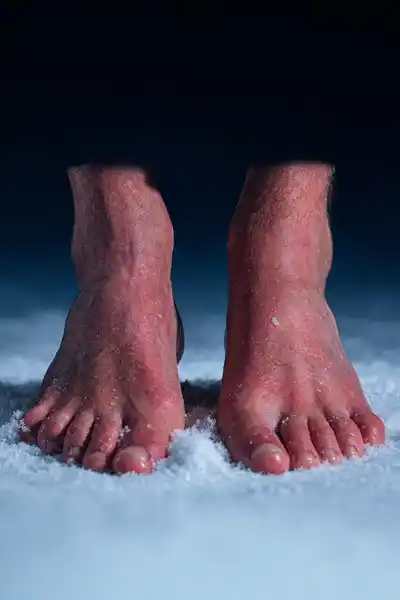
That is not what happened. Within days, Carney was stripped to his shorts in the snow, breathing in strange rhythmic bursts, and finding — against everything he assumed about human physiology — that he was not cold. Not gritting his teeth through it. Actually warm. A few years later he climbed a snow-covered mountain in Poland bare-chested and barefoot, alongside a group of ordinary people who, weeks earlier, had been sedentary office workers. The debunking assignment had turned into something the journalist could not explain away, and so he did the honest thing: he tried to understand it.
What Doesn't Kill Us is the record of that reversal. It sits at an odd intersection — part immersion journalism, part physiology, part the uncomfortable suspicion that our climate-controlled lives have switched off machinery we didn't know we were carrying. Carney is careful. He wants evidence, not testimonials. But the book keeps circling one idea that is harder to dismiss than he expected: the environments we've spent a century engineering away might have been doing something for us all along.
The question we’re asking : Have we lost the ability to endure hardship, or have we simply stopped switching it on?What we’ll see : A skeptic's reluctant reeducation in cold, breath, and the biology comfort taught us to ignore.
Table of contents
01Chapter 1 — The skeptic who went to the ice
Carney did not want to believe Wim Hof. Everything in his professional instinct pointed the other way. He had spent years documenting the damage that self-styled gurus do — people who follow a magnetic personality into danger and pay for it with their health or their lives. Hof, with his booming laugh and his talk of controlling the autonomic nervous system by will, fit the profile precisely. So Carney went to Poland the way a good reporter goes anywhere: watching for the sleight of hand.
The method Hof taught was almost embarrassingly simple. A breathing pattern — thirty or forty deep, forceful breaths, then a long exhale and a hold — repeated in rounds. Then exposure to cold: cold showers, cold air, eventually ice water. No incantations, no mysticism required, just breath and temperature. Hof's claim was that this combination gave a person conscious access to systems the textbooks called involuntary, the ones that manage inflammation, heat, and the stress response without asking permission.

02Chapter 2 — A nervous system we forgot we had
To make sense of what he'd felt, Carney had to reach for the physiology of stress, and specifically for a distinction the body draws between two kinds of it. There is chronic stress — the low, unrelenting hum of deadlines, traffic, and screens — which corrodes the system over time. And there is acute stress: sharp, intense, and brief, the kind our ancestors met constantly and then recovered from. The body was built for the second kind. Modern life delivers almost entirely the first.
Cold exposure, in Carney's reading, is a way of dosing yourself with the good kind of stress. Plunge into cold water and the sympathetic nervous system fires — the fight-or-flight machinery floods the body, blood vessels clamp shut to protect the core, the heart rate spikes. Stay with it, breathe through it, and something interesting follows: the system learns to switch back off. The vascular muscles that constrict and dilate around your blood vessels are, in effect, exercised. Carney describes people whose chronic hand-and-foot circulation problems improved simply from making those muscles work again.
03Chapter 3 — The comfortable cage
Carney's central provocation is historical. For nearly all of human existence, temperature was something you survived, not something you set. Our ancestors crossed deserts and mountain passes and open ocean, endured winters without central heating and summers without air conditioning, and their bodies were shaped by the constant negotiation with an environment that would not hold still. Endurance wasn't a hobby. It was the baseline condition of being alive.
Then, over roughly a century, we engineered the negotiation away. The thermostat is the quiet hero of the story — a device that holds the air around us within a few narrow degrees, day and night, summer and winter, for our entire lives. Carney is not a crank about it; he isn't asking anyone to freeze. His point is subtler and harder to dodge. When the environment never varies, the biological machinery built to respond to variation has nothing to do. Comfort, held constant, becomes a kind of confinement.
04Chapter 4 — The body as a story we tell it
Step back from the ice baths and the endotoxin studies and What Doesn't Kill Us is really an argument about where the mind stops and the body begins — a line Carney comes to suspect was never as firm as we were taught. The old model treats the autonomic system as a locked room: heart rate, inflammation, temperature regulation, all running on their own, none of your business. What the Hof method suggests, imperfectly and incompletely, is that the door has a handle. Attention and breath can reach in.
That reframing is bigger than one technique. It says that the environment is not merely something the body suffers but something it converses with, and that the terms of the conversation are partly ours to set. Carney is not selling mind-over-matter in the wishful sense; he's describing something more mechanical and more interesting — that deliberate exposure to real physical stress can retrain systems we assumed were beyond reach. The body listens to what we ask of it, and for a century we've mostly asked for nothing.
05Conclusion
The journalist who flew to Poland to write a takedown came home breathing differently and stepping into cold showers by choice. Carney never fully surrenders his skepticism — he keeps flagging what's proven and what isn't, keeps his reporter's distance even as his own body keeps contradicting his assumptions. That tension is the honest heart of the book. He wanted a fraud and found instead a set of physiological levers that anyone can pull, that leave marks in blood tests, and that our engineered lives have quietly disconnected.
Related books