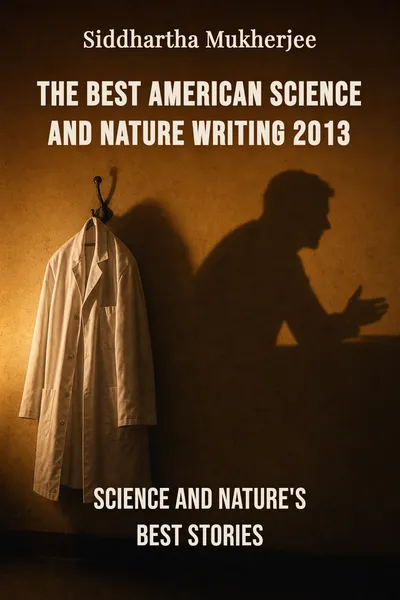
The Best American Science and Nature Writing 2013
Science and nature's best stories
Description
Every autumn, a series called The Best American Science and Nature Writing goes looking for the year's finest journalism about the physical world, and hands the choosing to a different guest editor. For the 2013 edition, that job fell to Siddhartha Mukherjee, an oncologist at Columbia who had won a Pulitzer two years earlier for The Emperor of All Maladies, his history of cancer. He read hundreds of pieces published across American magazines and journals in 2012 and pulled out roughly two dozen. The result is a book that reads less like a textbook than like a very good dinner party where everyone happens to have spent a year embedded with virologists, astronomers, or the dying.
What holds the collection together is not a subject. There are essays here about the neuroscience of memory and essays about the economics of drug pricing, pieces on the search for extraterrestrial life and pieces on a single doctor's mistake. What holds it together is Mukherjee's ear. As a working physician who also writes, he has a particular sense of when a science story is really a human story wearing a lab coat, and he selected for that. The strongest pieces in the book are the ones where a fact about the world turns out to be a fact about us.
An anthology is a strange object to describe, because it has no single argument to follow. What it has instead is a sensibility — a set of choices about what counts as good, made by one reader in one year, and then frozen in print. That is worth pausing over: not the individual findings, which date, but the shape of the collection and what a person picks when asked to say what the best looks like.
The question we’re asking : What does a single physician-writer decide counts as the best science writing of a year, and what do those choices reveal?What we’ll see : The sensibility of the editor, the pieces that lodge in memory, the stories where the science refuses to settle, and what the yearly form itself preserves.
Table of contents
01 Chapter 1 — A guest editor who reads for the human in the science
The series works on a rotation. There is a permanent editor — for years, Tim Folger — who casts a wide net across American publications and assembles a long list of candidates. Then a guest editor arrives for one year, reads that list, and makes the final cut. The guest changes every edition, and the choice of guest is itself editorial: it signals what the book will feel like. Handing 2013 to Mukherjee meant handing it to someone who spends his days with patients and his evenings with prose, and who is unusually suspicious of writing that keeps the reader at arm's length.
In his introduction, Mukherjee is candid about what he was reaching for. He describes wanting pieces that carry the texture of discovery — the false starts, the arguments between researchers, the moment when a result stops being a number and becomes a story about a person. He is a working scientist, so he knows the difference between how research is done and how it is later narrated, and he selected for writers who could hold both at once without cheating either.

02 Chapter 2 — The pieces that stay with you
The collection gathers writers who were, in 2012, doing some of the best reported work in American magazines — names that recur across the science-writing world, published in outlets from The New Yorker and Wired to smaller literary quarterlies. What unites the standouts is not their topic but their willingness to stay in one place long enough to see something. A good science piece, in Mukherjee's selection, earns its conclusions by reporting rather than by asserting them.
Several of the strongest entries work by narrowing. Instead of surveying a whole field, they follow one researcher, one patient, one anomaly, and let the larger questions rise out of the particular case. This is the oldest trick in narrative journalism, but it is harder in science, where the temptation is always to zoom out to the big picture. Mukherjee clearly rewards writers who resist that pull, who trust that a single well-observed life can carry more truth about a disease or a discovery than a page of context ever could.
03 Chapter 3 — When the science is unsettled, or unsettling
A recurring thread in the 2013 book is science caught mid-argument. Rather than presenting settled knowledge, many of the pieces enter the field while the researchers are still fighting — over what a result means, over whether an effect is real, over which of two rival models the data actually supports. Mukherjee, who came up inside oncology's own long uncertainties, seems drawn to that unfinished quality. He picks stories where the science is still being made, not just reported after the fact.
This makes the collection more honest than a lot of popular science, which tends to present research as a series of clean victories. The reality, as anyone inside a lab knows, is messier: most findings are provisional, many are later revised, and the process is closer to an argument than a march. Several pieces let the reader feel that mess directly — the replication that fails, the celebrated result that quietly erodes, the beautiful hypothesis that the evidence declines to support.
04 Chapter 4 — What a yearly anthology preserves
Step back from the individual pieces and the more interesting object comes into focus: the annual anthology as a form. A magazine article is built to be current and then to disappear. It runs, it circulates for a week or two, and then it slides off the front of everyone's attention. Most science journalism, however good, has this short half-life. The Best American series exists partly to fight that — to pull a year's worth of the strongest work out of the stream and set it down somewhere it can be found again.
What this preserves is not just individual essays but a cross-section of how a culture was thinking about the natural world in a given year. Read the 2013 book now and you get a snapshot of the questions that felt urgent then — which technologies people feared and hoped for, which diseases dominated attention, which cosmic mysteries were live. The anthology becomes, almost accidentally, a piece of intellectual history. Nobody set out to write the record of 2012's scientific imagination, but by choosing the best of it, Mukherjee produced one.
05 Conclusion
What Mukherjee assembled for 2013 is finally a portrait of a reader as much as a portrait of a year. Every choice — the reported piece over the explainer, the human face over the abstract idea, the unresolved ending over the tidy one — points back to a physician-writer who believes science is something that happens to people. The two dozen pieces cohere not because they share a subject but because they passed through one demanding and generous sensibility on their way into print.
Related books