Wonderful Life
Contingency, not progress
Description
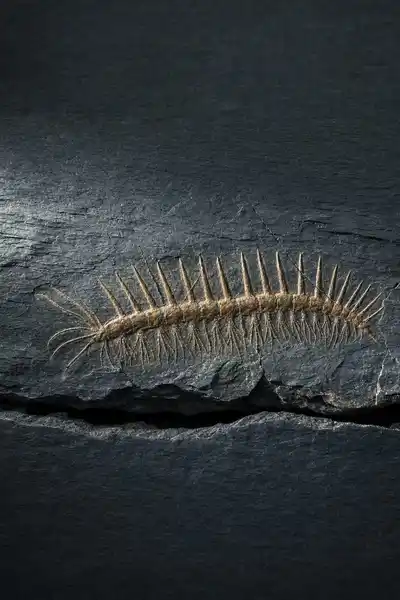
In 1909, high in the Canadian Rockies above the town of Field, British Columbia, a paleontologist named Charles Doolittle Walcott split open a slab of dark shale and found something that should not have survived. Walcott, who ran the Smithsonian Institution, had stumbled onto a bed of rock later called the Burgess Shale, and in it were the soft bodies of animals half a billion years old — not just shells and bones, but gills, guts, antennae, the delicate parts that normally rot away before anything can fossilize them. It was, and remains, one of the richest windows ever found onto the explosion of animal life in the Cambrian seas.
Walcott collected tens of thousands of specimens, hauled them back to Washington, and did something that would shape the field for decades: he filed the strange creatures into groups he already knew. A weird thing with legs became a kind of shrimp. An odd flattened animal became a kind of worm. Everything got sorted into the existing branches of the tree of life. For sixty years the Burgess animals sat in museum drawers, quietly labeled as early versions of familiar things. Then, in the 1970s, a small group of researchers took the fossils back out and looked again — and what they saw did not fit.
In 1989 the biologist Stephen Jay Gould turned that re-examination into a book called Wonderful Life, and used it to pick a fight with one of the most comforting stories we tell about ourselves: that evolution is a ladder climbing steadily toward us. The Burgess Shale, he argued, says something stranger and far less flattering about how we got here.
The question we’re asking : If we could run the history of life over again from the Cambrian, would anything like us appear a second time?What we’ll see : How a drawer of misfiled fossils became the strongest case that life's history is ruled by accident rather than ascent.
Table of contents
01 Chapter 1 — A shale quarry and a mistake that lasted sixty years
Charles Walcott was no amateur. He had risen from a farm boy without a college degree to the most powerful figure in American science, administering the Smithsonian and advising presidents. He found the Burgess Shale late in a long career, and he grasped at once that the preservation was extraordinary. What he did next, though, is the heart of Gould's story — and the part that reads less like villainy than like the quiet pull of habit.
Confronted with animals nobody had ever seen, Walcott interpreted them through the categories he carried in his head. His guiding assumption was what Gould calls the cone of increasing diversity: the idea that life began with a few simple forms and fanned steadily outward into more and more types over time. If that picture were true, then the Cambrian, being early, should hold only a modest handful of basic designs — primitive ancestors of the groups alive today. So Walcott shoehorned each oddity into a known box. He called the process, in Gould's phrase, 'shoehorning,' and it was almost invisible as an error because it confirmed what everyone already believed.

02 Chapter 2 — Reconstructing the impossible animals
The Burgess fossils are flattened almost to film, but the soft tissue leaves a trace, and Whittington's team learned to read the layers by carefully removing rock grain by grain to expose structures buried beneath the surface. What emerged, one creature at a time, was a bestiary that refused to behave. The reconstruction work stretched across the 1970s and into the 1980s, published in a series of exhaustive technical papers that Gould later retold as a detective story.
Consider Opabinia. When Whittington projected his reconstruction at a scientific meeting in 1972, the room reportedly laughed, because the animal had five eyes and a long frontal nozzle ending in a grasping claw. It belonged to no known group. Or Hallucigenia, named for its dreamlike improbability, so baffling that Conway Morris first reconstructed it upside down and walking on stilt-like spines. Or Wiwaxia, armored in scales and spines, fitting neatly into no living phylum. And towering over them, Anomalocaris, the largest Cambrian predator, whose parts had originally been described as three separate creatures before anyone realized they were one animal.
03 Chapter 3 — Decimation, then diversification
If the Cambrian produced more body plans than survived, then the history of animal life has a shape nobody expected. Gould described it as decimation followed by diversification. First a burst of experimentation threw up a wide array of basic designs. Then most of those designs were eliminated, leaving a small number of survivors. Only afterward did the survivors multiply into the many species we see now — many species, but built on comparatively few surviving blueprints.
The crucial question becomes: how were the winners chosen? The intuitive answer, the one that flatters the survivors, is that the losers were inferior — clumsier, less fit, destined to lose. Gould pressed hard against this. Looking at the Burgess animals, he could find no reliable way to have predicted, in advance, which designs would persist and which would vanish. The survivors do not look obviously better engineered than the casualties. Many of the losers appear every bit as competent for Cambrian life as the lineages that happened to continue.
04 Chapter 4 — Rerun the tape, get a different world
Gould's famous thought experiment follows directly from Pikaia and the decimated fauna around it. Imagine, he wrote, that we could rewind the history of life like a tape, back to the Burgess seas, and let it play again from the same starting point. Would we get the same result? His answer was an emphatic no. Replay the Cambrian a thousand times, and the overwhelming likelihood is that the chordates get pruned early in some runs, that different survivors inherit the ocean, and that the branch leading to large-brained land vertebrates never forms at all. In almost every rerun, there is no Pikaia lineage, and therefore no us.
This is the step back the Burgess Shale demands, and it cuts against a deep habit of thought. We tend to read the past as a corridor leading inevitably to the present — evolution as a story of steady ascent toward complexity, intelligence, and ultimately humanity as its crown. The fossils dissolve that corridor. If our existence depends on the survival of one inconspicuous animal that had no special claim to survive, then we are not the goal of the process. We are a contingent afterthought of it, one outcome among a near-infinity of equally possible histories that happened not to occur.
05 Conclusion
Charles Walcott's drawers turned out to hold not a modest collection of primitive ancestors but the strongest evidence yet that the history of life is ruled by accident rather than ascent. The misfiling lasted sixty years because it fit the story everyone wanted to be true. The redescription undid it one dissected fossil at a time, and Gould gathered the result into a single uncomfortable idea: the Cambrian was a moment of maximum experimentation, most of it erased by a cull no one could have predicted.
Related books