Petrol
The liquid that built the century
Description
On August 27, 1859, near Titusville, Pennsylvania, a former railway conductor named Edwin Drake struck oil at a depth of about seventy feet. He had been drilling for months, funded by investors who were on the verge of pulling out, and the black liquid that rose in his well was worth, at the time, mostly as a source of kerosene for lamps. The engines that would one day burn its lighter fractions did not yet exist. Nobody standing at that wellhead imagined that the fluid seeping up through the rock would go on to power armies, redraw borders, and set the tempo of an entire century of human movement.
For most of its early life, petrol — the volatile, lighter part of crude that refiners once burned off or dumped as waste — was the byproduct nobody wanted. Kerosene was the prize; gasoline was the dangerous leftover. Then the internal combustion engine arrived, the automobile followed, and within two decades the leftover became the point. By the middle of the twentieth century, the global economy ran on refined petroleum the way an earlier one had run on coal and muscle. Cheap, dense, liquid energy became so ordinary that we stopped noticing it, the way we stop noticing air.
That ordinariness is worth disturbing. Petrol is a specific substance with a specific chemistry, a specific price mechanism, and now a specific endgame, and each of those three things explains something the others cannot. Understanding why it won, and how it is beginning to lose, means treating it as a physical fact and an economic system at once — not as a symbol of progress or of catastrophe, but as a liquid that did an enormous amount of work.
The question we’re asking : How did a discarded byproduct end up powering a century, and what does its slow retreat actually look like when you count it?What we’ll see : A journey through petrol's chemistry, the economics it created, and the arithmetic now pulling it apart.
Table of contents
01 Chapter 1 — A barrel of sunlight, refined into motion
Crude oil is, in the most literal sense, ancient sunlight. It forms over millions of years as marine organisms — plankton, algae — settle on the seabed, get buried under sediment, and cook slowly under heat and pressure into a mixture of hydrocarbons. What comes out of the ground is not one substance but hundreds, molecules of carbon and hydrogen chained together at different lengths. A refinery's entire job is to sort them.
The sorting happens mostly by weight. Heated crude is fed into a distillation column, and its components boil off at different temperatures: the heaviest fractions, tar and bitumen, stay at the bottom; diesel and kerosene sit in the middle; and near the top, the light, volatile molecules that make up petrol come off as vapor. Petrol is roughly the fraction of hydrocarbon chains between five and twelve carbon atoms long — light enough to evaporate readily, heavy enough to hold a lot of energy.

02 Chapter 2 — The century oil bought and sold
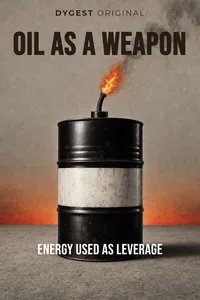
Once the engine made petrol valuable, the scramble to control crude reorganized the world's money and its maps. John D. Rockefeller's Standard Oil had already shown, before the automobile, how much power sat in refining and distribution; by 1904 it controlled the vast majority of American oil before antitrust regulators broke it into pieces in 1911. Those pieces became some of the largest companies on earth. The pattern held everywhere: oil was never just a commodity, it was leverage.
The twentieth century's wars ran on it. Navies converted from coal to oil before the First World War because oil-fired ships were faster and needed smaller crews, and that single decision turned petroleum into a strategic obsession. In the Second World War, campaigns were fought explicitly for oilfields, and armies stalled when their fuel ran out. Winning meant, in large part, keeping the tanks and planes supplied with refined product. The liquid had become a precondition for force itself.
03 Chapter 3 — The peak that kept moving
For most of the oil age, the great fear was that the wells would simply run dry. The theory of peak oil — associated with the geologist M. King Hubbert, who in 1956 predicted US production would crest around 1970 — assumed that supply was the binding constraint, and that scarcity would eventually force the world off petroleum whether it wanted to leave or not. Hubbert was right about American conventional output for a while, and wrong about the ceiling, because the ground kept surprising everyone.
The surprise came from technology. Hydraulic fracturing and horizontal drilling, refined in the United States through the 2000s, unlocked oil trapped in shale rock that had been considered uneconomic. American production, which many had written off as terminal, roughly doubled in the decade after 2008, turning the country from a shrinking producer back into the largest one. The lesson was uncomfortable for the peak-supply crowd: there was far more recoverable petroleum than the pessimists had assumed, and price, not geology, decided how much of it came up.
04 Chapter 4 — The arithmetic of leaving
Stepping back, petrol's decline is best understood not as a moral verdict but as a slow sum. Energy transitions have always been arithmetic before they were anything else — a matter of how many machines exist, how long they last, and how fast the replacements can be built and paid for. Coal did not vanish when oil arrived; it kept growing for decades alongside it. The world does not switch fuels by decree. It switches them one purchase at a time, and the total takes years to move.
Consider what the numbers actually contain. There are well over a billion petrol and diesel vehicles on the roads, and a car bought today may still be driving in fifteen years. Even when electric vehicles reach half of new sales — a threshold several markets are now approaching — the existing fleet keeps burning fuel until it retires. Demand for petrol falls not when the new technology wins, but when the old stock finally ages out, and that lag is measured in decades, not seasons.
05 Conclusion
The well at Titusville produced a fluid whose lighter fraction nobody wanted, and within two generations that fraction was moving the world. Petrol won because its chemistry gave it an advantage no rival could touch — energy packed tight into a liquid a person could carry — and because an entire civilization then arranged itself around the assumption that the advantage would last forever. The highways, the fleets, the borders drawn around reserves: all of it was built on nine kilowatt-hours a litre and a price that stayed low enough to ignore.
Related books