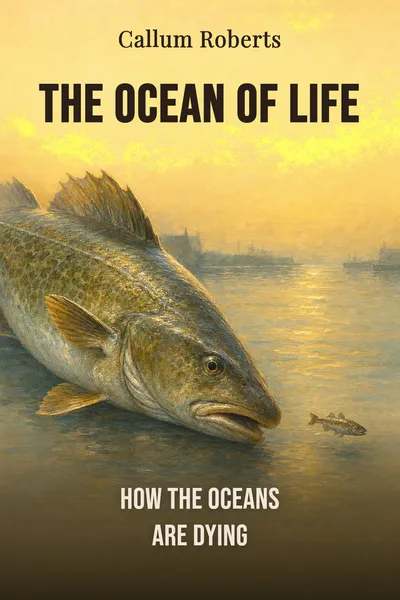
The Ocean of Life
How the oceans are dying
Description
In the late 1940s, a boy could stand on almost any European harbor wall and watch boats come back loaded with cod, herring, and haddock the size of a forearm. Callum Roberts, a marine biologist who has spent decades studying reefs and fisheries, opens The Ocean of Life with that kind of remembered abundance — not as nostalgia, but as a baseline. He shows a photograph of a 1950s trophy fish next to one caught in the same waters half a century later. The old fish dwarfs the new. And here is the unsettling part: nobody who caught the smaller fish felt cheated, because to them it was normal.
That slippage is the quiet engine of the whole book. Each generation of fishers, divers, and beachgoers takes the sea it first encountered as the natural state of things, forgetting how much richer it was for the people who came before. Roberts calls this the shifting baseline, and it means the ocean can empty out steadily without anyone noticing a single dramatic collapse. We are, in a sense, going blind to our own loss. The water still looks blue, the beaches still fill in July, and the fish counter is still stocked — with fish trucked from further away, caught deeper, and grown thinner.
Published in 2012, The Ocean of Life earned Roberts a comparison to Rachel Carson, whose Silent Spring did for pesticides what he tries to do for the sea. His wager is that the ocean, which covers most of the planet and shapes the air we breathe, has been treated as too vast to damage — and that this assumption is now failing, all at once, on several fronts.
The question we’re asking : What has actually happened to the ocean over a single human lifetime, and why did we not see it coming?What we’ll see : How Roberts traces the sea's decline through what we have pulled out of it and what we have poured into it, and why he insists on seeing it as one connected system.
Table of contents
01 Chapter 1 — The sea we inherited, and the one we made
Roberts begins with a long view, because the ocean's problem is partly that it changes slower than we watch. For most of human history the sea genuinely was inexhaustible relative to what we could take from it. A sailing boat with hooks and nets could barely dent a population of cod that spawned in the billions. That balance held for millennia, and it shaped a deep cultural conviction that the ocean simply replenished itself no matter what we did to it.
The twentieth century broke that balance quietly. Engines replaced sails, sonar found the fish that used to hide, and freezer trawlers meant a boat could stay at sea for weeks and haul from waters that had never been fished before. Roberts describes the moment industrial fishing crossed a threshold: for the first time, our capacity to remove life from the sea outran the sea's capacity to make more of it. Nothing looked catastrophic on any single day. The catches even rose for a while.

02 Chapter 2 — What we took out
The most direct assault Roberts documents is fishing itself, at a scale most people never picture. Modern industrial fishing does not resemble the postcard image of a boat and a net. It is bottom trawling that drags weighted gear across the seafloor, flattening coral, sponge, and every slow-growing structure in its path, in some places scouring the same ground several times a year. Roberts compares it to clear-cutting a forest to catch a few rabbits, except the forest is out of sight and the destruction leaves no stump anyone can photograph.
The arithmetic of overfishing is stark. Many of the great commercial stocks — the North Atlantic cod above all — have collapsed to a fraction of their former size, and some have not recovered even after decades of protection, because the ecosystem that supported them was dismantled along with them. Roberts is careful with numbers here, noting that estimates of large-predator decline are contested, but the direction is not in doubt: the biggest fish, the ones that took longest to grow, went first and are slowest to return.
03 Chapter 3 — What we put in
If the first half of the damage is subtraction, the second is addition — everything we pour into the sea assuming it will simply dilute away. Roberts moves methodically through the inputs, and the cumulative effect is meant to be sobering rather than sensational. Nitrogen and phosphorus from farm fertilizer wash down rivers and feed vast algal blooms; when the algae die and rot, they strip the water of oxygen, creating dead zones where almost nothing can breathe. The one in the Gulf of Mexico swells across thousands of square miles each summer.
Plastic is the input everyone can now picture. Roberts describes it accumulating in ocean gyres and, more insidiously, breaking into microscopic fragments that fish and plankton mistake for food, carrying it up the food chain and eventually onto our own plates. Alongside it runs a quieter tide of industrial chemicals and heavy metals that concentrate in the tissue of top predators — which is why the tuna steak, sitting at the summit of the marine food web, carries a mercury warning.
04 Chapter 4 — The ocean as a system, not a scenery
The deeper argument of the book is not really about fish, and this is where Roberts steps back. His claim is that we have persistently misread what the ocean is. We treat it as scenery — a blue backdrop to holidays, a larder we dip into, a place that begins where the beach ends and matters mostly when we want something from it. Roberts insists it is instead the planet's central life-support machine, and that nearly everything we have done to it follows from getting that category wrong.
Consider what the ocean quietly does. It produces a large share of the oxygen we breathe, through the photosynthesis of microscopic plankton most people have never heard of. It absorbs vast quantities of the heat and carbon dioxide our civilization emits, which is the only reason the land has warmed as slowly as it has. It drives the weather, moves heat from the equator to the poles, and feeds billions of people directly. These are not scenic amenities. They are the conditions that make the surface of the Earth habitable at all.
05 Conclusion
Roberts closes near where he began, with the shifting baseline and the trophy photographs. The danger, he argues, is not only that the ocean is emptying, but that we keep resetting our sense of normal downward, so that each generation defends a poorer sea than the one it was actually born into. Naming that blindness is the first act of the book, because a loss we cannot perceive is a loss we will never choose to reverse. Once we see the whole arc — from our great-grandparents' abundance to today's thinning stocks and acidifying water — the decline stops looking like weather and starts looking like a decision.
Related books