Archaeology of Health
Disease read from ancient bones
Description
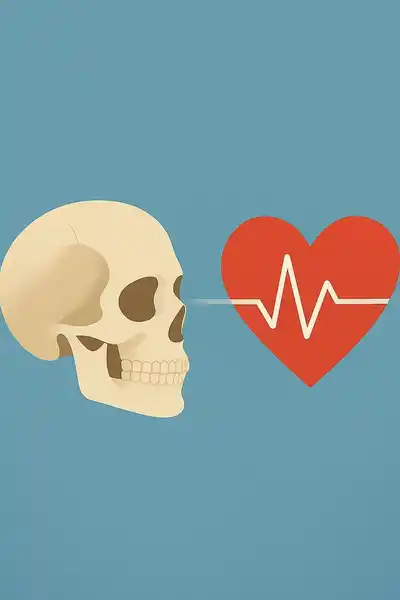
A skeleton laid out on a table in a laboratory doesn't look like it has much left to say. The flesh is gone, the voice is gone, the name usually gone too — often the century is a guess. And yet a trained eye can lean over a femur, a jawbone, a cracked vertebra, and read a life out of it the way a friend reads a worn-out jacket: the places it stretched, the places it tore, the weather it went through. This is the terrain Alain Froment and Hervé Guy map in Archaeology of Health — the quiet discipline that treats old bones as documents.
Their point of departure is almost provocatively simple. Long before there were hospitals, prescriptions, or doctors in white coats, there was health — and there was its opposite. People got sick, broke bones, went hungry, grew old, carried pain. All of this happened, and much of it left a trace. Palaeopathology, the study of ancient disease, is the attempt to recover that trace from what physically survives: mostly the skeleton, sometimes a preserved body, occasionally a tooth that has kept its chemical diary intact for thousands of years.
What makes the book worth sitting with is that it refuses the easy picture of the past as either a lost golden age of robust ancestors or a nightmare of universal suffering. The bones tell a more specific, more interesting story — one about work, food, violence, and above all about the moment our species changed how it lived. We've all wondered, vaguely, whether people used to be healthier. The dead, it turns out, can be surprisingly direct on the matter.
The question we’re asking : What can a skeleton actually tell us about the health, the suffering, and the way of life of someone who died thousands of years ago?What we’ll see : How buried bodies become readable documents, and what they reveal about the long story of health before medicine ever existed.
Table of contents
01 Chapter 1 — What a skeleton remembers
Bone looks inert, but in life it is one of the most responsive tissues we have. It builds, dissolves, and rebuilds itself constantly, reacting to the loads placed on it, the food that reaches it, the illnesses that pass through the body. That responsiveness is exactly what makes it an archive. A skeleton doesn't record everything — a fever that kills in three days leaves nothing behind — but it records what it has time to react to. Chronic trouble, repeated strain, long deprivation: these get written into the material itself.
Froment and Guy walk through the basic grammar of this reading. The pelvis and the skull give a reasonable estimate of sex. The fusion of growth plates, the wear on teeth, and changes at the joints give an approximate age at death. Height can be reconstructed from the length of the long bones. None of this is magic; it is comparative anatomy applied patiently, calibrated against known reference collections, and always stated as a range rather than a certainty. The honest palaeopathologist talks in probabilities, not verdicts.

02 Chapter 2 — Reading the marks of a hard life
Once the basic identity is sketched, the marks of a life come into focus, and they are often blunt. Healed fractures are common and tell their own story: a break that knit cleanly suggests the person survived and was cared for long enough to mend, while a break that set crooked speaks of a world without splints. Arthritic joints, worn down and rebuilt into knobs of extra bone, record decades of repetitive effort — the shoulders of someone who paddled or ground grain, the knees of someone who squatted and carried.
Froment and Guy are careful with the word that tempts everyone: violence. A skull with a healed depression might come from a fall as easily as a blow. But some signatures are unambiguous — a blade cut with no sign of healing, an arrowhead lodged in a vertebra, a pattern of injuries across a whole group that points to conflict rather than accident. The bones can distinguish, within limits, between the wounds of daily life and the wounds inflicted by other people.
03 Chapter 3 — The great transition that made us sicker
The strongest thread running through the book is a reversal of intuition about the invention of farming. For a long time the move from hunting and gathering to agriculture, beginning roughly ten thousand years ago, was told as pure progress: settled villages, stored food, the start of civilization. The skeletons from that transition tell a harsher story. On several measures, the first farmers were worse off than the foragers who came before them.
The pattern recurs across many regions studied. Average height tends to drop after the shift to agriculture. Those enamel lines of childhood stress become more frequent, suggesting more hungry seasons, not fewer. Teeth rot more, because a diet heavy in cultivated starch feeds decay in a way that a varied foraging diet does not. The picture that emerges is of a population trading the risk of the hunt for the different risk of the harvest — and paying for it in the body.
04 Chapter 4 — The body as the oldest archive
Step back from the individual cases and the discipline makes a larger claim about what health even is. We tend to think of health as the thing medicine produces — an outcome of hospitals, drugs, and expertise. Palaeopathology quietly dismantles that. For almost the entire span of human existence there was no medicine in any modern sense, and yet health existed as a real, variable, measurable condition. It was shaped by food, work, climate, violence, and the company of others, long before anyone thought to intervene in it on purpose.
Read this way, the skeleton becomes the oldest archive we have of human well-being, older than any text, any monument, any oral memory. It records something official history almost never does: not the names of kings or the dates of battles, but what ordinary bodies actually endured. A cemetery of worn joints and interrupted teeth is a census of ordinary suffering and ordinary resilience, written by people who left no other document behind.
05 Conclusion
The skeleton that looked mute at the start turns out to be a patient witness. It won't give up a name or a last thought, but it will testify, line by line, to the harvests that failed, the blows that landed, the years of grinding work, the illnesses slow enough to leave a scar. Froment and Guy's achievement is to show how much of a life survives in the part of us that outlasts everything else, and how carefully that evidence has to be handled — in ranges, in populations, in inferences stated plainly as inferences.
Related books