Viruses
Replicators at the edge of life
Description
A single influenza particle is about a hundred nanometers across — you could line up roughly a thousand of them across the width of a human hair. It carries no way to eat, no way to move on its own, no way to make more of itself. Left alone on a doorknob or a subway pole, it does precisely nothing. It waits. And then a hand touches the pole, an eye gets rubbed, and inside the warm chemistry of a living cell, that inert speck suddenly does the one thing it was built to do: it copies itself, thousands of times over, until the cell is spent.
This is the strange status of viruses. They sit on the border between chemistry and biology, and for a century biologists have argued about which side of the line they belong on. They evolve, they adapt, they carry genes — all the marks of the living. Yet they metabolize nothing and reproduce nothing without borrowing someone else's cellular machinery. Calling them alive feels like a stretch; calling them dead ignores how relentlessly they behave like something that wants to continue.
We tend to meet viruses only as trouble — a fever, a lockdown, a name in the news. But that framing misses most of what they are and nearly all of what they do. Viruses are the most abundant biological entities on the planet, outnumbering every cellular organism combined, and they have been rewriting genomes, including ours, since long before there were animals to infect.
The question we’re asking : What exactly is a virus — and if it barely qualifies as alive, why has it left such deep marks on everything that is?What we’ll see : How these borderline replicators are built, how they turn a cell into a copy factory, how they travel between bodies, and the far stranger role they play in the story of life itself.
Table of contents
01Chapter 1 — Neither alive nor dead, exactly
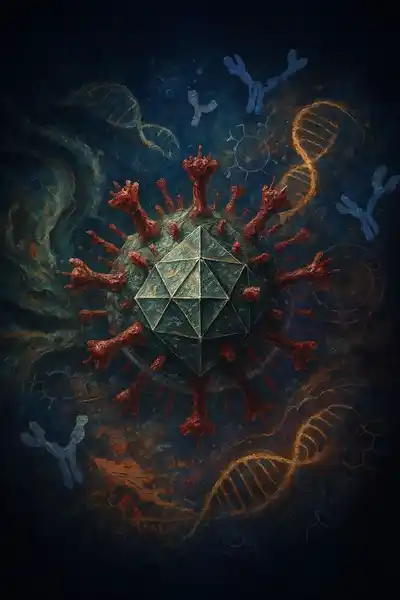
Strip a virus down and there is remarkably little there. At the core sits a length of genetic material — DNA in some, RNA in others — wrapped in a protein shell called a capsid. Some viruses add an outer envelope, stolen from the membrane of the last cell they left, studded with proteins that act like keys. That's essentially it. No cytoplasm, no ribosomes, no energy supply. Compared to even the simplest bacterium, a virus is less an organism than a set of instructions in a durable case.
The trouble with classifying it starts here. Every definition of life biologists reach for — a thing that grows, responds, metabolizes, and reproduces — a virus fails on the crucial ones. Outside a host, it doesn't grow or consume anything. It can be dried into a crystal and stored on a shelf, which is not something you can do to a mouse. When the American biochemist Wendell Stanley crystallized the tobacco mosaic virus in 1935, the result unsettled everyone: living things weren't supposed to behave like table salt.

02Chapter 2 — A set of instructions that hijacks the machine
The infection begins with a fit. A virus can only enter a cell whose surface carries a receptor its own proteins can latch onto — a lock-and-key match so specific it explains why a cold virus attacks your airway and not your liver, and why some animal viruses can't touch us at all until a mutation reshapes the key. This is also the fragile hinge on which pandemics turn: when a virus adapts a new key that fits a new species, a door that was closed swings open.
Once attached, the virus gets its genetic payload inside, and here the real trick unfolds. The cell is a factory full of machinery for reading genes and building proteins. The virus contributes none of that. It simply hands over its own instructions and lets the cell's ribosomes read them as if they were the cell's own. The machinery, unable to tell the difference, starts churning out viral proteins and copying the viral genome. The cell has been quietly repurposed into a plant for manufacturing more virus.
03Chapter 3 — How a virus goes from one throat to a continent
A virus that stays put dies with its host, so evolution has made them travelers, and each one specializes in a route. Respiratory viruses ride the droplets and fine aerosols we launch when we cough, sneeze, or simply talk, hanging in the air of a poorly ventilated room. Others move by touch, surviving on surfaces long enough to catch the next hand. Some spread through water and food, some through blood, some are carried body to body by mosquitoes and ticks that act as unwitting couriers.
What makes one virus a nuisance and another a catastrophe comes down to a handful of numbers. There's how contagious it is — epidemiologists talk about how many people, on average, one infected person passes it to. There's the incubation window, the lag between catching a virus and feeling sick, which is dangerous precisely because people spread it before they know they have it. And there's how long a person stays infectious. Measles, one of the most contagious things known, can linger in a room's air for up to two hours after the sick person has left.
04Chapter 4 — The oldest editors of the tree of life
Step back from the sickbed and viruses look less like invaders and more like a permanent feature of the biosphere. There are more of them than anything else alive — an estimated ten to the thirty-one particles on Earth, more than the stars in the observable universe. The oceans alone teem with them; a single teaspoon of seawater holds millions. Every day, these marine viruses kill a vast share of the ocean's bacteria, recycling their carbon back into the food web. Remove viruses and the chemistry of the planet's largest ecosystem would seize up.
Their influence runs deeper still, into the genomes of the things they infect. Because some viruses splice themselves into host DNA, and because those insertions can be passed to offspring, evolution has been quietly ferrying viral genes into cellular life for eons. Roughly eight percent of the human genome is made of sequences left behind by ancient viral infections — genetic fossils we now carry as our own.
05Conclusion
Return to that inert speck on the subway pole. It is doing nothing, and it will keep doing nothing until it finds a cell to borrow. That helplessness is the whole paradox: an entity too simple to be called alive, too active to be called dead, that has nonetheless outnumbered, outlasted, and quietly reshaped every living thing on the planet. Its power comes not from being a good organism but from being an exceptionally efficient set of instructions — one that only ever needed someone else's machinery to run.
Related books