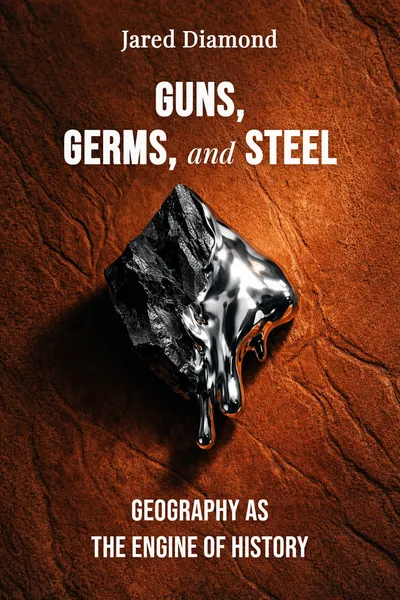
Guns, Germs, and Steel
Geography as the engine of history
Description
In 1972, a young American biologist named Jared Diamond was walking along a beach in New Guinea when a local politician named Yali asked him a question that would take twenty-five years to answer. Yali wanted to know why white people had so much cargo — steel tools, medicine, manufactured goods — and brought it to New Guinea, while his own people had so little. It was not a resentful question. It was a genuine puzzle about the arrangement of the modern world, put plainly by a man who had watched that arrangement arrive on ships. Diamond, who had been studying the birds of New Guinea, found he could not shake it.
The book that eventually answered Yali appeared in 1997, won the Pulitzer Prize the following year, and became one of the most widely read works of popular science of its generation. Its title names the tools of conquest — guns, the infectious diseases carried by Europeans, and the steel of weapons and ships. But Diamond's argument is that none of these were the real cause of anything. They were downstream effects. Behind them stood something far older, slower, and more impersonal than any conqueror: the shape of the continents, the plants and animals that happened to live on them, and the direction in which the land ran.
The claim is deliberately provocative, because it refuses two familiar stories at once. It rejects the idea that some peoples advanced further because they were smarter or more industrious. And it rejects the idea that European dominance was simply a matter of ruthlessness or luck in a single century. Diamond wanted a cause that reached back thirteen thousand years, to the end of the last ice age, and that a biologist could test the way one tests a hypothesis about ecosystems.
The question we’re asking : Why did wealth and power end up so unevenly distributed across the continents — and can geography really account for it?What we’ll see : How a single question on a beach became a thirteen-thousand-year argument about grain, livestock, the axis of continents, and the objections that argument still provokes.
Table of contents
01 Chapter 1 — A question asked on a beach in New Guinea
Yali's question is the hinge of the whole book, and Diamond takes it seriously rather than politely. Stripped of the local detail, it asks something enormous: why did history unfold so differently for different peoples? Why did Europeans end up sailing to New Guinea with steel and gunpowder, rather than New Guineans sailing to Europe? For most of the twentieth century, the respectable answer was to change the subject, because the older answers had been racist ones. Diamond's wager was that you could ask the question honestly and still arrive at an answer that had nothing to do with the abilities of any people.
In fact, he begins by insisting on the opposite. Diamond argues, from decades among them, that New Guineans are on average at least as sharp as Europeans, and possibly sharper, given the mental demands of surviving in their environment. If intelligence were the variable, the map of the world would look different. So the explanation has to be found not in the peoples but in the places — in the raw material each continent handed its inhabitants at the moment agriculture became possible.

02 Chapter 2 — The lucky latitudes and the gift of grain
The first advantage is botanical. Farming can only begin where there are wild plants worth domesticating, and those plants were not spread evenly. The Fertile Crescent — the arc of land running through modern Iraq, Syria, and Turkey — happened to hold an extraordinary concentration of large-seeded grasses and pulses: wild wheat, barley, peas, lentils. They were nutritious, easy to store, and quick to bring under cultivation. By contrast, much of the Americas offered maize, which took thousands of years of slow genetic tinkering to become a productive crop, and New Guinea's staples never yielded enough protein to build big populations.
The second advantage is the animals. Of the world's large mammals, only a handful can be domesticated — a species must breed in captivity, tolerate humans, eat what people can supply, and stay calm in a herd. That short list, cattle, sheep, goats, pigs, horses, lived overwhelmingly in Eurasia. The Americas had llamas and little else; Africa's zebras and buffalo remained stubbornly wild, as anyone who has tried to ride a zebra can confirm. Livestock gave Eurasians meat, milk, plowing power, and transport that other continents simply could not assemble.
03 Chapter 3 — From full granaries to guns and germs
A food surplus does something a foraging life cannot: it frees people from finding their next meal. Once a village produces more than it eats, it can support people who do not farm — potters, smiths, soldiers, scribes, priests, kings. Diamond traces how surplus leads to dense settlement, dense settlement to social hierarchy, and hierarchy to the centralized states that organize armies and taxes. The same surplus underwrites full-time specialists who develop metallurgy, and metallurgy is where the steel of the title finally appears, thousands of years downstream of the first stored grain.
Writing follows the same logic. It arises where there are surpluses to account for and administrators to keep records, which is why the earliest scripts appear in the grain-rich societies of Mesopotamia and China rather than among mobile foragers. Writing lets a society store and transmit knowledge across generations and distances — troop movements, sailing routes, the location of a rival's gold. By the time Europeans reached the Americas, they carried centuries of accumulated, written technique, while the peoples they met had no comparable archive to draw on.
04 Chapter 4 — When one explanation carries too much
The scope of Diamond's argument is also its vulnerability. To explain the entire sweep of human history with plants, animals, and the axis of continents is a spectacular intellectual move — and it invites the charge that a single material variable is being asked to carry more than any variable can. Critics, many of them historians and anthropologists, argued that Diamond had built an elegant machine that ran a little too smoothly, in which culture, religion, politics, and human choice appear mostly as the automatic output of geography rather than forces in their own right.
The label most often attached to the book is environmental determinism, an older tradition that geography as a discipline had spent decades trying to escape because of how it had once been used to rank peoples. Diamond is emphatically anti-racist — that is his whole starting point — but critics warned that a theory in which the winners were always going to win, given the map, can quietly excuse the specific violence of conquest and colonialism, folding centuries of deliberate cruelty into the neutral language of latitude and rainfall.
05 Conclusion
Yali's question never really goes away, because the world it describes is still the world we live in. Diamond's answer sends it backward through time until the cargo on the ships dissolves into something older and stranger: a handful of wild grasses in the Fertile Crescent, a short list of domesticable animals, a continent that happened to run east to west. Guns, germs, and steel turn out to be the visible tip of an advantage that began before anyone alive could have chosen it, and that no one at the time could have seen.
Related books