From Extraterrestrials to Animal Minds
Evolution's hidden assumptions
Description
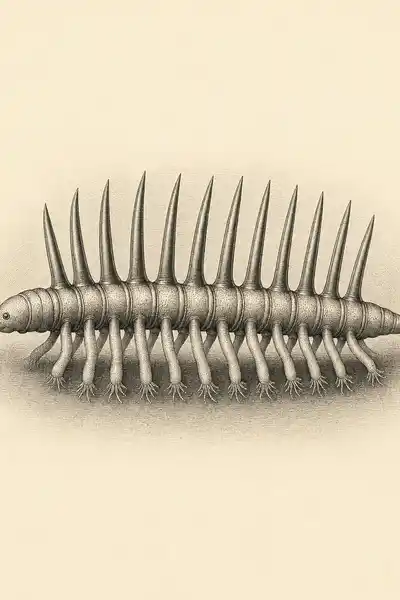
Simon Conway Morris made his name in his twenties, kneeling over 500-million-year-old rock in the Canadian Rockies. In the 1970s he was one of the young researchers who reopened the Burgess Shale, a fossil bed that preserves the soft-bodied strangeness of the Cambrian explosion — the moment, roughly 540 million years ago, when most major animal body plans show up in the record almost at once. The creatures he described were so bizarre that one of them, Hallucigenia, was named for the dreamlike difficulty of figuring out which way was up. It was, on the face of it, a monument to how weird and unrepeatable life on Earth could be.
And then he spent the rest of his career arguing the opposite. The same fossil record that Stephen Jay Gould read as a chronicle of luck — rewind the tape, Gould famously said, and you'd get a different world every time — Conway Morris came to read as a record of near-inevitability. Life, in his telling, keeps arriving at the same solutions from different starting points: eyes, wings, intelligence, agriculture, even something like consciousness. His book gathers six of these heresies into one argument, and the tone is not that of a man hedging.
What holds the six together is not a single claim about biology but a suspicion about how biology tells its own story. Conway Morris thinks the field carries assumptions it rarely says out loud — about accident, about mind, about whether we are alone — and that these assumptions do more work than the evidence licenses. He wants those hidden premises dragged into daylight, even at the cost of sounding, to some of his colleagues, like a scientist who has wandered off the reservation.
The question we’re asking : When evolution keeps producing the same answers, is that chance dressed up as history, or a signal about how deeply the outcomes were constrained?What we’ll see : A paleontologist who read the fossil record against the grain, and the six uncomfortable conclusions he drew from a lifetime spent among the oldest animals on Earth.
Table of contents
01Chapter 1 — The Cambridge paleontologist who kept asking awkward questions
Conway Morris belongs to a small class of scientists who become famous for one thing and then spend decades arguing against the reading everyone took from it. The Burgess Shale, when he and Harry Whittington and Derek Briggs reworked it in the 1970s and 1980s, seemed to reveal a Cambrian world teeming with failed experiments — animal designs that flourished briefly and then vanished, leaving no descendants. Gould turned that picture into the bestselling Wonderful Life in 1989, and the moral he drew was stark: history is contingent, humanity is a cosmic afterthought, and if you replayed the whole thing, nothing like us would appear.
Conway Morris looked at the same rocks and refused the moral. Much of his later work went into showing that the Burgess creatures were not nearly as unclassifiable as the early accounts suggested — many slotted into groups that survive today. The disagreement with Gould turned personal and public through the 1990s, and it set the template for everything that followed. Where Gould heard the music of accident, Conway Morris heard constraint: the sense that the range of workable biological solutions is far narrower than the range of imaginable ones.

02Chapter 2 — Run the tape again — you get eyes anyway
The keystone of the whole enterprise is convergence, and it is the idea Conway Morris has defended most tirelessly. Convergent evolution is the phenomenon of unrelated lineages independently arriving at the same solution. The camera eye evolved separately in vertebrates and in octopuses, two lineages whose common ancestor had nothing like it. Wings appeared independently in insects, pterosaurs, birds, and bats. Echolocation shows up in bats and in dolphins, built from different genetic starting points. The list, once you start looking, becomes very long.
For most biologists convergence is a curiosity — a footnote that shows natural selection is good at finding functional answers. Conway Morris makes it the headline. If life keeps landing on the same solutions from wildly different origins, he argues, then those solutions are not accidents waiting in an infinite lottery. They are more like attractors: destinations that any sufficiently rich evolutionary process will tend to reach. The space of viable biological forms, on this view, is not open prairie but a landscape with deep valleys, and things keep rolling into the same ones.
03Chapter 3 — Minds that keep reappearing where they shouldn't
Having argued that intelligence is a recurring destination, Conway Morris presses into the murkier territory of mind. Here the assumption he wants to expose is the quiet consensus that consciousness and rich cognition are late, rare, essentially human accessories — nice tricks bolted onto a body by an unusually large primate brain. The animal record, read closely, keeps embarrassing that consensus.
The evidence he assembles is the kind that has piled up quietly over the last few decades. Corvids fashion and modify tools, and appear to plan for futures they cannot currently see. Octopuses — molluscs, separated from us by more than half a billion years of divergence — solve puzzles, recognize individual keepers, and behave in ways that look uncomfortably like personality. Great apes and cetaceans pass tests of self-recognition and social reasoning. The striking thing is not any single case but the pattern: sophisticated minds arising in lineages with almost nothing in common except the pressure to survive and the equipment, however different, to model a complicated world.
04Chapter 4 — The universe should be crowded, and it isn't
Stand back from the six provocations and a single buried assumption is being pried loose in each one: the idea that evolution is fundamentally a story of accident, and that treating it so is the neutral, scientific default. Conway Morris's whole project is the claim that this is not neutral at all — it is a metaphysics, chosen rather than proven, and it shapes what the science is willing to see. Convergence, animal minds, the recurrence of intelligence: each is a place where the assumption of contingency has been quietly filling a gap that the evidence, he thinks, points the other way.
Nowhere does the tension bite harder than in the question of extraterrestrial life, where two of Conway Morris's convictions collide. If life's solutions are near-inevitable, then given a habitable world, evolution should reliably climb toward complexity and eventually toward intelligence. That should mean a universe thick with minds. And yet the sky is silent — the old puzzle Enrico Fermi sharpened into a question: if they should be everywhere, where is everybody? Conway Morris takes the silence seriously rather than explaining it away, and it forces his own logic into a corner.
05Conclusion
The young man who described Hallucigenia and the older one who argues that eyes and minds are near-destinations are the same person, working the same rock toward opposite conclusions from the ones the world drew. That is the shape of Conway Morris's career: taking the era's favourite lesson about life's contingency and running it in reverse. His six arguments do not all stand or fall together, and he would be the first to say some may not stand at all. What holds is the manner of asking — evidence in one hand, an unfashionable question in the other.
Related books