The Evolution of Beauty
Darwin's taste for the beautiful
Description
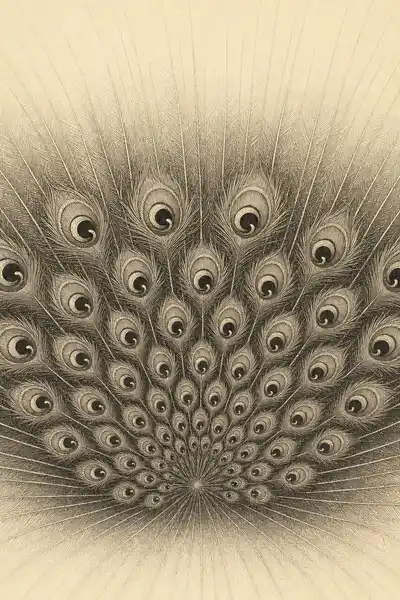
In 1871, twelve years after On the Origin of Species, Charles Darwin published a second, stranger book called The Descent of Man, and Selection in Relation to Sex. Buried inside it was an idea he seemed almost embarrassed to keep returning to: that animals have aesthetic preferences. Female birds, he argued, choose their mates for beauty — for the sheer look and sound of them — and over generations that choosing sculpts the males into the extravagant creatures we know. The peacock's tail was not a survival tool. It was, in Darwin's phrase, the product of a "taste for the beautiful."
The scientific establishment of his day found this unbearable. A leading co-discoverer of natural selection, Alfred Russel Wallace, spent years scrubbing the aesthetic claim out of evolutionary theory, insisting that every ornament must secretly encode fitness — health, vigor, good genes. For more than a century, that view won. Beauty in nature was treated as a message about quality, never as a preference worth having for its own sake. Darwin's animals-with-taste quietly disappeared from the textbooks.
The ornithologist Richard Prum, who has spent a lifetime watching birds do bewildering things in the forests of the tropics, thinks the establishment got it backwards — and that Darwin was right the first time. His book is an attempt to put the taste for the beautiful back at the center of the story, and to follow that idea all the way to where it becomes uncomfortable.
The question we’re asking : What if beauty in nature isn't a signal of anything useful — but a preference that evolves for its own sake?What we’ll see : How a discarded Darwinian idea, revived through decades of watching birds, unsettles our picture of how evolution works and who does the choosing.
Table of contents
01Chapter 1 — The idea Darwin published and almost nobody wanted
Darwin knew he had a problem. Natural selection explained a great deal, but it could not comfortably explain a peacock's tail, which is heavy, conspicuous, and useless for staying alive. So he proposed a second mechanism running alongside the first. Sexual selection came in two flavors: males competing with each other, which produced antlers and brute size, and females choosing among males, which produced color, song, and display. The second kind depended on something radical — that the female animal has preferences, and acts on them.
This was the sentence that scandalized Victorian science. To grant a female bird a sense of beauty was to grant her subjectivity, judgment, a point of view. Darwin didn't flinch from it; he wrote that many animals possess "a taste for the beautiful" much as we do, and that this taste, exercised over generations, is a genuine evolutionary force. He piled up example after example — the drumming, the dancing, the plumage — as if trying to overwhelm the reader's resistance with sheer accumulation.

02Chapter 2 — The bowerbird, the peacock, and the trouble with usefulness
Spend enough time watching birds and the usefulness story starts to strain. Take the bowerbirds of Australia and New Guinea. A male builds an elaborate structure on the forest floor — a woven avenue, a tower, a cleared court — and decorates it with berries, shells, flowers, bits of glass, all arranged by color, sometimes with a sense of perspective. The bower is not a nest. No eggs are laid there. It exists solely to be judged by females, who visit several, inspect the work, and pick. It is hard to see what a pile of blue bottle caps says about a male's immune system.
Or take the club-winged manakin, the small South American bird Prum studied closely. The male sings with his wings, rubbing modified feathers together to produce a violin-like tone. To do it, his wing bones have thickened and solidified in ways that make him a worse flyer. Here is an ornament that actively costs survival — the exact opposite of what the good-genes model predicts. The female preference for that strange sound has literally deformed the male's skeleton, dragging his anatomy away from what would keep him alive. Even the females of the species carry those same thickened bones, a useless inheritance of their own taste.
03Chapter 3 — What Prum means by beauty happening
The alternative Prum champions is not his invention — it goes back to the mathematician Ronald Fisher in the early twentieth century — but he pushes it further than most biologists dare. The model is called runaway selection, and its logic is almost circular in a productive way. Suppose females happen to prefer a slightly longer tail, for no adaptive reason at all. Males with longer tails get chosen. But their daughters inherit the preference and their sons the tail, so the two traits become genetically linked and start amplifying each other.
Once that feedback locks in, the process can run away. The preference selects for the trait; the trait reinforces the preference; each generation ratchets both a little further, with no destination and no external justification. The tail can grow until it nearly cancels out the male's survival — held in check only when the cost of being beautiful finally balances the reward of being chosen. Beauty, in this picture, is not a signal. It is a coevolved relationship between a display and a desire, spiraling together, each pulling the other along.
04Chapter 4 — Desire, coercion, and the long argument about freedom
Here is where Prum's birds start to speak about more than themselves. If female choice is a real force, then it can do more than build pretty tails — it can push back against males. In many species, male animals get what they want through force or intimidation, and coercion has its own evolutionary momentum. But where females can freely choose, their collective preferences can select against the coercive males, favoring instead the ones who court, display, and wait to be picked. Choice becomes a lever for something Prum is willing to call sexual autonomy.
His most striking case is the ducks. Waterfowl are notorious for forced copulation, and males have evolved elaborate corkscrew-shaped phalluses to overpower resistance. But females have evolved counter-armor: vaginal tracts that spiral in the opposite direction, full of pouches and dead ends, structures that make forced insemination fail and preserve the female's ability to choose whose sperm succeeds. It is, quite literally, an anatomical arms race over who gets to decide. The female body is fighting to keep the choosing, and the fight has left its shape written into the anatomy of both sexes.
05Conclusion
Darwin's second book was long treated as the messy sequel, the place where the great man overreached and let sentiment cloud his science. Prum's wager is that the overreach was the insight. The taste for the beautiful, so uncomfortable to Victorian and modern biologists alike, turns out to be the missing term that makes the peacock, the bowerbird, and the wing-singing manakin intelligible without pretending their extravagance secretly serves survival.
Related books