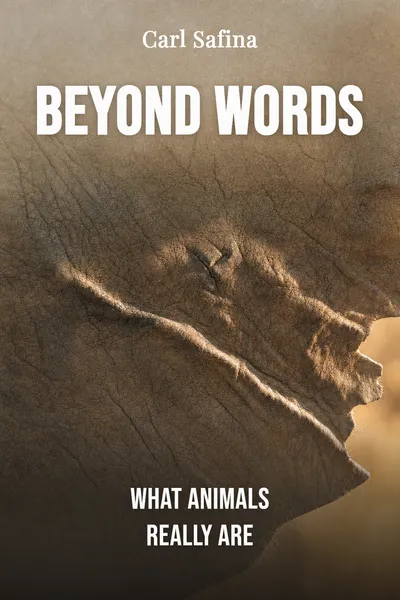
Beyond Words
What animals really are
Description
In the Amboseli basin of Kenya, at the foot of Kilimanjaro, a researcher named Cynthia Moss has spent more than four decades following the same elephant families. She knows them by name, by ear-notch, by the shape of a scar. She can tell you which matriarch died in which drought, which calf was orphaned, which family fractured and which one held. When Carl Safina came to sit beside her, he was not looking for behavior in the clinical sense. He was watching a scientist who had stopped pretending she didn't know the animals in front of her as individuals — and he wanted to understand what she was actually seeing.
Safina is an ecologist, and for most of his career he was trained the way every biologist of his generation was trained: describe what the animal does, never guess what it feels. Attributing an inner life to a non-human was the cardinal sin, the thing that got your paper rejected and your judgment questioned. Feelings were unmeasurable, so officially they didn't exist. But sitting with elephants, then wolves, then killer whales, he found that the taboo had started to feel less like rigor and more like a refusal to look.
So in his 2015 book Beyond Words he let himself do the forbidden thing. Not sentimentally, not by dressing animals in human costume, but by taking seriously what decades of field observation and neuroscience were both pointing toward. The result is a book that keeps returning to a single, unscientific-sounding word: who.
The question we’re asking : When we watch an elephant mourn or a wolf lose its family, are we projecting a story onto them, or finally reading one that was there all along?What we’ll see : How three long-studied species pushed one ecologist past the rule he was trained to obey, and what falls apart once we stop asking what an animal is and start asking who.
Table of contents
01Chapter 1 — The question a scientist was not supposed to ask
The rule Safina grew up under has a name and a genealogy. It runs back through behaviorism, through the mid-century conviction that the only honest data were observable actions, and further back to a caution that hardened into dogma: never attribute to an animal a mental state you can't measure. Anthropomorphism became the accusation that ended arguments. To say an elephant was grieving, or a dog was jealous, was to reveal yourself as soft, unserious, a person who watched too much Disney.
There was a real reason for the caution. Humans do project. We read faces into clouds and moods into weather, and a scientist who assumes a chimp thinks exactly as a person does will get the chimp wrong. Safina doesn't dismiss this. His move is subtler: he points out that the opposite error is just as unscientific. Insisting an animal feels nothing, in the face of a nervous system built from the same parts as ours, wired by the same evolutionary pressures, is not neutral caution. It is its own unproven assumption, one we happen to find flattering.

02Chapter 2 — Elephants keep a ledger of grief
Elephants are Safina's first and most patient teachers, largely because of the record Amboseli provides. When you have followed named families across forty years, you are no longer looking at elephant behavior in the abstract. You are watching known individuals make choices, and the choices don't fit the tidy machinery of instinct. Matriarchs, the oldest females, hold a kind of institutional memory — where water sits in a bad year, which strangers are dangerous, which routes are safe. Kill the old ones and the family doesn't just lose a leader. It loses its library.
The behavior that stopped Safina cold was around death. Elephants react to the bones of their own dead in ways they react to nothing else — turning them over with their trunks, standing in long silence, returning to a place where a family member fell. They distinguish elephant bones from other animals' bones. They pay no such attention to a buffalo skull. Whatever this is, it is specific, repeated, and directed only at their own kind, which is a strange thing to call meaningless.
03Chapter 3 — Wolves have politics, and it costs them
The second teacher is the wolf, and the classroom is Yellowstone, where wolves were reintroduced in 1995 and have been watched almost continuously since. Here Safina leans on observers like Rick McIntyre, who has logged more hours watching wild wolves than perhaps anyone alive. What emerges is not the snarling machine of folklore, nor the rigid pyramid of the old "alpha" myth, which even the researcher who coined it later disowned. A wolf pack is mostly a family: parents and their grown offspring, held together by relationship rather than by domination.
And within that family, wolves have personalities as distinct as people's. Safina relays McIntyre's portraits of specific animals — a famous male known as Twenty-one, remembered for a kind of restraint that reads, uncomfortably, like character. He was a formidable fighter who never killed a defeated rival, and who was gentle with the pups, including a sickly one the others ignored. Another wolf might be timid, or reckless, or a bully. These aren't roles the pack assigns. They are individuals, and the pack's fortunes rise and fall on which individuals it happens to contain.
04Chapter 4 — What it means to say who, not what
Step back from the elephants and the wolves and the killer whales, and the real subject of Beyond Words comes into focus. It isn't animal intelligence, exactly. It's a line — the one we've drawn around ourselves, with humans as someone and everything else as something. Safina's whole project is to show that this line was never as clean as we needed it to be, and that we've spent a great deal of effort policing it precisely because it keeps leaking.
For a long time, the burden of proof sat entirely on the animal's side. You had to prove a creature felt or thought before you were allowed to treat it as if it did; absent proof, the safe assumption was emptiness. Safina's argument quietly flips this. Given shared brains, shared chemistry, shared evolutionary history, and decades of consistent field observation, the assumption of emptiness is the one now carrying an unpaid debt. If an animal has the organs of feeling and behaves exactly as a feeling creature would, insisting it feels nothing is no longer the conservative position. It's the extraordinary claim.
05Conclusion
Safina began beside Cynthia Moss, watching a scientist who had stopped pretending she didn't know her elephants as individuals. By the end of the book, that refusal to pretend has become the method rather than the lapse. He never claims certainty about the inner lives of other creatures; certainty was never on offer, not even about the humans next to us. What he claims is that the honest reading of the evidence points one way, and that the old caution had curdled into a habit of looking away.
Related books