
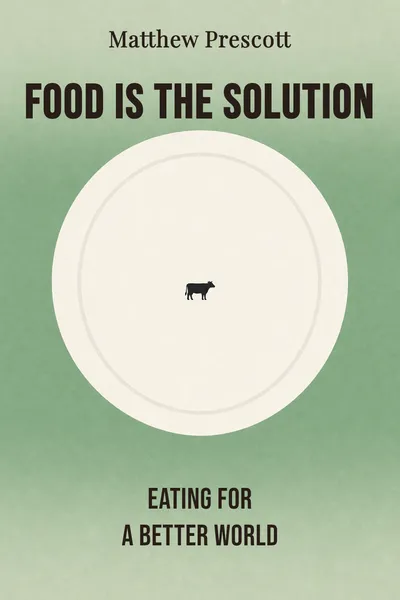
Food Is the Solution
Eating for a better world
Description
Matthew Prescott opens his 2018 book, Food Is the Solution, with a claim that sounds almost too tidy: the single most consequential environmental decision most of us make in a day happens three times, sitting down, fork in hand. Not the car we drive, not the thermostat, not the flight we didn't take. The meal. Prescott, who spent years working on food policy and animal welfare in the United States, wrote the book to make a case that had mostly lived in academic journals and activist circles feel like something you could act on tonight, at dinner.
What makes the book unusual is the shape of it. Half of it reads like the friend who has read all the studies and can tell you, without lecturing, why beef sits so heavily on the land. The other half is a cookbook, more than eighty plant-forward recipes photographed to look like food you'd actually want, not penance. Prescott refuses to separate the argument from the eating. The point, he keeps insisting, is that the two belong on the same page.
That refusal is the whole gambit. Plenty of writers have told us that industrial meat is expensive for the planet. Fewer have tried to hand us a spinach lasagna in the same breath. Prescott bets that people change what they eat not because they've been frightened, but because they've been fed well and shown the math afterward. Whether that bet holds is the thread worth pulling.
The question we’re asking : Can what we put on a plate really function as an environmental lever, and does turning it into recipes rather than warnings change anything?What we’ll see : How Prescott builds the case that everyday meals carry outsized weight, and why he chose to argue it with a fork instead of a finger.
Table of contents
01Chapter 1 — The plate as a lever
Prescott's starting move is to reframe scale. We're used to thinking of the food system as a backdrop, something that happens in fields and factories far from us. He flips it. Agriculture uses roughly half the world's habitable land and drives a large share of freshwater use and deforestation. Livestock alone accounts for a substantial slice of global greenhouse gas emissions, comparable in the same rough neighborhood as the whole transport sector, depending on how you draw the accounting lines. These aren't marginal numbers, and Prescott's point is that they resolve, ultimately, into billions of individual meals.
From there he narrows to the choice itself. The environmental cost of what we eat, he argues, varies enormously depending on where on the food chain it sits. Producing a pound of beef demands far more land, water, and feed than producing the same protein from beans, lentils, or grains, because a cow spends most of what it eats simply staying alive. Prescott calls this the conversion problem: we grow enormous quantities of crops to feed animals we then eat, losing most of the calories and protein along the way. Cut out the middle step and the land opens up.

02Chapter 2 — What a burger actually costs
The book spends its most vivid pages on beef, and not by accident. Prescott walks through the accounting the way a friend might explain a bill you hadn't looked at closely. A single beef burger carries a hidden ledger: the feed grown to raise the animal, the water that grew the feed, the land cleared to grow it, the methane the animal produces along the way. He cites figures that put the water footprint of a pound of beef in the hundreds of gallons, most of it invisible in the crops that fed the cow rather than the animal directly.
Methane is where he lingers, because it's the part most people underestimate. Cattle are ruminants, and their digestion releases methane, a gas that traps far more heat than carbon dioxide over the short term. Prescott's framing is that beef isn't bad because cows are villains; it's costly because the biology of raising them is simply inefficient at turning plants into food we can use. The animal is doing what animals do. The system built around it is what carries the weight.
03Chapter 3 — The middle of the plate, rearranged
This is where Prescott makes good on his promise not to leave the reader with a problem and no dinner. The recipes, more than eighty of them, aren't an afterthought bolted onto an argument. They're the argument made edible. Chili built on beans rather than beef, hearty pastas, grain bowls, stews that lean on mushrooms and lentils for the savory depth that meat usually provides. The photography is unapologetically appetizing, and that's a strategic choice as much as a stylistic one.
His central culinary idea is simple: rearrange the plate rather than empty it. For generations the Western dinner has been organized around a slab of animal protein in the center, with vegetables and grains playing supporting roles at the margins. Prescott's move is to promote the sides to the center and let meat, if it appears at all, become a seasoning or an accent. This isn't deprivation dressed up. It's a different geometry of the meal, one that most of the world's cuisines have used for a long time without ever calling it sacrifice.
04Chapter 4 — A menu for a warming century
Step back and the book is making a larger wager about where ordinary agency lives in the climate era. Most of the big environmental levers feel out of reach. We don't personally set energy policy, redesign supply chains, or negotiate international agreements, and the gap between the size of the problem and the size of our influence can produce a kind of paralysis. Prescott's proposition is that food is the rare domain where the individual choice and the systemic outcome are directly linked, and where a person can act today without permission from anyone.
What's distinctive is his refusal to frame that agency as burden. A great deal of environmental writing runs on guilt and abstention, on the ledger of what we must give up. Prescott inverts it. Eating for a better world, in his telling, is not a diet of denial but an expansion, more vegetables, more grains, more of the world's cuisines, better cooking. He's betting that a practice framed as pleasure sustains itself where a practice framed as sacrifice quietly collapses within a month.
05Conclusion
Prescott ends more or less where he began, at the table, fork in hand. The book closes the loop it opened: the meal that seemed too small to matter turns out to be one of the few environmental decisions fully within our reach, repeated thousands of times across a life. The argument and the recipes were never two things. They were one gesture, an invitation to see dinner as both pleasure and consequence, and to act on that without waiting to feel guilty first.