Every Life Is on Fire
Life as physics, not chance
Description
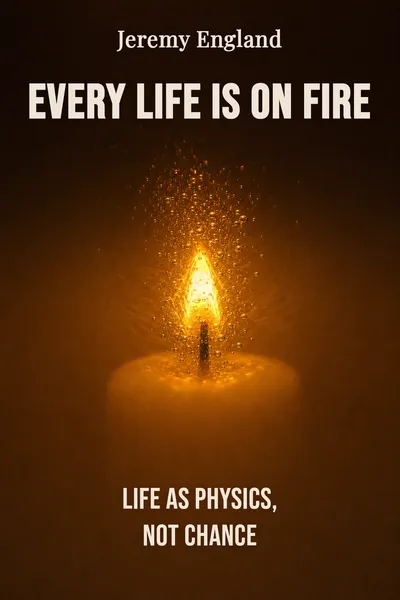
There is a moment early in Jeremy England's book where he asks us to look at a candle flame and take it seriously as a puzzle. A flame holds its shape. It has an edge, a color, a rough constancy, even though the wax below and the air around it keep changing. Nothing about the flame is fixed matter — it is a pattern that persists because energy keeps flowing through it. Cut off the fuel or the oxygen and the shape collapses instantly. England, a physicist trained at Harvard, Oxford and Stanford who later moved between MIT and industry, wants us to hold that image in mind, because he thinks a living cell is closer to the flame than to the rock beside it.
That comparison is old — living things have been called flames since antiquity. What England did, starting around 2013 with a set of papers that drew a startled reaction from other physicists, was try to make the metaphor into arithmetic. He reached for thermodynamics, the branch of physics that governs heat, energy and disorder, and asked a blunt question: given the laws we already have, is matter that comes alive a strange exception to physics, or something physics quietly favors? His answer, developed across the book, leans hard toward the second.
The stakes are larger than they first appear. For a century the default story has been that life is a magnificent accident — chemistry that got lucky once, then was shaped by natural selection. England does not throw out Darwin. He asks what happens before selection can even begin, in the raw physics of matter under a constant push of energy. And he writes as a religiously observant Jew who reads Genesis alongside the equations, which makes the book unusual company on a science shelf.
The question we’re asking : Is life a lucky accident chemistry stumbled into, or something the laws of physics were already leaning toward?What we’ll see : How a physicist reaches for thermodynamics to argue that matter under a steady push of energy tends to organize itself — and where that leaves both Darwin and Genesis.
Table of contents
01Chapter 1 — The candle that doesn't want to stop burning
Start with what makes a living thing baffling to a physicist. The second law of thermodynamics says that closed systems drift toward disorder — heat spreads out, structures crumble, order decays. Yet a bacterium is exquisitely ordered, and it keeps itself that way for as long as it lives. It looks, at first glance, like an affront to the law. The usual resolution is that living things are not closed: they eat, they excrete, they radiate heat, so they can build order inside by exporting a larger mess to the world around them. England accepts all of that, then pushes past it to a sharper question.
The sharper question is not how life avoids breaking the law, but whether the law might actively encourage things like life to appear. The second law is really a statement about probability — matter tends toward the arrangements there are simply more ways to be in. England's move is to ask what those probable arrangements look like when a system is not left alone but driven, held under a constant flow of energy, the way sunlight pours onto a shallow pond or a chemical soup near a hot vent.

02Chapter 2 — What matter does when energy pushes
To test whether this was more than a nice story, England and his collaborators turned to computer simulations of small chemical systems. In one much-discussed study they took a virtual soup of particles that could react and be driven by an external energy source, and let it run. What emerged, without anyone designing it in, were structures that tuned themselves to absorb the driving energy with unusual efficiency — matter that had, in effect, found the frequencies of its environment and organized around them. Nothing here was replicating or evolving in the Darwinian sense. It was pure physics finding pockets of order.
The word England leans on is fine-tuning, though not in the cosmic sense the phrase usually carries. He means that driven matter can adjust its own arrangement to match the particular way it is being pushed, the way a set of strings will start to hum when the right note is played nearby. Over many cycles, the configurations that resonate best with the energy source persist, while the clumsy ones fall apart and get recycled. A kind of pre-biological selection appears — selection by physics, before genes exist to be selected.
03Chapter 3 — Where physics and Genesis end up in the same room
What makes England's book different from most origin-of-life science writing is that he refuses to keep his religion in a separate drawer. He is an observant Jew, and he reads the opening chapters of Genesis and passages of the Hebrew Bible not as data to be debunked but as another serious attempt to say what life and order are. The book moves, sometimes within a single chapter, between the mathematics of dissipation and close readings of ancient text, and he insists this is not decoration.
His point is not that the Bible anticipated thermodynamics, which would be silly, nor that physics proves scripture, which would be worse. It is that both are answers to the same primal unease: why is there ordered, living matter rather than inert dust, and does its arising mean anything? The burning bush that is not consumed, the breath that animates clay — England treats these as images that grapple with exactly the thing his equations grapple with, a flame that persists without burning out.
04Chapter 4 — The universe was never neutral toward us
Step back from the equations and the scripture, and what England is really unsettling is a mood — the modern intuition that life is a lonely fluke in an indifferent cosmos. That intuition has done a lot of quiet cultural work. It underwrites a certain reading of Darwin, a certain existential chill, the sense that we are cosmic orphans who happened, against staggering odds, to switch on. England's thermodynamics does not restore a designer, but it does soften the loneliness. If matter under a steady push tends toward the living, then the universe was leaning our way all along.
That is a genuinely different relationship to belonging than the accident story allows. The accident story says: nothing was pulling toward you; you are the winner of a lottery no one was running. England's story says: the conditions that make dissipating, self-organizing matter likely are the same conditions we find across much of the cosmos, wherever energy flows steadily through matter. Life stops being the exception that needs excusing and becomes something closer to a tendency the physics carries.
05Conclusion
The book ends roughly where it began, at the flame — that pattern which holds its edge only because energy keeps pouring through it. England's wager is that we are flames too, that the constancy we call being alive is the constancy of a structure caught in a good flow, endlessly rebuilt as fast as it decays. His theory of dissipation-driven adaptation does not overturn Darwin or hand the origin of life to God. It slides underneath both, into the physics that has to be true before a cell can copy itself or a lineage can be selected.
Related books