
Finding the Mother Tree
How trees talk underground
Description
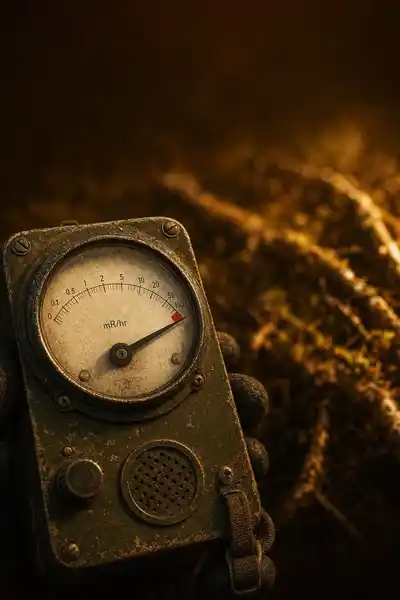
In the late 1990s, a young forest ecologist in British Columbia injected radioactive carbon into paper birch trees and waited to see where it went. The prevailing wisdom said the answer was simple: nowhere useful. Trees were understood as competitors, each one fighting its neighbors for light, water and soil, and forestry policy in Canada was built on that assumption — clear the weeds, space the crop, let the strongest survive. Suzanne Simard, who had grown up among these forests and joined the logging industry that shaped them, suspected the picture was incomplete. When she ran her Geiger counter over a Douglas fir growing beside those birches, it clicked.
The carbon had moved. It had traveled out of the birch, down into the soil, through a web of fungal threads, and up into a fir several feet away — a species the birch was supposed to be at war with. The two trees were trading. Simard's finding, published in the journal Nature in 1997, suggested that a forest was not a collection of individuals competing in isolation but something closer to a trading floor, wired together underground by fungi that carried food and, it seemed, information between distant roots.
Finding the Mother Tree is the book Simard wrote decades later, braiding that science with the story of her own life in the woods. It is partly a memoir of family, loss and stubbornness, and partly the record of a scientist arguing against an entire field. The forest she describes is not the silent, brutal arena of survival most of us picture. It is talking, and once we learn to listen, the woods stop looking the same.
The question we’re asking : What is actually moving between trees underground, and how did one ecologist convince a skeptical field it was real?What we’ll see : How a life spent in British Columbia's forests turned into evidence that trees cooperate, and into a different idea of what a forest is.
Table of contents
01Chapter 1 — A childhood in the roots
Simard did not arrive at her ideas through theory. She grew up in the interior of British Columbia, in a family that had logged the forests around the Monashee mountains for generations — with horses, selectively, one tree at a time. The woods were not an abstraction to her; they were where the family worked, camped and buried its dead. When her grandfather's outhouse pit once collapsed, she found herself staring at a cross-section of forest soil, at the dense weave of roots and pale fungal threads running through it. She did not have a word for it yet, but she never forgot the tangle.
That intimacy is the engine of the whole book. Simard writes about digging in the dirt as a girl, about a beloved dog nearly lost in a latrine pit, about a grandfather who read the land by instinct. She then took a job with a commercial logging company in the 1980s, and the contrast unsettled her. The industry planted tidy single-species plantations, sprayed and cut back the birch and alder it considered weeds, and expected the prized conifers to thrive once freed from competition. Often they did the opposite. The cleared seedlings yellowed and sickened.

02Chapter 2 — The experiment nobody wanted to see
To answer that, Simard needed proof that could not be waved away. She designed an experiment in the field: pairs of paper birch and Douglas fir seedlings growing near each other, with some shaded to change how much sugar they could make. She fed the birches carbon dioxide made with radioactive and heavy isotopes of carbon — tracer atoms she could later detect — and let the trees photosynthesize. If carbon moved from one tree to another underground, the tracers would reveal the traffic and its direction.
They did. The carbon flowed between species through the fungi wrapped around and inside their roots, the mycorrhizae that trade sugars from the plant for water and minerals from the soil. The birch, richer in sunlight, sent more carbon to the shaded fir than it received back — net support, flowing toward the tree that needed it most. When the fir was later shaded in turn, the direction of the flow shifted. The trees were not simply leaking; they appeared to be responding to each other's condition, moving resources toward scarcity.
03Chapter 3 — The mother tree
As the research deepened, one pattern kept surfacing. In an old forest, the oldest and largest trees were not simply the biggest winners of a long competition. They were hubs. Their roots connected, through the fungal network, to a great many younger trees around them — the more Simard mapped these links, the more the big old trees looked like central nodes wired into dozens of others. She began calling them mother trees, the term that gives the book its title.
A mother tree does more than hold a place in the canopy. Simard's work suggested these elders channel carbon and nutrients to seedlings struggling in the shade below, giving the young a subsidy of food they cannot yet make enough of themselves. The effect appeared strongest toward related seedlings: in her experiments, mother trees seemed to recognize their own kin and direct more support their way, easing back on their own root competition to make room. A dying mother tree, she found, would even dump its carbon and defense compounds into the network, as if handing down its resources to the next generation.
04Chapter 4 — What a cooperating forest asks of us
Step back from the birches and firs, and Simard's forest quietly challenges one of the oldest stories we tell about the living world. Since Darwin was flattened into slogan, we have tended to read nature as competition first — every organism a rival, scarcity the only law, cooperation a rare exception that needs special explanation. The mycorrhizal network does not overturn competition; the trees in Simard's plots still compete for light and space. But it insists that cooperation is not a footnote. It is woven into the basic architecture of how a forest survives, running under the competition like plumbing under a floor.
That reframing matters most where it touches practice. Industrial forestry, and much of land management generally, inherited the competition model and built policy on it: remove the weeds, plant in uniform rows, harvest the strongest, replace old growth with fast crops. Simard's research argues that this treats a connected system as if it were a warehouse of separate units. When we cut the mother trees and erase the mixed understory, we are not clearing clutter from around the valuable trees. We are dismantling the network that makes the valuable trees possible in the first place, and then wondering why the replanted forest struggles.
05Conclusion
The story that runs through Finding the Mother Tree begins with a Geiger counter clicking over a Douglas fir and ends with a whole way of seeing the woods. Between the two lies a life: a logging family in British Columbia, a young scientist arguing against her field, a mother tracing lines of care between old trees and her own children while ill. The carbon that moved through those first birch and fir seedlings turned out to be the thread of a much larger web, one that Simard spent decades pulling on until the forest revealed itself as a connected, cooperating community rather than a silent contest.