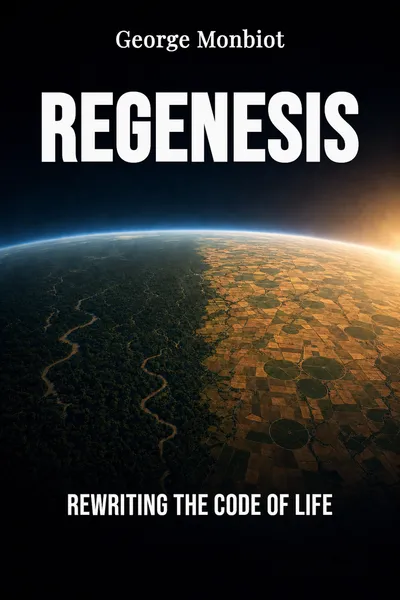
Regenesis
Rewriting the code of life
Description
George Monbiot begins Regenesis, published in 2022, not with a laboratory or a policy paper but with a spade. He is digging in a patch of ground near his home in Oxford, and what he finds under the surface pulls him into a story that occupies the rest of the book. The soil, he realizes, is not the inert brown stuff we picture. It is a dense, living civilization — fungi threading through roots, bacteria trading chemicals, a whole economy of organisms most of which science has never named. Standing there, Monbiot, a British environmental writer known for three decades of hard reporting on land and climate, has the uncomfortable thought that the way we grow food is destroying the very thing that makes food possible.
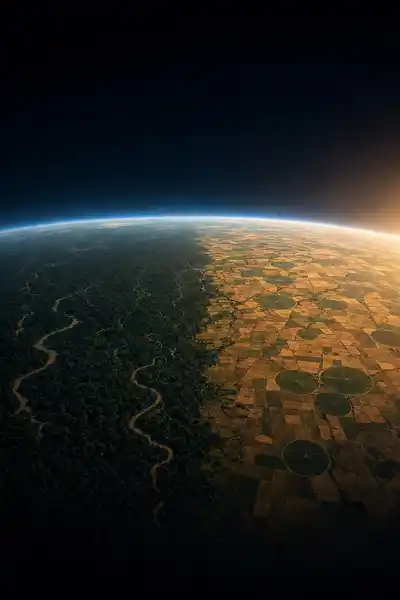
From that patch of ground the book widens into an indictment. Farming, Monbiot argues, is the most destructive thing humans have ever done to the planet — not because farmers are villains, but because the sheer footprint of feeding eight billion people has swallowed forests, drained rivers, and turned living soil into eroding dust. Agriculture occupies roughly half the planet's habitable land. And yet the standard environmental script tells us the answer is more of it, done more gently: local, organic, pasture-fed, artisanal. Monbiot spent years believing that script. Regenesis is partly the record of him losing faith in it.
What replaces that faith is stranger and more unsettling than anything the organic aisle prepares us for. Monbiot goes looking for a way to feed everyone while giving most of the land back — and he finds it in places that make many of his own allies wince. The book is an argument, delivered by someone who does not enjoy where the argument leads him, about what it would actually take to eat without wrecking the only planet we have.
The question we’re asking : Can we feed everyone on Earth while returning most farmland to the wild — and are we willing to accept where that road leads?What we’ll see : How one writer's disillusion with 'good' farming turns into a case for reinventing food from the microbe up.
Table of contents
01 Chapter 1 — The farm that ate the planet
Monbiot's first move is to make us see the scale of what farming costs, because the numbers are so large they have become invisible. Agriculture is the leading driver of habitat destruction, of freshwater use, of the collapse in wild animal populations. It is a major source of greenhouse gases. Roughly half the world's habitable land is given over to crops and livestock, and the great majority of that is not feeding people directly — it grows feed for animals or fuel for cars. We have, in effect, paved over the living world with fields.
The part that stings, coming from a lifelong environmentalist, is his attack on the alternatives that greens tend to cheer. Grass-fed beef, he shows, is not a solution but an amplification of the problem: it uses far more land per calorie than the intensive systems it is meant to replace, because grass is a thin diet and cattle are inefficient converters. The romance of the traditional mixed farm, the pasture and the hedgerow, disguises an enormous land bill. If everyone ate the way the food movement recommends, we would need several more planets to do it on.

02 Chapter 2 — Feeding the world from a vat
The answer he lands on will strike many readers as science fiction, and Monbiot admits it unsettled him too. In a modest brewery-like facility in Finland, he watches a company grow protein-rich flour out of almost nothing — a soil bacterium, hydrogen split from water, carbon dioxide from the air, and a few minerals. No field, no herd, no plough. The organism does the work that photosynthesis and livestock normally do, but in a steel tank, using a fraction of the land and water. Monbiot tastes the pancake made from it and, to his own surprise, finds it good.
This is the emerging discipline he asks us to take seriously: what is sometimes called precision fermentation, the farming of microbes rather than of acres. The idea is not new in principle — we have brewed and baked with microbes for millennia — but the ambition is. Instead of coaxing calories from vast stretches of countryside, you culture single-celled organisms that reproduce quickly, feed on cheap inputs, and can be engineered to produce specific proteins, fats, and nutrients. The whole operation could sit in a building the size of a warehouse and out-yield a landscape.
03 Chapter 3 — The soil we barely know
If the fermentation vat is Regenesis looking forward, the soil chapters are it looking down, into a world we have farmed for ten thousand years without understanding. Monbiot is fascinated by how little we actually know about what happens beneath our feet. Soil is not a substrate that plants happen to sit in; it is a vast, interdependent web of bacteria, fungi, and microscopic animals, most of them unstudied, exchanging nutrients with roots in ways science is only beginning to map. He compares it, without much exaggeration, to a rainforest turned upside down and buried.
The revelation that grips him is how much of a plant's life is outsourced to this hidden network. Fungi extend the reach of roots, ferrying phosphorus and water in return for sugars. Bacteria fix nitrogen and fend off disease. A healthy plant is less an individual than a partnership, and the health of the whole system depends on relationships we routinely destroy with the plough and the chemical bag. Ploughing tears the fungal threads apart; heavy fertilizer lets plants stop bothering with their microbial partners, and the underground economy withers.
04 Chapter 4 — A different kind of abundance
Step back from the vats and the fungi and Regenesis is really an argument about a metaphor. For as long as anyone can remember, the way we picture a better food future has been a better farm — smaller, greener, closer to home, more like the farms of the past. Monbiot's provocation is that the farm itself, as the organizing image of how humans eat, may be the thing we have to let go of. The problem is not that we farm badly. It is that farming, by its nature, spreads us across the living surface of the planet, and there is no gentle version of covering half the Earth.
This is why the book unsettles the very movement Monbiot comes from. Environmentalism has long carried a deep attachment to the rural, the local, the natural — a sense that salvation lies in going back. Regenesis flips that instinct. It suggests that the most nature-friendly thing we could do is to shrink our physical footprint dramatically, concentrate food production into small high-tech spaces, and hand the freed land back to forests, wetlands, and wild animals. Progress, in this telling, means fewer fields, not more thoughtful ones.
05 Conclusion
The book closes near where it opened, with Monbiot back among the roots and the fungal threads, still turning over soil in his hands. The difference is that he now sees the patch of ground as both a wonder to protect and a burden to lift. The spade that began the story has become a symbol of the choice he lays before us: keep spreading ourselves across the land in ever-gentler ways, or find the nerve to feed the world from a much smaller footprint and give the rest back.
Related books