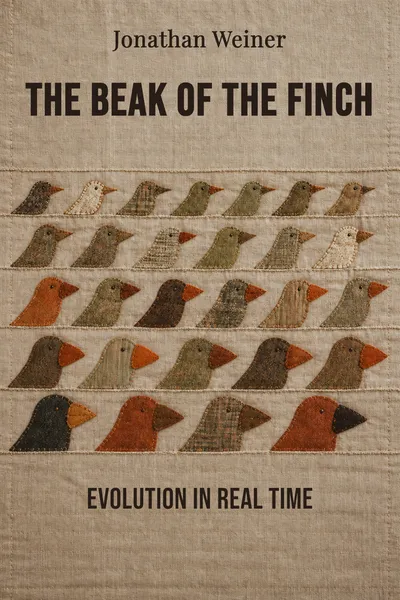
The Beak of the Finch
Evolution in real time
Description
In 1973, a British couple named Peter and Rosemary Grant landed on Daphne Major, a tiny volcanic cone in the Galápagos with almost nothing on it — no shade, no fresh water, a few thousand birds, and a lot of cactus. They came to do something that sounds almost unreasonable: to watch evolution happen. Not to reconstruct it from fossils, not to infer it from bones millions of years old, but to catch natural selection in the act, on living animals, in real time. The received wisdom, going back to Darwin himself, was that this could not be done. Evolution was supposed to be far too slow to see.
So the Grants and their students settled in for what became one of the longest continuous field studies in the history of science. They caught the finches, banded them, and measured them — beak length, beak depth, wing, weight — bird by bird, year after year, until they knew the population on Daphne Major more intimately than any wild animals have ever been known. Jonathan Weiner spent time with them on the island and in their Princeton lab, and turned the whole thing into a book that reads like a detective story where the suspect is a general law of life.
What they found ran against the intuition that evolution needs geological time to do anything at all. On Daphne Major, it turned out, natural selection was not a background hum. It was violent, measurable, and fast — fast enough to reverse itself inside a single human career. The finches Darwin had barely noticed became the clearest window we have onto the engine that made everything alive.
The question we’re asking : Can natural selection actually be caught in the act, on living animals, within a human lifetime?What we’ll see : An island, a couple who measured everything, and a drought that turned Darwin's slow abstraction into something you could read off a caliper.
Table of contents
01 Chapter 1 — The islands where nothing holds still
Darwin spent about five weeks in the Galápagos in 1835, and the finches were nearly an afterthought. He didn't sort them carefully at the time, mixed up which island some came from, and only later, back in England, did the ornithologist John Gould tell him that these drab little birds were a cluster of closely related species found nowhere else. That was the seed of an idea: a single ancestral finch, blown out to a bare volcanic archipelago, had fanned out into a dozen or more forms, each one shaped to a different way of making a living.
The mechanism behind that fanning-out is what biologists call adaptive radiation. One founder population lands somewhere with lots of empty niches and no competitors, and over generations it splits — some birds specialize on big hard seeds, some on small soft ones, some on insects, one famous species even on using cactus spines to pry grubs out of bark. The beak is the tool that does the specializing, which is why it became the thing to measure. A finch's beak is, in a real sense, its trade.

02 Chapter 2 — The measure of a millimeter
The genius of the Daphne Major study was patience turned into data. Every finch on the island got caught, weighed, and measured, then marked with a unique combination of colored leg bands so it could be recognized on sight for the rest of its life. The Grants and their team learned to read the birds individually — this one's parents, that one's beak, who paired with whom, who survived which year. Over decades they built a genealogy of a wild population reaching back many generations, something almost no other field study can claim.
The tool that mattered most was the caliper. Beak depth was measured to a fraction of a millimeter, and those fractions turned out to carry the whole argument. Because the differences that natural selection acts on are usually tiny — not the difference between a finch and a hawk, but the difference between a beak nine and a half millimeters deep and one eleven millimeters deep. In an ordinary year that gap means nothing. The birds eat, breed, and die more or less regardless. The variation just sits there in the population, apparently pointless, waiting.
03 Chapter 3 — When the rain rewrites the rules
The drought of 1977 was the experiment the Grants could never have designed. For a year and a half almost no rain fell. The plants that produced small, soft, easy seeds withered first, and the finches ate through the easy food fast. What remained were the big, hard, spiny seeds that only the birds with the largest, deepest beaks could crack. The rest starved. The population of the medium ground finch on Daphne Major crashed — roughly eighty-five percent of them died over that stretch.
And the survivors were not a random sample of who had been alive before. They were, on average, measurably bigger-beaked. The birds that could crack the tough seeds ate; the birds that couldn't did not. When the Grants compared the beaks of the dead with the beaks of the living, the difference showed up right there in the caliper readings — a fraction of a millimeter, but a fraction that decided who ate and who died. This was natural selection, not inferred from fossils but watched, counted, and quantified over a single dry season.
04 Chapter 4 — Watching the thing Darwin only imagined
What the Daphne Major finches change is not the theory of evolution — Darwin's argument was sound long before the Grants arrived — but our sense of its speed, and therefore its distance from us. We are used to filing evolution under deep time: dinosaurs, fossils, the slow grinding of millions of years, a process safely too vast to witness. Darwin himself believed the change was so gradual that no human eye could ever catch it moving. The finches quietly demolish that. Selection turns out to be something that runs at the pace of weather, visible on the scale of a graduate student's fieldwork.
That shift has a sharp practical edge. If evolution can reshape a beak in a couple of dry seasons, then it is happening constantly, everywhere, on organisms whose generations are far shorter than a finch's — and Weiner draws the line straight to us. Bacteria evolving resistance to antibiotics, insects shrugging off pesticides, weeds outrunning herbicides: these are not slow geological curiosities. They are the finch story sped up and pointed at the human world, natural selection responding within months to pressures we ourselves apply.
05 Conclusion
Peter and Rosemary Grant kept returning to Daphne Major for more than four decades, long past the drought that made the study famous, watching a population that had by then been measured through every kind of year the island could throw at it. What began as an almost unreasonable ambition — to catch evolution in the act — became a mountain of caliper readings that showed natural selection doing exactly what Darwin said it did, only far faster than he ever dared to claim. The birds he had barely noticed in 1835 turned out to be the plainest demonstration of his own idea.
Related books