Sequoia
The tree that makes us rethink time
Description
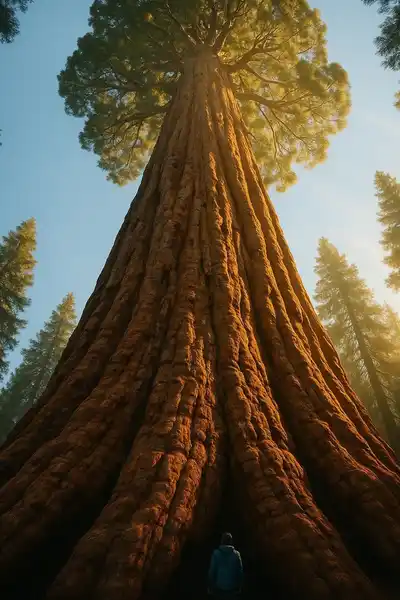
In the central Sierra Nevada of California, about three hundred miles east of San Francisco, there is a tree named General Sherman. It is the largest single-stem tree on Earth by volume — about 52,500 cubic feet of wood, roughly the size of a ten-story building. It is approximately 2,200 years old. When the first humans carved stone tools in the valley beneath it, the tree was already a seedling. It has been alive through the entire span of written European history.
General Sherman belongs to a species called the giant sequoia — Sequoiadendron giganteum — which grows almost exclusively in a few dozen groves on the western slope of the Sierra Nevada. Its cousin, the coast redwood, Sequoia sempervirens, grows in a narrow fog belt along the California and Oregon coasts and includes the tallest trees in the world. Together these species are the largest and among the oldest living things on the planet. There are roughly eighty individual sequoias still alive today that were seedlings when Jesus was born.
What makes these trees remarkable is not just their size. It is the combination of what it takes to live that long, what it takes to grow that big, and what it took for them to still be here after a century of industrial logging almost wiped them out. The sequoia is a useful entry point into a set of natural-history questions — how organisms survive deep time, what it means to be a species rather than an individual, and how a conservation movement saved something it barely understood.
● The question we're asking: how does a tree live for 3,000 years, what does it take to keep one alive across deep time, and what went wrong with the conservation movement that was supposed to save them?
● What we'll see: the fire-evolved biology that makes sequoias what they are, the industrial logging that almost erased them, the Muir-Roosevelt conservation that saved the survivors, and the unintended consequence of a century of fire suppression that is now killing them.
Table of contents
01 How a tree lives 3,000 years
A giant sequoia starts as a seed about the size of a pinhead — roughly five grams of mass per thousand seeds. It comes out of a cone about the size of a chicken egg, and the cones themselves can stay on the tree for twenty years without releasing their seeds. What opens them is fire. A sequoia cone relies on the heat of a surface fire to dry its scales and release its seeds onto a forest floor that has just been cleared of competing vegetation by the same fire. The species is, in a specific sense, fire-evolved.
This has big consequences for how sequoias live. An adult sequoia has one of the thickest barks of any tree on Earth — up to two feet thick on a mature specimen — which insulates the living wood inside from the heat of the surface fires that move through the forest floor. A fire that would destroy most other trees simply passes under a sequoia, scorching its base and clearing its competitors. The tree also has almost no flammable compounds in its bark. It is the closest thing in the plant kingdom to fireproof.

02 The sixty years of almost erasing them
European awareness of giant sequoias began in 1852, when a hunter named Augustus Dowd stumbled into a grove near the Calaveras River while chasing a wounded bear. The trees he described seemed impossible to people who had never seen them. Newspapers called them a hoax. Within a year, expeditions had confirmed their existence, and within two, the first sequoias had been cut down for bark exhibitions that toured Eastern cities. One tree, dubbed the Mother of the Forest, was stripped of its bark in sections that were reassembled in New York as a demonstration specimen. The tree itself died.
That exhibition was the beginning of roughly sixty years in which sequoias and coast redwoods were logged at industrial scale. The wood turned out to be, relative to expectations, commercially disappointing — it was soft, brittle, and often shattered when trees fell. Giant sequoias in particular tended to break into pieces on impact, wasting much of their volume. But the scale of the trees meant that even half-usable timber produced enormous amounts of lumber, and the logging industry of northern and central California was soon cutting the oldest, biggest trees at a rate that would have exhausted the species within a few decades.
03 The fire paradox
For most of the twentieth century, the sequoia conservation story was told as a clean victory. The big trees were saved; the groves were protected; the parks were visited by millions every year. The story was about rescuing individual trees from commercial destruction, and on that metric the story worked. What it didn't account for was the second order problem — what happens to a fire-dependent species when you put fire management around it.
Throughout the twentieth century, the National Park Service and the Forest Service aggressively suppressed all fires in sequoia groves. This was the received ecological wisdom of the era — fire was bad, fire destroyed forests, fire had to be stopped. In practice, a century of fire suppression meant that sequoia cones weren't opening, seedlings weren't germinating, and fuel loads on the forest floor were accumulating to levels the ecosystem had never seen before. By the 1960s, researchers were noticing that new sequoias weren't establishing. The existing giants were doing fine. There were no replacements.
04 What deep time teaches
The sequoia is a useful case for thinking about deep time and the limits of human perception. We evolved to operate on timescales measured in seasons and generations. The sequoia operates on a timescale measured in millennia. Standing under a 2,500-year-old tree does a thing to one's sense of duration that almost nothing else in ordinary experience does — it makes the span of one human life feel very small, and it makes the span of civilizations feel less stable than usual. The tree's presence is a physical reminder that there are living things for which most of recorded human history is a brief window.
It is also a useful case for thinking about what it means to be an individual versus a species. A single giant sequoia, standing alone in a clearing, will die. Its root system is too shallow, its lifespan too long, its reproductive cycle too dependent on fire and soil conditions. What survives deep time is not the individual tree but the grove — the fused root systems, the cone storage across multiple trees, the genetic population spread across slopes and river valleys. The sequoia is as much a collective organism as an individual one. Its deep-time survival depends on the network.
05 Conclusion
Eighty individual sequoias alive today were seedlings when Jesus was born. General Sherman has been alive for 2,200 years. In the last three years, thirteen to nineteen percent of all giant sequoias on Earth have been killed by fires that a century of well-intended fire suppression made possible. The species is older than every human institution and more fragile than any of them.
Related books