Toxic Cocktail
Endocrine disruptors and the brain
Description
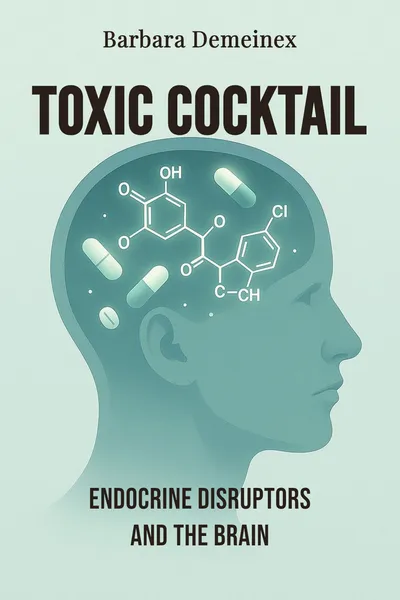
In 2017, a French biologist named Barbara Demeneix published a book with a title that sounds like a bad night out: Toxic Cocktail. Demeneix is not a popularizer by temperament. She runs a laboratory at the Muséum national d'Histoire naturelle in Paris, spent decades studying the thyroid hormone system, and her previous book, Losing Our Minds, laid out the same alarm in more technical terms. Toxic Cocktail is the version she wrote for the rest of us — meant to be read on a train, not graded in a seminar. The subject is narrow and enormous at the same time: what the industrial chemicals circulating through modern life are doing to the developing human brain.
The word cocktail in the title is doing precise work. Demeneix is not telling us that any single chemical is a smoking gun. Most of the compounds she tracks — flame retardants, plasticizers, pesticide residues, the lining of a food can — show up in our bodies at doses regulators have signed off on as safe, one molecule at a time. Her argument is that we do not live one molecule at a time. We carry dozens of these substances simultaneously, some interfere with the same hormonal machinery, and that machinery happens to be the one that assembles a brain before birth.
That is the unsettling core of the book: the most vulnerable moment in a human life is also the moment our chemical environment is least accounted for. A fetus cannot filter what crosses the placenta. The hormones that guide brain development are measured in trace amounts, and trace amounts are exactly what these pollutants disturb. Demeneix spent years assembling the evidence, and the picture she draws is not reassuring — not because the science is loud, but because of how quietly the exposure accumulates.
The question we’re asking : What are endocrine disruptors doing to the developing brain, and why has the system meant to protect us failed to see it?What we’ll see : How a single hormone builds a brain, why the danger lives in the mixture and its timing, and where the rules fall apart.
Table of contents
01 Chapter 1 — The thyroid hormone that builds a brain
To understand why Demeneix spends a career worrying about trace chemicals, you have to start where she starts: with thyroid hormone. Most people file the thyroid under metabolism — the gland that governs weight and energy. That is true, but it undersells the story. During pregnancy, thyroid hormone is one of the master signals that tells the fetal brain how to build itself. It directs when neurons migrate, how they connect, when the insulating sheaths form around them. Get the levels wrong at the wrong moment, and the architecture comes out subtly different.
The evidence is not speculative. Demeneix points to the long, grim natural experiment of iodine deficiency. Iodine is the raw material the body needs to make thyroid hormone, and in regions where diets lacked it, children were born with severe intellectual disability. Correct the iodine, and the problem largely disappears. That single public-health link established the principle at the heart of her book: thyroid hormone is non-negotiable for the developing brain, and anything that lowers or garbles its signal lands directly on cognition.

02 Chapter 2 — A cocktail, not a poison
The reason endocrine disruptors slipped past our defenses is that they break the oldest rule in toxicology. Since the sixteenth century, the field has run on a maxim credited to Paracelsus: the dose makes the poison. More of a substance is worse; less is safer; below some threshold, nothing happens. Regulators built their entire apparatus on that logic. You find the dose at which harm appears, divide by a safety margin, and declare everything below that line acceptable.
Hormones do not obey that rule, and neither do the chemicals that mimic them. The endocrine system is a signaling network tuned to react to vanishingly small concentrations — that is the whole point of a hormone. A molecule that slots into a hormone receptor can therefore matter at doses far below the thresholds classical toxicology was designed to catch. Worse, some compounds produce effects at low doses that vanish at high ones, so the standard practice of testing big and extrapolating down can miss the harm entirely. The tool was built for a different kind of poison.
03 Chapter 3 — The timing is everything
If the dose does not reliably make the poison, something else does much of the work — the timing. Demeneix returns again and again to the idea of a developmental window: a stretch of weeks in the womb when a particular brain process is underway and exquisitely sensitive to the hormonal signal guiding it. Hit that window with a disruptor and the effect can be permanent, written into the brain's structure. Deliver the exact same chemical to a grown adult and it may do nothing. The vulnerability is not a property of the person; it is a property of the moment.
This reframes the whole question of exposure. We tend to imagine toxic harm as something that scales with lifetime accumulation. For the developing brain, it can instead be a matter of the wrong thing during the wrong fortnight. A fetus has almost no defenses. Its systems cannot detoxify compounds the way an adult liver can, and the placenta, long imagined as a protective filter, lets many of these molecules through. The body with the most at stake is the one least equipped to protect itself.
04 Chapter 4 — The chemicals keep coming
Step back from the biology and the real subject of Toxic Cocktail comes into view: a regulatory system designed for a problem it no longer faces. Chemical safety was built in the mid-twentieth century to catch acute poisons — things that kill or sicken quickly, in proportion to dose, one substance at a time. Endocrine disruptors are none of those things. They act at trace levels, in mixtures, during narrow developmental windows, with consequences that surface years later. The law is not merely slow to catch them; it is looking in the wrong direction by construction.
Demeneix is blunt about how this plays out in practice. A chemical is presumed usable until harm is proven, and proof is expensive, slow, and easy to contest. The burden falls on public science to demonstrate danger rather than on industry to demonstrate safety. Testing protocols often fail to probe the low doses and developmental windows that matter most. And when a compound is finally restricted, the frequent outcome is a regrettable substitution — swapped for a cousin molecule, barely tested, that behaves much the same. Bisphenol A gives way to bisphenol S, and the cycle resets.
05 Conclusion
The book closes more or less where the thyroid began. A hormone measured in trace amounts guides the construction of a brain during weeks in the womb when nothing can be redone. Into that process we have introduced a steady, low-level stream of synthetic compounds that nudge the same hormone — arriving not singly but as a mixture, at exactly the moment the body is least able to defend itself. Demeneix's achievement is to hold those facts together long enough that the shape of the problem becomes visible, while resisting the temptation to overstate any single link.
Related books