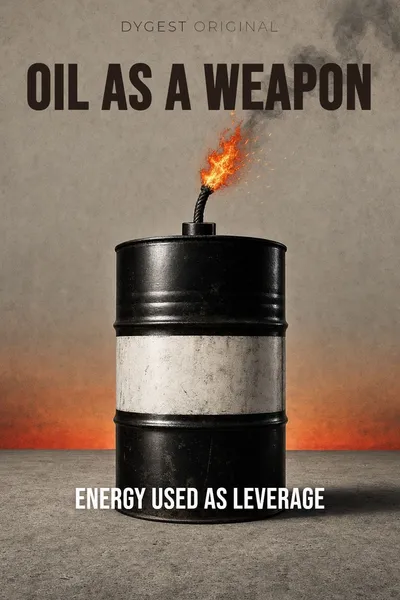
Oil as a Weapon
Energy used as leverage
Description
On October 17, 1973, the oil ministers of the Arab members of OPEC met in Kuwait City and decided to do something their predecessors had mostly threatened. Ten days after Egypt and Syria launched a war against Israel, and with the United States moving to resupply the Israeli military, they announced production cuts and an embargo on shipments to countries backing Israel — the United States and the Netherlands first among them. The posted price of a barrel of Saudi crude, around three dollars before the crisis, would quadruple within months. In American cities, drivers sat in lines that wrapped around blocks, filling stations ran dry, and speed limits dropped to save fuel.
What made the embargo land was not the volume withheld — the cuts were real but modest — so much as the shock of discovering that a resource the industrial world had treated as a background utility could be switched, deliberately, into a lever. For roughly a century oil had been priced, shipped, and burned as though its supply were a matter of geology and engineering. The autumn of 1973 rephrased it as a matter of politics. Governments that had never thought about where their energy came from suddenly built strategic reserves, chased efficiency, and started reading the map of the Persian Gulf like a threat assessment.
Half a century on, the reflex has never gone away, even as the commodity carrying it has quietly changed hands. The instrument that felt so novel in 1973 turned out to be a permanent feature of how powerful states press one another — and the ground it operates on keeps shifting.
The question we’re asking : What happens when a country decides that the energy it sells, or refuses to sell, is worth more as pressure than as revenue?What we’ll see : How the oil weapon was fired, why it is blunter and stranger than the 1973 legend suggests, and where the same instinct has migrated since.
Table of contents
01Chapter 1 — The autumn Riyadh turned off the tap
The 1973 embargo is remembered as a single Arab hand on a single valve, but the machinery behind it had been assembling for years. OPEC, founded in 1960 by five producers frustrated at watching Western companies set the price of their own oil, had spent a decade as a mostly toothless cartel. The turn came when the balance of supply tightened in the early 1970s and American domestic production peaked, leaving the industrial world newly dependent on imports. The producers noticed. What had been a buyers' market was becoming a sellers' one, and a sellers' market is where leverage lives.
The trigger was the Yom Kippur War. When Washington authorized a major arms airlift to Israel in mid-October, the Arab producers had both a grievance and, for the first time, the market conditions to act on it. The embargo itself was leaky — oil is fungible, and tankers rerouted through third countries kept crude flowing to embargoed states in practice. The physical shortfall in the United States was real but limited. Much of the panic at the pump came from hoarding, allocation rules, and price controls that scrambled distribution rather than from an absolute absence of fuel.

02Chapter 2 — The barrel was never just a barrel
It is tempting to read the oil weapon as a clean act of coercion: producer withholds, importer capitulates. The historical record is messier, and the mess is the interesting part. Embargoes work best when the target has few alternatives and the seller can afford to lose the sale — and those two conditions rarely hold at the same time. The 1973 producers could tolerate lost volume because higher prices more than compensated. Later attempts to repeat the trick mostly failed, because the market had learned to route around them.
Consider the reverse move: flooding the market rather than starving it. In 1985 and 1986, Saudi Arabia abandoned its role as swing producer and opened the taps, and the price of crude collapsed from around thirty dollars a barrel to near ten. Many analysts read this partly as pressure on the Soviet Union, whose economy leaned heavily on oil exports and which lost a critical stream of hard currency at a delicate moment. Whether or not it was decisive, it made the point that low prices can be a weapon too. The lever runs in both directions, and the party pulling it is not always the one holding the reserves.
03Chapter 3 — Sanctions, ceilings, and the caps nobody obeys
After 1973, the initiative in energy coercion drifted from the sellers back toward the buyers — specifically toward the coalition of wealthy importers who could cut a producer off from the financial and shipping systems that move oil to market. The weapon changed shape. Instead of an exporter withholding crude, an importing bloc now tries to strangle an exporter's ability to sell it at all. Iran spent decades under sanctions targeting its oil revenue; Venezuela watched its output collapse under a combination of mismanagement and American restrictions; Iraq lived for years under an oil-for-food regime after 1990.
The most ambitious recent version came after Russia invaded Ukraine in February 2022. Europe, which had bought a large share of its gas and much of its oil from Russia, faced the classic importer's dilemma: cut the flow and punish itself, or keep buying and fund the war. The improvised answer was a price cap, agreed by the G7 in late 2022 at sixty dollars a barrel for Russian crude, enforced not by blockade but by denying Western insurance and shipping to cargoes sold above the line. The idea was elegant — keep Russian oil flowing so global prices stay calm, but skim off the profit.
04Chapter 4 — When the leverage moves off the tanker
The instinct that fired the oil weapon in 1973 was never really about oil. It was about finding the chokepoint in an adversary's economy and pressing on it. Oil happened to be the obvious chokepoint of the twentieth century because industrial life ran on it and only a few states controlled the taps. But as oil grows harder to weaponize — too fungible, too easily rerouted, too well hedged by reserves and diversification — the same logic looks for a commodity where the chokepoint is genuinely narrow. Increasingly, it has found two.
The first is natural gas, which behaves nothing like oil. You cannot easily divert a pipeline; the gas goes where the tube goes. When Russia throttled and then halted deliveries to Europe through the Nord Stream system in 2022, the continent could not simply summon replacement molecules the way it could reroute crude purchases. It had to build liquefied-gas import terminals, sign long contracts with the United States and Qatar, and endure a winter of extraordinary prices. Gas turned out to be a far stickier lever than oil precisely because its geography is fixed. The pipeline is the weapon.
05Conclusion
The gas lines of 1973 faded, the salt caverns filled, and the embargo settled into memory as the moment energy stopped being invisible. What the autumn in Kuwait City actually launched was not a shortage but a habit of mind. Every government that scrambled for fuel that winter came away convinced that supply was a lever someone would eventually pull again — and set about making itself harder to squeeze. The reserves, the agencies, the diversification: all of it descends from ten days of decisions taken half a century ago.
Related books