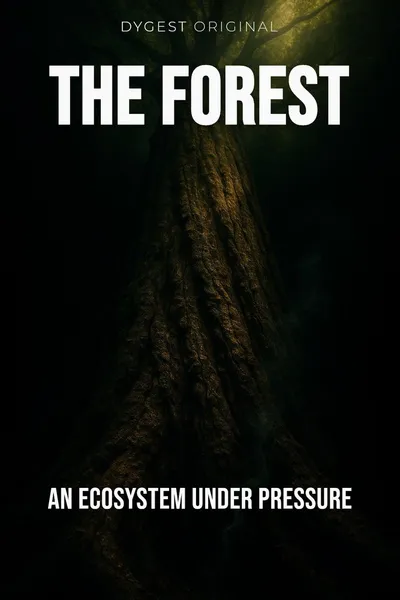
The Forest
An ecosystem under pressure
Description
Walk into an old forest and the first thing that hits you is how little of it is trees. There's the smell of wet leaf litter, the give of the ground underfoot, the strange dim light filtered through layers of canopy. There are fungi threading through the soil, beetles working the dead wood, birds you hear but never see. The trees are the part we notice because they're the part that's tall. But a forest, in the way ecologists have come to understand it, is less an assembly of trunks than a dense web of relationships — most of them invisible, most of them slow, most of them happening below the ground or across timescales far longer than a human attention span.
We tend to treat forests as a resource that regrows. Cut some down, plant some more, and the ledger balances. It's a comforting arithmetic, and it's the logic behind most of the reforestation pledges announced over the past two decades — billions of trees promised, sometimes hundreds of millions planted in a single day for the record books. The trouble is that a forest and a stand of young trees are not the same thing, and the difference is precisely the part that doesn't show up in a photo of freshly turned soil dotted with saplings.
Meanwhile the pressure keeps mounting. Roughly ten million hectares of forest are lost worldwide each year, cleared for cattle, soy, palm oil, timber and roads, while fire and drought push the survivors closer to their limits. The forest is one of the oldest things we live alongside, and one of the least understood in the terms that actually matter for keeping it alive.
The question we’re asking : If a forest is a system rather than a stock of trees, what exactly are we losing when we clear it — and can we really put it back?What we’ll see : How a forest works as a living network, what's driving its decline, and why the tidy math of replanting runs into something the numbers can't capture.
Table of contents
01Chapter 1 — What a forest actually is
The old picture of a forest was a collection of individual trees competing for light, each one out for itself, the tall ones winning. That picture has been steadily complicated over the past few decades. The work of ecologists like Suzanne Simard, who spent years tracing how carbon and nutrients move underground in Canadian forests, helped bring a different image into focus: trees connected through fungal networks in the soil, exchanging sugars, water and chemical signals, sometimes across species. The relationships aren't purely cooperative — competition is real and constant — but the forest turns out to be far more interlinked than the free-for-all model suggested.
Most of that action happens where we can't see it. Under a single footstep of forest floor runs a mesh of fungal threads, called mycorrhizae, that wrap around and into tree roots and vastly extend their reach for nutrients. In return the fungi take a cut of the sugars the trees make from sunlight. This trade has been going on for hundreds of millions of years; it's roughly as old as land plants themselves. The visible forest above ground is, in a sense, the fruiting tip of a much larger underground economy.

02Chapter 2 — The pressure from every side
The single largest driver of forest loss isn't logging in the way people often imagine. It's agriculture. Across the tropics, forests are cleared to make room for cattle pasture, soy fields, palm oil plantations and the export commodities that feed distant supply chains. The Amazon, the Congo Basin and Southeast Asia each tell a version of the same story: land is worth more, in the short term, with the trees gone. The chainsaw is really an economic instrument.
The scale is hard to hold in the mind. The world has lost something on the order of a third of its forest cover over the long span of human history, with much of that loss concentrated in the last few centuries and a sharp acceleration in the tropics since the mid-twentieth century. In recent years the annual net loss has run in the millions of hectares — an area of tree cover disappearing each year larger than many countries. Some of that is offset by regrowth elsewhere, but the forests being lost and the ones growing back are rarely equivalent.
03Chapter 3 — Numbers that don't add up
Faced with all this, the response of the last two decades has often taken a satisfying, countable form: plant trees. Governments and companies have pledged billions of them. Campaigns have staged mass plantings — volunteers putting hundreds of millions of seedlings in the ground in a single day, records set and celebrated. The appeal is obvious. A tree planted is a fact you can photograph, a figure you can announce, a gesture almost everyone can get behind.
The problem starts after the photo. A striking share of planted seedlings don't survive their first years. Follow-up studies of large restoration schemes have repeatedly found survival rates well below half, sometimes far below, when the wrong species are chosen for the site, when there's no plan to tend them, or when the land was cleared again for farming a few seasons later. In one much-discussed Turkish mass-planting effort, a large fraction of the saplings were reported dead within months. The seedling in the ground is the beginning of the work, not the end of it, and the counting usually stops at the beginning.
04Chapter 4 — The seedling and the system
The gap between a planted stand and a living forest is, in the end, the gap between a thing and a process. You can plant a tree in an afternoon. You cannot plant a forest, because a forest isn't an object you install — it's a set of relationships that assemble themselves over decades, given the right soil life, the right mix of species, the seed-dispersing animals, the accumulated dead wood, and above all the time to grow old. A seedling is a bet on that whole process taking hold. Very often it doesn't.
This is why ecologists increasingly argue that protecting existing forest is worth more than planting new trees, hectare for hectare. An intact forest already contains the network, the age, the complexity that a plantation would need a hundred years and a great deal of luck to approach — if it ever did. Letting degraded land regenerate on its own, seeded by nearby survivors, often produces a richer result than planting, because it lets the system rebuild in its own order rather than forcing a design onto it.
05Conclusion
Step back into that old forest one more time — the dim light, the give of the ground, the fungal threads running under a single footstep. Almost none of what makes it a forest could be installed by a planting crew. It was assembled over a century or more, in an order no one designed, out of relationships that mostly happen where we can't watch them. That's the thing under pressure, and it's the thing a freshly planted field of saplings does not yet contain.
Related books