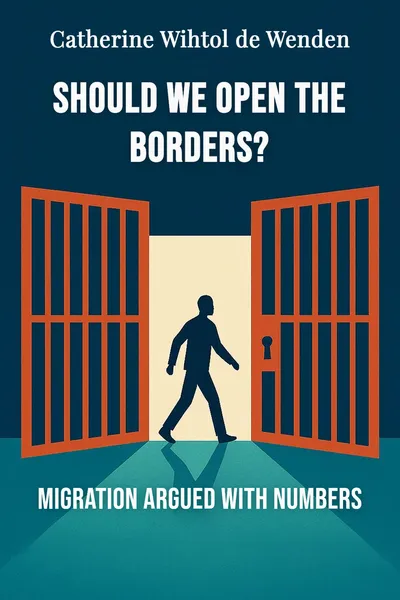
Should We Open the Borders?
Migration argued with numbers
Description
Catherine Wihtol de Wenden has spent most of her career counting. A political scientist at the French CNRS and one of the most cited migration researchers in Europe, she has built four decades of work around a plain conviction: the migration debate runs almost entirely on feelings, and almost none of the figures people argue about hold up. Her short book, published in French as Faut-il ouvrir les frontières? and reissued across the 2010s as the numbers kept shifting, takes the most radical proposition in the field — open the borders, let people move — and runs it through the data instead of the usual moral theater. The result is neither a manifesto nor a warning. It is an audit.
The question itself sounds utopian, the kind of thing you debate once and then file away. But Wihtol de Wenden points out something awkward: for most of human history there were no borders to open, and the closed world we treat as natural is roughly a century old. Passports, quotas, the whole machinery of admission and refusal — recent inventions, bolted onto a species that has always moved. So the real question isn't whether opening borders is desirable in the abstract. It's what the evidence actually says would happen, against what we fear would happen.
That is the gap her book sits in. On one side, the public conversation, loud and largely innumerate. On the other, a body of research on who moves, why, how many, and to what effect — research that keeps producing answers nobody seems to want. Reading her is less like being persuaded of a position than like watching a familiar argument get slowly disassembled and laid out on the table, part by part.
The question we’re asking : When the open-borders argument is tested against evidence rather than instinct, how much of the usual fear — and how much of the usual idealism — actually survives?What we’ll see : A century-old invention taken apart with numbers, and what remains firmly in the hands of states once the easy certainties fall away.
Table of contents
01 Chapter 1 — The border is younger than we think
Wihtol de Wenden opens by unsettling the thing everyone assumes is permanent. The sealed national border, policed and documented, is not an ancient feature of human life. Before the First World War, a person could cross most of Europe and much of the world without a passport, without a visa, without proving anything beyond the price of a ticket. Stefan Zweig, she likes to recall, traveled his whole early life carrying almost no papers at all. Movement was the default; control was the exception.
The modern apparatus arrived with the twentieth century. States closed around themselves during the war, kept the controls afterward because wartime habits are hard to undo, and gradually built the system we now treat as the natural order — identity documents, residence permits, quotas, categories of admissible and inadmissible people. What feels eternal is in fact about a hundred years old, a bureaucratic layer laid over a species that has always drifted across territory in search of safety, work, or kin.

02 Chapter 2 — The economics that keep refusing to cooperate
If the demographic fear is overstated, the economic one is where Wihtol de Wenden spends her sharpest pages, because the economics keep producing conclusions that neither side of the debate finds convenient. The common claim is that immigrants take jobs and drain public money. The research, accumulated over decades and across countries, mostly says the opposite, or something more complicated than a slogan can hold.
Migrants, she notes, are overwhelmingly of working age. They arrive having cost their origin country the price of their upbringing and education, and they enter the labor market of the receiving country without the receiving country having paid for any of that. They tend to take jobs that the resident population has stopped wanting — in care, construction, agriculture, cleaning, the night shifts of the service economy — rather than displacing natives from desirable ones. Study after study in France and across the OECD finds the net fiscal effect of immigration to be small, and more often slightly positive than negative, once you count the taxes paid alongside the services used.
03 Chapter 3 — The gap between movement and the promise of control
Here Wihtol de Wenden turns to the thing states promise voters and cannot quite deliver: control. The entire closed-border system is sold on the premise that a government can decide who enters and who does not. Her evidence suggests this premise is far shakier than the rhetoric around it.
The more a border is fortified, she observes, the more it tends to trap people rather than deter them. When crossing becomes dangerous and expensive, the old pattern of seasonal, circular migration — come for the harvest, go home after — breaks down. People who once moved back and forth now stay, because leaving means risking the entire perilous journey again. Hardened borders, counterintuitively, can increase permanent settlement. They also hand the business of crossing to smugglers, turning what was once an ordinary movement into a lucrative criminal market whose growth tracks the height of the walls built against it.
04 Chapter 4 — What a state can actually hold
Step back from the slogan and a quieter point emerges from Wihtol de Wenden's work. The real question was never open versus closed, because no border is fully either. States do not actually govern the flow of people the way they claim to. What they genuinely control is something less visible and more consequential: the categories.
A state decides who counts as a refugee and who counts as an economic migrant, which is often the difference between protection and deportation for people whose actual circumstances are identical. It decides who may work legally and who is pushed into the undocumented shadow economy, where the same labor happens but without rights, taxes, or recourse. It decides who can become a citizen and under what terms, who can bring a family, who waits years in administrative limbo. These are not decisions about whether people arrive. They are decisions about what happens to people once they are already here — and they are the levers a state can genuinely pull.
05 Conclusion
Wihtol de Wenden ends roughly where she began: with the quiet insistence that the figures have been available all along, and that the conversation keeps refusing to use them. The share of humanity that migrates has stayed small. The economic effects have stayed modest and mostly benign. The hardened borders have mostly raised the cost of a movement they fail to stop. None of this is secret research; it is the ordinary consensus of the field, sitting next to a public debate that behaves as though none of it existed.
Related books