Agriculture
Feeding a planet within limits
Description
Roughly twelve thousand years ago, in the hills of the Fertile Crescent, small groups of people began saving seed from one harvest to plant the next. It was not an obvious move. The first farmers, the skeletal record suggests, were shorter, sicker, and worked longer hours than the foragers they descended from. They traded a varied diet and mobility for a monotonous one and a permanent tie to a patch of ground. And yet the practice spread, independently, on nearly every continent, because farming did one thing hunting and gathering could not: it produced a surplus, and a surplus fed more people, and more people meant more farmers.
That bargain has never really been renegotiated. It has only been scaled. Today a little over one percent of the population in wealthy countries grows the food for everyone else, using nitrogen pulled from the air, seeds bred in laboratories, and machines that harvest a field of wheat in an afternoon. Humanity now feeds around eight billion people, more than at any point in its history, and does so with a smaller share of its labor than ever before. By almost any measure of output, it is a staggering success.
But output has never been the whole ledger. Every system that has fed us has also cost us something — a forest, a river, an aquifer, a layer of topsoil — and the bill has mostly arrived late, and somewhere else. As the planet's population approaches its likely peak and the climate that made stable harvests possible starts to shift, the old question returns with a sharper edge: not just how much we can grow, but what growing it does to the ground underneath.
The question we’re asking : Can a system built to maximize how much comes off the land keep doing so without exhausting the land itself?What we’ll see : How the oldest bargain in civilization was scaled into the modern food system, what that scaling quietly spends, and why the real accounting happens in the soil.
Table of contents
01Chapter 1 — The most successful bad idea in human history
Agriculture is one of those inventions that looks inevitable in hindsight and was anything but. For most of the ten thousand years after those first sown fields, the deal was brutal. A farming society could support far more people per acre than a foraging one, but it lived close to the edge — one failed rain, one blight, one raiding army from the next surplus of famine. Malthus, writing in 1798, described the logic coldly: population grows until it hits the ceiling of what the land can produce, then hunger pushes it back down. For most of history, he was simply describing how things worked.
What broke the Malthusian ceiling was not one thing but a stack of them, assembled over two centuries. Crop rotation and enclosure in England raised yields before anyone understood the chemistry. Then came the understanding of the chemistry. In the early nineteenth century, the German chemist Justus von Liebig worked out that plants needed nitrogen, phosphorus, and potassium, and that depleting soil of these was what exhausted old fields. For a while the world mined its nitrogen — from Peruvian guano islands, from Chilean nitrate deposits — and the supply was visibly running out.

02Chapter 2 — The Green Revolution kept the promise, and sent the bill
The clearest modern chapter opens in Mexico in the 1940s, where an American agronomist named Norman Borlaug spent years breeding wheat that resisted disease and, crucially, grew short and stiff. Tall wheat, fed heavily with fertilizer, grows fast and then falls over under the weight of its own grain. Borlaug's dwarf varieties could take the fertilizer and stand, pouring the extra energy into seed instead of stalk. Paired with irrigation and synthetic nitrogen, the new wheat roughly doubled and tripled yields where it was planted.
In the 1960s the package moved to India and Pakistan, then across much of Asia, at exactly the moment famine seemed imminent. India, widely expected to face mass starvation, was exporting grain within a decade. Borlaug received the Nobel Peace Prize in 1970, credited by some with saving a billion lives — a number impossible to verify but not obviously wrong. Global grain production more than doubled between the 1960s and the 1990s while farmed area barely grew. On its own terms, it worked spectacularly.
03Chapter 3 — What the yield number hides
We tend to judge agriculture by yield: tons per hectare, the number that goes up and to the right on every chart. It is a genuinely useful figure, and it flatters the modern system relentlessly. But it measures only what leaves the field, not what it took to get there, and the gap between those two things is where most of the trouble lives.
Start with energy. Pre-industrial farming was, roughly, a machine for turning sunlight into calories, and it returned far more food energy than it consumed. Modern industrial agriculture inverts that. Once you count the natural gas burned to make nitrogen fertilizer, the diesel in the tractors, the fuel in transport and refrigeration, the system spends several calories of fossil energy for every calorie of food it delivers to a plate. We have, in effect, learned to eat oil. That works beautifully as long as the oil is cheap and the atmosphere is free to pollute — two assumptions now visibly wobbling.
04Chapter 4 — The living thing we treat as inert
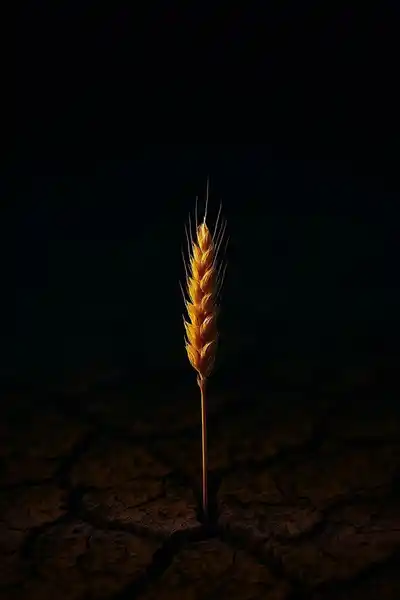
Step back from the tractors and the trade figures and you land, eventually, on the ground — a layer of topsoil rarely more than a foot deep, on which essentially all terrestrial food depends. It is easy to picture soil as inert brown backdrop, the stuff plants happen to stand in. It is closer to the opposite. A handful of healthy soil holds billions of organisms — bacteria, fungi, protozoa, the fine root networks that trade sugars for minerals. Soil is less a substance than a slow, living process, and it builds at a rate of roughly an inch every few centuries.
The modern food system, for all its sophistication, largely treats this living process as a passive medium — a place to inject nitrogen and extract grain. That framing is the deep move underneath everything in this story. Once soil is a substrate rather than an organism, its erosion becomes a rounding error, its microbial life an irrelevance, its depletion invisible until it stops delivering. The United Nations has estimated that a third of the world's soils are already degraded, and that on current trends much of the planet's remaining topsoil could be worn out within a lifetime or two. Those are contested figures. That they are even plausible is the point.
05Conclusion
The first farmers made a trade whose terms we have honored ever since: a harder, narrower life in exchange for a surplus that could feed more people. Every advance since — Liebig's chemistry, Haber's nitrogen, Borlaug's wheat — has widened that surplus without ever quite settling the older debt underneath it. We got very good at the question of how much. We stayed strategically vague about the question of at what cost, and to whom, and when.
Related books