

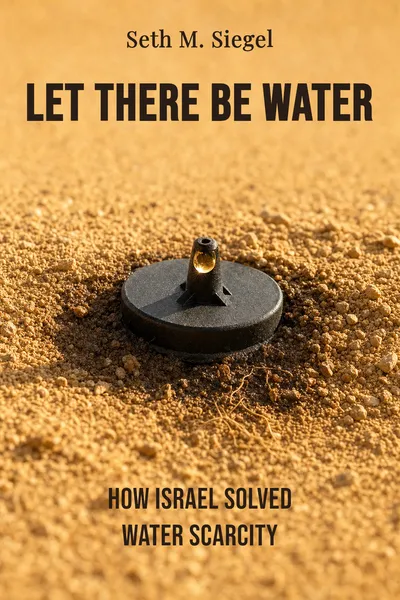
Let There Be Water
How Israel solved water scarcity
Description
Israel is roughly 60 percent desert. It sits on a thin, salty strip of the eastern Mediterranean, its rainfall is stingy and unreliable, and its population has grown more than tenfold since 1948. By every rule of thumb, it should be a country rationing showers and importing its vegetables. Instead, it grows its own food, keeps its rivers running, and — this is the part that stops people — sends water every single day to the Palestinians and to the Kingdom of Jordan next door. Somewhere along the way, a place with almost no water became a place with more than it needs.
That reversal is the subject of Seth M. Siegel's Let There Be Water. Siegel, a businessman and writer who spent years on the research and hundreds of interviews, tells the story not as a miracle but as a series of deliberate choices, stubborn engineers, and a national habit of treating water as a shared emergency rather than a private convenience. His timing is pointed. The US government's own projections warn that forty of the fifty states, and a majority of the planet's land surface, are heading toward alarming gaps between the water people have and the water they want. When that gap opens, food gets pricier, growth stalls, and politics gets ugly.
Siegel's wager is that Israel is not a curiosity but a template — a small, dry, crowded place that faced the future early and built its way out. The interesting thing is how ordinary the ingredients turn out to be: pricing, plumbing, culture, patience. None of it required a miracle. It required deciding, decades in advance, that running out was not an option.
The question we’re asking : How did a country that is mostly desert end up with more water than it needs — and what can everyone else take from that?What we’ll see : A national mindset, a generation of offbeat inventors, the machinery that turned seawater and sewage into supply, and the surprising diplomacy that flows through a pipe.
Table of contents
01Chapter 1 — A country that decided water was everyone's business
Long before Israel had the technology, it had the attitude. Siegel traces the country's water culture back to the pre-state pioneers and to David Ben-Gurion, who talked about making the Negev desert bloom as a national mission rather than a slogan. Water was treated the way other countries treat defense: as an existential matter, planned centrally, funded seriously, and never left to chance. That framing — scarcity as a shared threat, not an individual inconvenience — turns out to be the quiet foundation everything else was built on.
The clearest expression of it was the decision, unusual among nations, to make all water national property. Nobody in Israel owns the rain that falls on their land or the aquifer beneath it. The state manages the resource as a single system, which means it can move water from where it is to where it is needed, and it can plan for the whole country rather than watch a thousand landowners drain the commons. In 1964 Israel completed the National Water Carrier, a network of pipes, canals and tunnels that hauls water from the Sea of Galilee in the wetter north down to the arid south. It was, at the time, an audacious piece of plumbing.

02Chapter 2 — The engineers who made scarcity productive
The most famous of the inventors is Simcha Blass, and his breakthrough started with a tree. Blass noticed that one tree in a row was growing far larger than its neighbors, and eventually found the cause: a leaking underground pipe was feeding it a slow, steady trickle right at the roots. The observation became drip irrigation — delivering small, precise amounts of water directly to each plant instead of flooding a whole field and letting most of it evaporate. In the 1960s Blass partnered with a kibbutz in the Negev to found Netafim, and the idea spread from there to farms around the world.
Drip irrigation is the sort of thing that sounds trivial and turns out to be transformative. It can cut the water a crop needs while raising the yield, because the plant gets exactly what it wants and no more. For a country trying to feed itself on almost no rainfall, it was close to alchemy. Siegel's point is not that one gadget saved Israel but that Netafim was typical — a case where a working farm, a curious mind and a national appetite for water efficiency met and produced something the whole planet could use.
03Chapter 3 — Turning the sea and the sewer into rivers
Efficiency can only take a country so far. At some point, a growing population simply needs more water than the sky provides, and this is where Israel made its two boldest bets: it decided to manufacture supply. The first source is the ocean. Desalination — pushing seawater through membranes at high pressure to strip out the salt — used to be prohibitively expensive and energy-hungry. Israel invested in it anyway, and drove the cost down through a run of large plants along the Mediterranean coast, starting with the facility at Ashkelon in the mid-2000s.
The result is that a meaningful share of Israel's drinking water now comes from the sea. A country that once prayed for rain built a way to make its own, at a price and scale that turned desalination from a desperate last resort into a routine part of the supply. Siegel treats this as a psychological turning point as much as a technical one: once you can produce fresh water from an effectively infinite ocean, the ancient anxiety about the next dry winter loosens its grip.
04Chapter 4 — Water as a language between enemies
Step back from the pipes and the membranes, and Siegel's larger claim comes into view: water security is finally a problem of governance and relationships, not just of engineering. The technology matters, but what made it work was a country willing to plan for the long term, price honestly, and treat the resource as collective. And once a nation has abundance, water stops being only a domestic asset. It becomes a form of currency in the region — and even a diplomatic one.
Some of Siegel's most striking material is about how water crosses borders that armies cannot. Israel supplies water to the Palestinians and to Jordan under agreements that survive even when the wider politics is poisonous, because the alternative — a neighbor with no water — is dangerous for everyone. He also recounts less familiar chapters: how Israeli expertise once helped manage water systems in Iran, back when the two countries were not enemies, and how Israel's water know-how has helped thaw relations with countries wary of dealing with it, China among them.
05Conclusion
The image Siegel keeps returning to is the strangeness of it: a country that is mostly desert, hemmed in by hostile borders and short on rain, that nonetheless has water to spare and water to give away. It got there not through luck or geography but through a long sequence of unglamorous choices — national ownership, honest pricing, relentless reuse, patient investment in inventors who noticed a leaking pipe feeding a tree. None of it was quick, and none of it was free.