Fast Food Nation
How fast food changed us all
Description
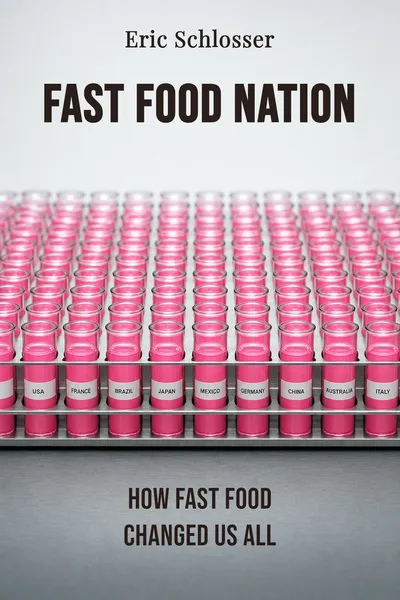
In the closing years of the twentieth century, a journalist named Eric Schlosser spent a lot of time in places most of us drive past without a thought: the parking lots of drive-thrus off the interstate, the feedlots of the high plains, the meatpacking towns of Colorado and Nebraska, the flavor laboratories of New Jersey where the taste of a strawberry milkshake is quietly assembled from chemicals. He started with a simple assignment for a magazine and ended up with something much larger. In 2001 it came out as a book, Fast Food Nation, and it landed like a small earthquake — a bestseller that changed how a lot of people looked at the tray in front of them.
Schlosser's wager was that the hamburger is not just a hamburger. Behind that cheap, warm, familiar object sits an entire way of organizing a country: how its cattle are raised and slaughtered, how its teenagers and immigrants are paid, how its land is used, how its children are advertised to, even how its taste buds are engineered. Fast food, he argued, was one of the most powerful forces to reshape American life in the second half of the century — and, because America exports its habits, the world's life too.
What makes the book stick is that it never lectures us about calories. Schlosser treats the drive-thru as a doorway. Walk through it and you end up somewhere you didn't expect: a slaughterhouse, a courtroom, a franchising seminar, a lab. The meal is the same on every corner of the planet, and that sameness turns out to be the whole point — and the whole problem.
The question we’re asking : What does the cheap, uniform, everywhere-identical hamburger actually cost, once we follow it back to where it comes from?What we’ll see : We follow a single meal backward — from the counter through the supply chain to the kill floor — and watch a whole model of standardization take shape.
Table of contents
01Chapter 1 — The counter where America ate itself
Schlosser opens close to home, because that is where the story hides in plain sight. Americans, he notes, spent more on fast food by the end of the 1990s than on higher education, or new cars, or movies, books and music combined — somewhere north of $110 billion a year. That is not a marginal industry. It is a central fact of how a country lives, and it happened fast. In 1970 the numbers were a fraction of that. Within a single generation, a way of eating that barely existed had become the default.
The origins are Californian and postwar. The McDonald brothers, running a drive-in in San Bernardino, tore out their carhops and their long menu and rebuilt the kitchen like a factory line — one product, made the same way every time, cheap and quick. Schlosser lingers on the men who scaled that idea: Ray Kroc, who turned it into an empire; Carl Karcher; the founders of the chains that colonized every highway exit. Their genius was not cooking. It was systems. They understood that if you could make the process identical, you could make the worker replaceable.

02Chapter 2 — How the burger got built before it hit the grill
To understand the meal, Schlosser argues, we have to stop looking at the plate and start looking at the supply chain — because almost everything that matters was decided long before the food reached the fryer. Take the taste. That fry, that shake, that specific savor we associate with a childhood treat, is largely the work of the flavor industry, a cluster of companies concentrated along the New Jersey Turnpike. In quiet labs, chemists blend the aromatic compounds that make a processed food taste like the thing it is imitating. The 'natural' and 'artificial' flavors on the label are, chemically, close cousins produced by the same technicians.
The point is not that this is poison. The point is that the taste we think of as authentic is manufactured — engineered to be consistent from Ohio to Osaka. Consistency is the god the whole system serves. A customer in one country must get the identical experience as a customer six thousand miles away, and that demand ripples all the way back to the field. Potatoes are bred and grown to a franchise's specification. Chickens are reshaped, over decades, into a bird designed to be cut into uniform, dippable pieces.
03Chapter 3 — The kill floor nobody was meant to see
If the book has a moral center, it is the meatpacking chapter, and Schlosser writes it as reportage rather than accusation. He goes to the towns of the high plains — Greeley, and the corridor around it — where the slaughterhouses now sit. A century earlier, meatpacking had been a skilled, comparatively well-paid, unionized job, the world Upton Sinclair described in 1906. Schlosser's argument is that the industry, over the second half of the century, deliberately undid all of that.
The method mirrors the fast food kitchen. Break the work into tiny, repeated motions, so that no skill is needed and any worker can be replaced. Move the plants to rural areas far from union strongholds. Staff them with a workforce that cannot easily complain — often recent immigrants, many undocumented, drawn from across the border with the tacit understanding that they are disposable. Turnover in some plants approached the entire workforce every year. That churn is not a failure of management. It is the design.
04Chapter 4 — A machine for making everything the same
Step back from the burger and Schlosser's real subject comes into view. Fast food is not, finally, a story about food. It is a story about a template — a way of organizing work, land and desire that proved so profitable it spread far beyond the drive-thru. The core move is always the same: take something that used to require skill, judgment and variety, break it into identical interchangeable parts, and drive the cost down until it becomes ubiquitous. Cooking, ranching, slaughtering, even flavor and childhood memory get run through the same logic.
What that logic produces is uniformity, and Schlosser is honest that uniformity has its comforts. The traveler tired and far from home is soothed by a sign that promises the identical meal they had yesterday. But the same force that flattens the menu flattens the landscape — the interchangeable strips of franchises that make one American exit indistinguishable from the next, and increasingly one country's outskirts indistinguishable from another's. The book connects this directly to the widening gap it documents: cheap food built on cheap labor concentrates wealth at the top of the chain and hardship at the bottom, while an epidemic of obesity spreads fastest among those with the least.
05Conclusion
Schlosser ends where he began, at the counter, but the meal looks different now. When Fast Food Nation appeared in 2001 it became an international bestseller precisely because it performed this trick on so many readers at once: it took the most ordinary object in American life and made it strange again. The burger was never just lunch. It was a set of choices about labor, land, animals and appetite, made far upstream and delivered to us pre-decided, wrapped in paper and sold with a smile.
Related books