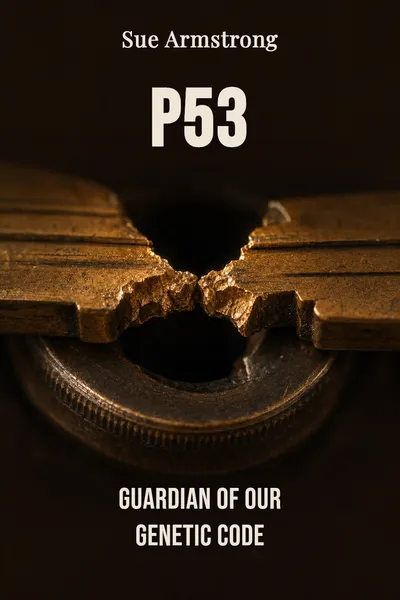
p53
Guardian of our genetic code
Description
In 1979, in three separate laboratories working more or less blind to each other, researchers kept fishing the same molecule out of cancer cells. It was a protein weighing in at around 53 kilodaltons, so they called it p53, a placeholder name that stuck the way placeholder names do. At first everyone agreed on what it was: an oncogene, one of those rogue genes that drives cells to divide out of control. It showed up in tumours, it was abundant, it looked guilty. For nearly a decade the field treated p53 as one of cancer's accomplices.
Then, in the late 1980s, the story flipped completely. The p53 that had been pulled from tumours was a mutant — a broken version. The normal protein did the exact opposite of what everyone had assumed. Far from driving cancer, it was one of the body's main defences against it, a molecule that halts damaged cells before they can turn dangerous. Bert Vogelstein and others reclassified it not as an oncogene but as a tumour suppressor, and by 1992 a British researcher named David Lane had given it the nickname that stuck even harder than the first: the guardian of the genome.
Sue Armstrong's book follows this molecule from mistaken identity to the centre of modern cancer biology. It is the story of how a protein found in roughly half of all human tumours became the most studied gene in the history of the discipline, and of the researchers who spent their careers arguing about what it actually does. The reversal at its heart is not a footnote — it is the whole point.
The question we’re asking : How did a protein first mistaken for a villain turn out to be the cell's chief line of defence against cancer?What we’ll see : The tangled discovery, the molecular job p53 actually performs, what happens when it breaks, and how it reshaped the way we understand the disease itself.
Table of contents
01 Chapter 1 — A gene nobody could place
The trouble with p53 started with how it was found. In 1979, teams led by Lionel Crawford, Arnold Levine, David Lane and others independently detected a protein that latched onto a viral molecule called large T antigen, produced by a tumour-causing virus. Wherever the virus transformed cells into cancer, this 53-kilodalton protein was present in unusual quantity. The inference seemed obvious. Abundance plus cancer equals culprit. The molecule went into the textbooks as an oncogene, one of the genes whose activation pushes cells toward malignancy.
The evidence, at the time, held together. When researchers introduced p53 into cells in the lab, the cells seemed to transform. The protein cooperated with known oncogenes. It was doing everything a cancer-driving gene was supposed to do. For most of the 1980s the classification looked secure, and the field built on it. What almost nobody suspected was that the p53 being studied was not the real thing.

02 Chapter 2 — The switch at the heart of the cell
So what does the real p53 actually do? Armstrong describes it less as a single-purpose tool and more as a decision-maker sitting at a crossroads inside the cell. Most of the time it is quiet, held at very low levels, kept in check by a partner protein called MDM2 that tags it for rapid destruction. The cell does not want p53 hanging around when nothing is wrong. It is a molecule built to be summoned, not to linger.
The summons comes when something goes wrong with the DNA. Radiation, a chemical insult, an error during copying — any damage that threatens the integrity of the genetic code sends a signal, and p53 stops being destroyed and starts accumulating fast. Once it builds up, it acts as a transcription factor: it binds to specific stretches of DNA and switches on a whole battery of other genes. In effect, it broadcasts an alarm and directs the response.
03 Chapter 3 — When the guardian fails
If p53's job is to stop damaged cells from multiplying, then disabling p53 is one of the surest ways to let cancer proceed. This is precisely what happens. Armstrong points to the striking figure that anchors the whole field: the p53 gene is mutated or otherwise knocked out in roughly half of all human cancers. No other single gene comes close to that reach. A tumour that has lost functioning p53 has effectively removed the sentry that would have caught it.
The mutations tend to cluster in a particular way. Rather than simply deleting the gene, cancers often carry a single altered copy that produces a faulty protein — one that can no longer bind DNA properly and, worse, can interfere with any remaining good copies. The damaged version is not merely useless; it can be actively obstructive. This is part of why mutant p53 accumulates in tumours to such high levels, and why, decades earlier, it was so easy to mistake for the real thing.
04 Chapter 4 — What one molecule taught cancer science
Step back from the biochemistry and the p53 story changes how we picture cancer itself. For a long time the disease was imagined as something foreign, an invader to be cut out or poisoned. p53 reframes it as an internal failure. Cancer, in this telling, is what happens when the body's own quality control breaks down — when the sentries that are supposed to catch damaged cells are themselves disabled. The enemy is not outside; it is the loss of a defence we all carry.
That reframing has practical consequences, which is where Armstrong turns to the therapeutic hope. If p53 is missing or broken in half of all tumours, then restoring its function, or mimicking it, becomes an obvious target. Researchers have pursued drugs that block MDM2, the protein that normally keeps p53 suppressed — the idea being that in tumours still carrying a good copy, freeing p53 could reactivate the built-in self-destruct programme. Others chase molecules that might coax a mutant, misfolded p53 back into its working shape. The book presents these as genuinely promising but hard-won, with the usual gap between an elegant idea and a drug that works in patients.
05 Conclusion
The molecule that spent its first decade filed as a villain now occupies the centre of cancer research, the most studied gene in the discipline and the one whose loss most reliably accompanies the disease. Armstrong's account keeps returning to that first mistake, because the correction is what gives the story its shape: the guardian of the genome was hiding inside its own broken form, invisible precisely because the cancers it failed to stop had corrupted it.
Related books