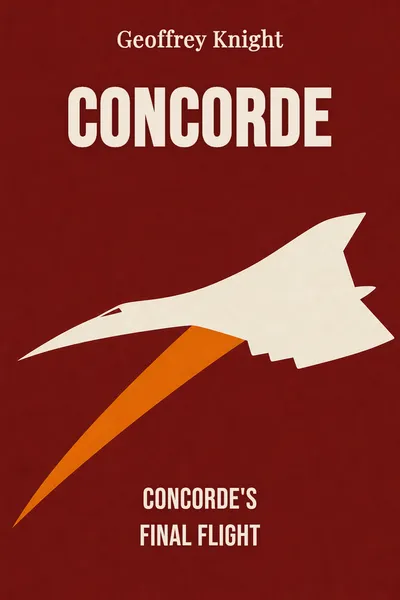
Concorde
Concorde's final flight
Description
On July 25, 2000, an Air France Concorde bound for New York left the runway at Charles de Gaulle with a trail of flame streaming from beneath its left wing. It stayed airborne for barely a minute and a half before coming down on a hotel at Gonesse, a few kilometres from the airport. All 109 people on board died, along with four on the ground. For a machine that had flown for a quarter of a century without a single fatal accident, the images were shattering. Here was the aircraft that had made supersonic travel look effortless, the white delta shape people still pointed at from the ground, going down within sight of the airport it had just left.
For most of the world, that was the story: the beautiful anachronism had finally failed. Within days the fleet was grounded, and the question was no longer whether Concorde would keep flying but whether it would ever fly again. Yet the men who had built and tested the aircraft read the wreckage differently. To them the crash was not proof that Concorde was flawed. It was a chain of small, almost banal misfortunes — a strip of metal on a runway, a burst tyre, a fuel tank in the wrong place at the wrong moment — that happened to line up on a single afternoon.
Geoffrey Knight's book, updated after the disaster, hands the microphone to the people closest to that machine, among them Brian Trubshaw, the British chief test pilot who had coaxed the prototype into the air three decades before. Their account is not a eulogy. It is an argument about what actually brought the aircraft down at Gonesse, and about whether the end that followed was written into the engineering or written by everyone who had to decide what came next.
The question we’re asking : Did Concorde crash because of what it was, or because of what happened to it that afternoon?What we’ll see : How a singular aircraft was built, what unfolded in the ninety seconds over Gonesse, and how the people who knew it best read its ending.
Table of contents
01 Chapter 1 — The machine that shouldn't have existed
Concorde began as a wager that most engineers of the early 1960s thought was reckless. Flying a passenger aircraft at twice the speed of sound meant fighting physics the whole way: the airframe heated up in flight until it stretched by inches, the wing had to work at both crawling take-off speeds and Mach 2, and the fuel had to be pumped around the aircraft to keep it balanced as it accelerated. No single country wanted to shoulder the cost or the risk alone. Britain and France signed a treaty in 1962 to build it together, and the treaty was written so tightly that pulling out later would have cost more than pressing on.
The result was a machine assembled from thousands of solutions to problems nobody had faced before. The slender delta wing, the drooping nose that lowered for the pilots to see the runway, the reheated engines that let it push through the sound barrier — each was an answer that had to be invented rather than borrowed. Two prototypes were built, one in Toulouse and one in Bristol, and the teams flew them in parallel, comparing notes across the Channel as they went. When the French prototype first flew in March 1969, followed weeks later by the British one, the aircraft was already years behind schedule and far over budget.

02 Chapter 2 — One tyre, ninety seconds
The chain that ended at Gonesse started with a small strip of metal. A Continental Airlines DC-10 had taken off from the same runway minutes earlier and shed a titanium wear strip from one of its engines. The piece lay on the tarmac as the Air France Concorde began its take-off run, fully loaded with fuel and passengers for a charter flight to New York. Nobody had seen it, and at that speed nobody could have avoided it.
As the aircraft accelerated past the point where stopping was no longer an option, its left main tyre ran over the strip and burst. A tyre failure by itself is survivable. But a chunk of the disintegrating tyre struck the underside of the wing with enormous force, and the shock ruptured a fuel tank from the inside. Fuel poured out and ignited — investigators disagreed about exactly how, whether from severed wiring or the sheer violence of the impact — and within seconds the aircraft was trailing a sheet of fire longer than itself.
03 Chapter 3 — The pilot who knew the aircraft
Brian Trubshaw had flown Concorde before almost anyone else. As British chief test pilot he had taken the prototype up on its maiden flight in April 1969 and spent years probing the edges of what the aircraft could do — the speeds, the failures, the emergencies rehearsed deliberately so that airline crews would never meet them by surprise. When he looked at the Paris crash, he did so with the eyes of a man who had spent his career deciding what the machine was and was not capable of.
His view, set out in the updated book, was measured rather than defensive. He did not pretend the aircraft was invulnerable. He accepted that the tyre burst and the fuel-tank rupture were a genuine and dangerous weakness, one that could and should be engineered against. But he resisted the leap from that specific failure to the conclusion that Concorde as a whole was unsafe. The aircraft had flown for a generation without a fatal accident, and a single catastrophe built on a freak sequence did not, in his reading, overturn that record.
04 Chapter 4 — What the enquiry could and couldn't settle
The formal enquiry did much of what enquiries are meant to do. It reconstructed the sequence, identified the debris and the burst tyre as the trigger, and led to real modifications: reinforced fuel tanks lined with Kevlar, stronger tyres, changes to the wiring. On the strength of those fixes the aircraft was recertified, and Concorde returned to service in November 2001, a little over a year after the crash. On paper, the problem had been diagnosed and cured.
But an enquiry can settle the cause of a crash without settling the fate of an aircraft, and this is where the book's real argument sits. A machine like Concorde does not fly on engineering alone. It flies on confidence — the willingness of passengers to board, of airlines to keep an expensive specialist in the air, of a public to believe in the white delta shape they had trusted for decades. The crash damaged something that no Kevlar lining could repair, and that damage was not the kind an accident report is built to measure.
05 Conclusion
The aircraft that came down at Gonesse was the same one that had crossed the Atlantic faster than the sun for twenty-four years without a fatal accident. That is the tension the book keeps returning to. The people who built and flew Concorde looked at the wreckage and saw a chain of ordinary misfortunes that had lined up once, could be engineered against, and had been. They were, on the narrow question, proven right: the fixes worked, and Concorde flew again.
Related books