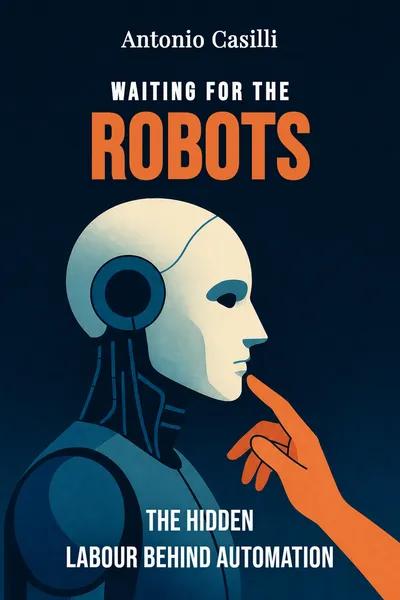
Waiting for the Robots
The hidden labour behind automation
Description
Somewhere right now, a person is looking at a photograph on a screen and drawing a box around a pedestrian so that a self-driving car can one day learn to see. They are paid a few cents for the task. They do thousands of them a day. When the car eventually stops at a crosswalk and the marketing copy calls it artificial intelligence, no one will mention them. They will have vanished into the result — which is, in a sense, the whole point. In his book Waiting for the Robots, the sociologist Antonio Casilli spends several hundred pages tracking down these invisible people, and finds them everywhere automation claims to have arrived.
The promise we keep being sold is clean: machines are learning, labour is disappearing, and soon enough the robots will do the dull work for us. Casilli's argument runs the other way. The more automated a system looks, he says, the more human hands it usually requires — hands that have been pushed offscreen, broken into micro-tasks, scattered across continents, and paid by the piece. The intelligence in artificial intelligence is frequently just people, working cheap and fast, in places the brochure never shows.
That gap between the story and the machinery is where this book lives. It asks us to look again at the things we call automatic — the feed that seems to curate itself, the assistant that seems to understand, the moderation that seems to happen by magic — and to notice the labour quietly keeping them running. Casilli's wager is that once we see it, we can no longer un-see it, and the familiar talk of jobs being destroyed by robots starts to sound like a story told by the people who profit from the arrangement.
The question we’re asking : When a system looks automatic, who is actually doing the work — and why have we been trained not to see them?What we’ll see : How the clean promise of automation rests on a vast, scattered, badly paid human workforce that the technology is built to hide.
Table of contents
01 Chapter 1 — The ghost on the other end of the chatbot
Casilli opens where most of us meet automation: the ordinary interface. We type a question into a support window and a friendly bot answers. We ask a voice assistant to set a timer and it obliges. The experience is designed to feel seamless, as if we were conversing with a system rather than a person. But peel back the interface, he argues, and the seam is full of people. Many "chatbots" quietly hand difficult messages to human agents. Many "smart" assistants were trained, corrected, and are still monitored by workers listening to clips and rating whether the machine got it right.
He borrows a useful image from the eighteenth century: the Mechanical Turk, a chess-playing automaton that toured European courts and beat Benjamin Franklin and, by legend, Napoleon. It was a hoax. A human chess master was folded inside the cabinet, working the arm. Centuries later Amazon named its micro-task platform Amazon Mechanical Turk, with unusual honesty — the system runs on a person hidden in the box. Casilli treats that name as a confession the whole industry made and then forgot.

02 Chapter 2 — Three ways the work gets hidden
Having found the people, Casilli sorts the ways their labour gets concealed. The first he calls on-demand digital labour — the gig work we half-recognise. The driver, the delivery courier, the cleaner summoned by an app. The app presents itself as a neutral piece of software matching supply with demand, which lets the company avoid calling itself an employer. The platform looks like infrastructure; the worker absorbs the risk, the waiting, the wear. Here the work is visible but its status is hidden, reclassified as self-employment so the automation story has someone to point at.
The second is micro-work, and this is where the book bites hardest. These are the tasks too small to call jobs: tagging an image, transcribing a receipt, judging whether a sentence is offensive, confirming that two photos show the same face. Platforms slice a problem into millions of fragments and distribute them to a crowd paid per fragment, often a cent or two each. No single task means anything. Together they train the models that will later be sold as intelligent. The worker never sees the product, the product never credits the worker, and the pay stays below almost any wage floor because, formally, no job was ever offered.
03 Chapter 3 — The global assembly line of clicks
Where are these workers? Casilli went looking, and the geography is the quietly damning part of the book. Micro-work is a planetary operation that follows the familiar contours of economic inequality. Tasks priced in cents flow from the companies of wealthy countries toward places where those cents stretch further and where labour protections are thin or absent. He documents click workers across Venezuela during its economic collapse, across sub-Saharan Africa, across India and Southeast Asia — people for whom tagging images or moderating content became a plausible source of income precisely because the alternatives were worse.
The content moderation story is the hardest to read. Behind every platform that seems to magically keep violence and abuse off your screen sits a workforce watching that violence and abuse, hour after hour, deciding what stays and what goes. Casilli describes people in places like the Philippines and Kenya absorbing the internet's worst material so that the rest of us encounter a feed that feels safe and self-cleaning. The moderation looks automated. It is largely a person with a queue and a quota, carrying a psychological cost the brochure will never list.
04 Chapter 4 — Automation as a promise, not a fact
Step back from the individual worker and a larger claim comes into view, and it is the one that makes Casilli's book more than an exposé. Automation, he argues, is not mainly a technical state of affairs. It is a frame — a way of describing work that reclassifies it as something else. When a company says a task has been automated, what has usually happened is that the task has been made cheaper, more fragmented, and harder to see. The robot is less a machine than a word we use to stop asking who did the work.
This reframing has a purpose, and it serves the people who deploy it. If the intelligence belongs to the system, the value belongs to whoever owns the system. The workers who labelled the data, moderated the content, and corrected the model become a cost to be minimised rather than a labour force with a claim on what they produced. The endlessly repeated fear that robots are coming for our jobs does quiet political work here: it treats automation as an impersonal force of nature, like weather, rather than a set of choices about how to organise and pay human beings.
05 Conclusion
We began with a person drawing a box around a pedestrian, paid in cents, waiting for the next image. Casilli's achievement is to put that person back into the picture we had been trained to see as empty. The seamless chatbot, the clever assistant, the feed that seems to clean itself — each turns out to rest on a scattered workforce doing piecework no one credits, in places the marketing never shows. The automation was always partly a staging, and the stage had people on it the whole time.
Related books