The Black Swan
The rare event is history's hidden engine
Description
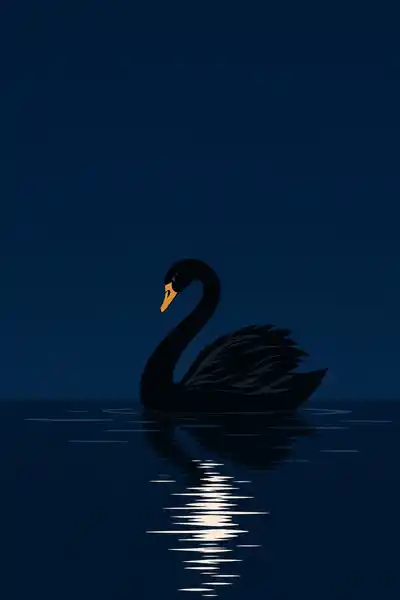
For roughly two thousand years, Europeans were certain that all swans were white. Every swan anyone had ever seen confirmed it. The phrase "a black swan" was even used in Latin to mean something that could not exist, the way we might say "when pigs fly." Then, in the late 1690s, a Dutch expedition led by Willem de Vlamingh reached the west coast of Australia and found a river full of swans that were black. One sighting undid a belief built on millions of confirmations. Three centuries later, a former options trader turned essayist named Nassim Nicholas Taleb borrowed the bird as the title of a book that became, after its publication in 2007, one of the most argued-over works of popular thought of its decade.
Taleb's Black Swan isn't really about birds. It's the name he gives to a particular kind of event: one that lies outside the range of what we expected, that carries enormous consequences, and that we rush to explain as obvious only after it has happened. The fall of the Soviet Union, the rise of the internet, the attacks of September 11th, the financial crash that broke open the year after the book appeared — each landed from outside the model, reshaped the world, and was then narrated as if anyone paying attention should have seen it coming. They never do.
What gives the book its bite is that Taleb isn't content to point at these events. He goes after the machinery we use to convince ourselves they won't happen — the curves, the forecasts, the confident experts, the stories we tell to make a chaotic past feel orderly. His claim is that the rare event isn't an exception to history. It is the engine of history, and we have built our tools of understanding to look the other way.
The question we’re asking : Why do the events that matter most always seem to come from outside everything we predicted?What we’ll see : How the problem of the unseen swan, a doomed Thanksgiving turkey, two imaginary countries, and a strange way of placing bets add up to a case against our whole habit of forecasting.
Table of contents
01 Chapter 1 — The bird that wasn't supposed to exist
Taleb defines a Black Swan by three traits, and all three have to be present. First, it is an outlier — it sits beyond the realm of regular expectations, because nothing in the past convincingly pointed to it. Second, it carries an extreme impact, the kind that bends the course of a life, a market, or a civilization. Third, and this is the part he cares about most, human nature drives us to concoct explanations for it after the fact, making it appear predictable in hindsight even though it was nothing of the sort while it was happening.
The white-swan problem is the philosophical heart of it. You can watch a million white swans and feel your certainty grow with each one, but a single black swan dismantles the whole conclusion. Taleb borrows this from David Hume's old worry about induction and from Karl Popper's insistence that we can never truly confirm a theory, only fail to disprove it. No quantity of confirming evidence proves a general rule; one counterexample is enough to break it. We mistake the accumulation of confirmations for knowledge, when really we have only been lucky enough not to meet the exception yet.

02 Chapter 2 — The turkey and the man who feeds it
To show how confidence betrays us, Taleb tells the story of a turkey. Imagine a bird fed every single day by a kind human. With each feeding, the turkey's belief in the friendliness of humans strengthens, supported by hundreds of data points. Its sense of safety is, statistically speaking, at its absolute peak on the afternoon before Thanksgiving — the very moment before everything it knew turns out to be catastrophically wrong. The turkey's past data didn't just fail to warn it. The data actively misled it, growing more reassuring as the danger grew closer.
The turkey is a warning about anyone who reasons purely from a track record. A trader whose strategy has worked for years, a bank whose models have never broken, a society that has not seen war in a generation — each is collecting confirmations that feel like proof and are really just the absence, so far, of the event that matters. Taleb's point is not that the past is useless. It is that the past is silent about exactly the thing you most need to know, which is the size and timing of the rupture it has never yet contained.
03 Chapter 3 — Why the bell curve lies about the world
The deepest argument in the book is about which mathematics we use to describe reality. Taleb splits the world into two imagined provinces. The first he calls Mediocristan: the domain of things that don't stray far from the average, where no single observation can move the total very much. Human height lives here, along with weight, calorie intake, the outcome of a coin flip. Pile up a thousand people and the tallest among them, however tall, barely shifts the group's average. The second he calls Extremistan: the domain where a single observation can dominate everything — wealth, book sales, casualties in wars, the damage from financial crashes. Let the wealthiest person on earth walk into a room of a thousand random people, and that single arrival swamps the whole sample. In Extremistan the outlier isn't a footnote. It is the story.
The error Taleb hammers at, again and again, is that we keep applying the gentle tools of Mediocristan to the wild terrain of Extremistan. The bell curve — the smooth, symmetrical Gaussian curve named for the mathematician Carl Friedrich Gauss, and the thing Taleb treats as something close to an intellectual fraud when misused — assumes that extreme deviations get so improbable so fast that they can be safely ignored. That assumption holds for height. It is disastrous for finance, where the model says a certain crash should happen once in millions of years, and then it happens twice in a decade. The map quietly declares the most consequential territory off-limits, and the people using the map believe it.
04 Chapter 4 — Living in a world we can't forecast
Picture two stacks of chips on a table. One sits in the safest place imaginable — cash, short-term government bills, things almost nothing can touch. The other is small, and it is parked where a wild bet could pay off enormously, with the loss capped at whatever you put down. This is the barbell, Taleb's practical posture, and it is built on a refusal: we cannot predict Black Swans, so we should stop trying to be right about the future and start making sure the future can't ruin us. Extreme caution on one end, extreme but limited risk on the other, and nothing in the deceptively comfortable middle the turkey would have loved.
The barbell quietly admits you can't know which improbable thing will happen; it just makes sure that when one does, the downside is bounded and the upside is open. And the upside is real, because positive Black Swans exist too — the discovery nobody was looking for, the book that sells against every expectation, the chance encounter that rearranges a life. The same unpredictability that can wipe you out can also hand you something no forecast could have promised. The trick is to stay exposed to the good surprise while staying shielded from the fatal one.
05 Conclusion
The black swans that de Vlamingh's expedition found on that Australian river in the late 1690s had been swimming there the whole time. What changed in an afternoon was not the world but the certainty of everyone who had never gone looking. That is the move Taleb makes across the entire book: he never pretends to predict the improbable. His target is our confidence about its impossibility — a confidence, he argues, that is manufactured by the very tools we trust most.
Related books