Tocqueville on Social Media
A nineteenth-century diagnosis, reapplied
Description
In 1831, a twenty-five-year-old French magistrate named Alexis de Tocqueville landed in Newport, Rhode Island, officially to study American prisons on behalf of his government. He spent nine months criss-crossing the young republic with his friend Gustave de Beaumont, filling notebooks with observations about courts, churches, townships, newspapers, and the strange energy of a society that had no aristocracy and no king. The prison report got written. But the real yield of the trip was a two-volume book, Democracy in America, published in 1835 and 1840, that tried to answer a larger question: what does it do to people when everyone is, in principle, equal?
Tocqueville admired a great deal of what he saw, and he worried about some of it. The worry that has aged most strangely was not about mobs or dictators. It was about something softer and harder to name—the way a society of equals could come to police itself, not with force, but with the sheer weight of shared opinion. He gave it a cold phrase: the tyranny of the majority. He meant a pressure so ambient that it rarely needed to punish anyone, because almost no one was willing to stand against it in the first place.
Nearly two centuries later, we spend our days inside machines built to show us, in real time, what most people think and how they're reacting. It's an odd coincidence of vocabulary and experience—the aristocrat describing a mood that the timeline now manufactures by design. Reading him today feels less like studying a historical document and more like getting a note from someone who saw the weather coming.
The question we’re asking : What did Tocqueville see in a society of equals that reads like a field report on the platforms we scroll today?What we’ll see : We follow a young traveler's unease about public opinion from the townships of the 1830s to the feeds we refresh now.
Table of contents
01 Chapter 1 — A Frenchman takes notes on America
Tocqueville came from the kind of family the French Revolution had nearly erased. His great-grandfather had been guillotined; his parents had come close. He grew up with the sense that the old world of ranks and deference was finished, and that something else was arriving whether anyone liked it or not. America was his laboratory for seeing that something else up close—a country that had started, more or less, from the premise he thought the future would impose everywhere: that no one is born above anyone else.
What struck him first was how thoroughly equality had soaked into everything. Not just laws and institutions, but manners, habits, the way people talked to each other, the way they formed opinions. In an aristocracy, he reasoned, a person inherits a place and, with it, a set of fixed reference points—a class, a tradition, a line of people to defer to and a line to look down on. Strip all that away and you get a society of individuals who are freer than ever and, at the same time, oddly unmoored.

02 Chapter 2 — The quiet pressure to agree
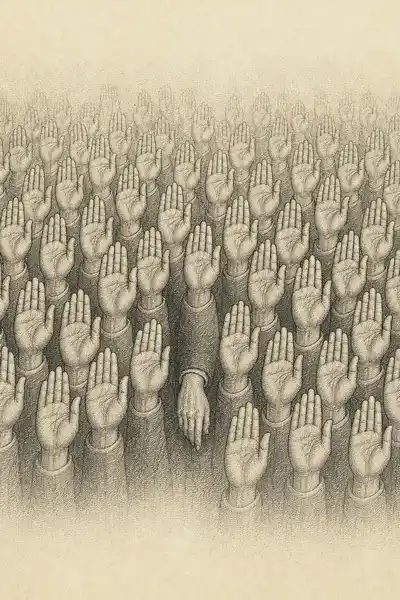
The phrase that carried the most weight was tyranny of the majority, and Tocqueville meant it less literally than it sounds. He wasn't mainly worried about fifty-one percent voting to crush forty-nine, though he noted that danger too. He was worried about something that never reached a ballot: the power of a dominant opinion to make dissent feel not dangerous, exactly, but pointless and lonely. The majority, he wrote, doesn't need to forbid a thought. It only has to surround the person who holds it until speaking up seems like a strange, isolating thing to do.
His description of how this works is unnervingly precise. The majority, he argued, draws a line around what can be said, and inside that line debate is lively and free. Cross it, and you don't get arrested—you get something subtler. People stop arguing with you, because to them the matter is settled. You keep your rights and lose your audience. You're left intact and alone, which in a society that runs on belonging is its own kind of penalty. He thought this was more effective than any censor, precisely because it looked like freedom from the outside.
03 Chapter 3 — The crowd as the only authority left
Now set that description next to an ordinary afternoon on a platform. The entire experience is engineered to do what Tocqueville said equality did to opinion: to put the aggregate verdict of strangers constantly in front of us. Every post arrives wrapped in its own reception—the like count, the ratio of replies, the quote-tweets piling up, the little number that tells us how the crowd has already scored this before we've finished reading it. We're never alone with an idea. We meet it with the majority's reaction already attached.
Tocqueville said the equal individual, having no superior to trust, trusts everyone else instead. The feed makes that reflex literal and instantaneous. We genuinely don't know what to think about most of what scrolls past—a controversy we hadn't heard of, a person we've never met, a claim we can't verify. So we do what he predicted: we glance at how the mass is reacting and let that stand in for a judgment. The engagement metrics aren't decoration. They're the authority the aristocracy used to supply, served up in real time.
04 Chapter 4 — When the many become the rule
Step back from any single feed and the deeper match comes into focus. What Tocqueville feared was never a strongman; it was a condition—a society so saturated with the opinion of the many that the many became the only standard anyone measured by. He thought this was the characteristic danger of equality, the shadow side of a world where no one could claim to know better than anyone else. The platform is that condition, refined and accelerated. It takes the ambient pressure he described and gives it an interface.
The crucial thing is that it keeps his softness. We tend to picture online tyranny as the crude stuff—the ban, the pile-on, the account wiped overnight. Those exist, but they're the loud exception. The everyday version is the one he actually warned about: the withdrawal of agreement, the quiet recalibration of what we'll say, the sense that an opinion has become unspeakable without anyone ever having spoken against it. No authority imposes this. It emerges from all of us reacting to all of us, which is exactly why it can't be appealed.
05 Conclusion
Tocqueville went home in 1832, wrote his two volumes, served briefly in French politics, and died in 1859 at fifty-three, convinced that the age of equality was only beginning and that its hazards were still mostly unexamined. He had no vocabulary for an algorithm and no reason to expect one. What he had was an unusually clear eye for the way a society of equals could come to govern its members through nothing firmer than the pressure of shared opinion—a pressure that punished no one and shaped everyone.
Related books