Breaking the Social Media Prism
Why social media deepens division
Description
In the autumn of 2017, a team led by the Duke sociologist Christopher Bail paid a large group of Democrats and Republicans on Twitter a modest sum to do something that sounds, on paper, entirely reasonable. For a month, the participants would follow a bot that quietly retweeted messages from the other political side — a Republican would see a steady diet of liberal voices, a Democrat a steady diet of conservative ones. The premise was one of the most cherished ideas of the internet age: that we fight online because we live in bubbles, and that if we could just be exposed to the other side, we would soften. Meet the human behind the opposing tweet and the temperature drops.
It did not drop. When Bail and his colleagues measured the participants' attitudes afterward, the Republicans who had spent a month reading liberal messages came out markedly more conservative than they started. The Democrats drifted left too, though less sharply. The intervention everyone assumed would build bridges had, in the aggregate, dug the trench deeper. A result that clean and that counterintuitive is the kind of thing that forces a researcher to rethink the whole model — and that is roughly what Bail did.
His book takes that failed experiment as a starting point rather than a footnote, and asks why the obvious cure made the disease worse. The answer he builds, across surveys, interviews and a small army of bots, is that we have been misdiagnosing the problem — mistaking a feature of the platforms for a fact about human nature.
The question we’re asking : If exposure to the other side is supposed to calm us down, why does it so often do the opposite?What we’ll see : How a sociologist's tools turned a comforting theory about online division inside out, and what he found underneath it.
Table of contents
01 Chapter 1 — The experiment that was supposed to work
The idea Bail set out to test has a respectable pedigree. It descends from the contact hypothesis, the mid-twentieth-century notion that prejudice between groups fades when members of those groups actually spend time together. Transposed to the internet, it became the echo-chamber theory: we grow hostile because algorithms and our own choices wall us off into ideologically pure feeds, and the remedy is a burst of fresh air from the far side of the aisle. It is an appealing story because it is a flattering one. It says the problem is structural and accidental, and that we would all be reasonable if only we saw more.
So Bail's team built the test carefully. They recruited over 1,500 active Twitter users who identified with one party or the other, confirmed they were paying attention, and offered payment to follow a bot for a month. The bots were not subtle propaganda machines; they simply amplified a wide range of elected officials, pundits and organizations from the opposing side, roughly two dozen messages a day. Before and after, participants answered a battery of questions measuring where they stood on immigration, the economy, the environment and the rest of the familiar terrain.

02 Chapter 2 — What the prism actually does
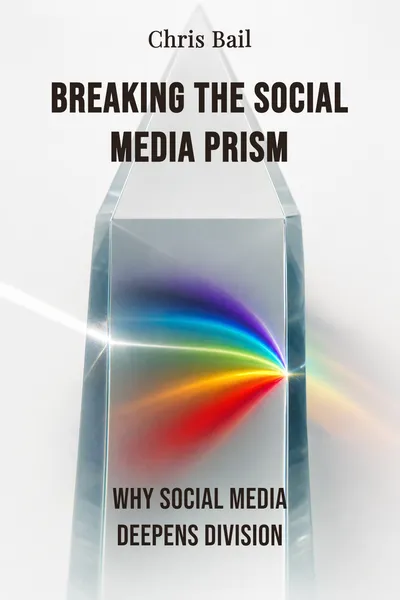
Bail's central image is not the bubble but the prism. A prism takes light and bends it, splitting a clean beam into a distorted spread. Social media, he argues, does the same to our sense of who other people are and who we are in relation to them. We do not log on and see the other side as it actually is. We see it refracted — its loudest, angriest, most extreme voices magnified, its quiet majority rendered invisible. And crucially, we see ourselves reflected back through the same warped glass, which changes how we behave.
The mechanism, in his telling, is identity rather than information. We are not primarily reasoning machines out to update our beliefs; we are social creatures constantly checking our standing, working out who we are by contrast with who we are not. Platforms are exquisitely tuned to this instinct. They hand us instant feedback — likes, retweets, replies — on every performance of self, and they surround us with vivid examples of the opposing tribe at its worst. The result is a hall of mirrors that inflames the very sense of us-versus-them it appears merely to display.
03 Chapter 3 — The moderates who left the room
If the prism magnifies the extremes, it must be doing something to everyone else. Here Bail delivers his quietest and most unsettling finding: the platforms don't just amplify the loud, they actively drive out the reasonable. Political social media, in his data, is dominated by a small minority of intensely committed partisans who post constantly, while the moderate majority mostly watches, says little, and eventually looks away.
The reason is not apathy but incentive. Extremists thrive online because the platform rewards exactly what they do — strong claims, tribal signaling, contempt for the other side generate the engagement that the system feeds on. Moderates get the opposite treatment. When they venture a nuanced take, they are attacked from both flanks, gain little of the affirmation that fuels the extremists, and quickly conclude the whole arena is toxic and beneath them. So they go quiet. Their exit is rational, and it is corrosive, because it hands the microphone to the very people least interested in talking across the divide.
04 Chapter 4 — Rebuilding the room, not the person
The step Bail takes with all this is where the book earns its argument. The dominant public conversation about online toxicity treats it as a problem of individuals — of misinformation to be corrected, of bad actors to be banned, of media literacy to be taught. Fix the people, the thinking goes, and the platform will heal. Bail's evidence points the other way. If moderates flee, extremists flourish, and exposure backfires, then the trouble lives in the architecture, in the incentives baked into how these spaces are built. You cannot lecture your way out of a design problem.
That shifts the burden from users to structures, and it makes the question a practical one: what would a platform look like if it were engineered to reward the behavior we actually want? Bail is not utopian about this. He does not believe we can scrub identity out of political life, nor should we want to — the pull toward tribe is human, not a glitch. The aim is more modest and more achievable: to stop amplifying the worst expressions of that pull and to give the quiet majority a reason to stay in the room.
05 Conclusion
The month-long experiment that opened Bail's inquiry never delivered the reconciliation its designers hoped for. Republicans read liberal messages and grew more conservative; Democrats read conservative ones and drifted the other way. But the failure turned out to be more useful than success would have been, because it exposed the flaw in the cure and, behind it, the flaw in the diagnosis. We were never trapped in bubbles so much as staring into a prism, watching a bent and inflamed version of one another and adjusting ourselves accordingly.
Related books