Descartes' Error
Emotion is required for reason
Description
On a September afternoon in 1848, a twenty-five-year-old railroad foreman named Phineas Gage was packing explosive into a hole in a rock near Cavendish, Vermont. The charge went off early. A tamping iron more than a meter long and about three centimeters thick shot up through his left cheek, behind his left eye, and out the top of his skull, landing dozens of feet away. Gage did not die. Within minutes he was talking. He walked, with a little help, to an oxcart, and sat upright for the ride into town. By most medical expectations of the age, the story should have ended there, as a freak survival. It didn't.
The Gage who recovered was, physically, almost intact. His speech, his memory, his hands, his capacity to calculate and recall facts all came back. What did not come back was the man his friends had known. The reliable, shrewd foreman became profane, erratic, unable to hold a plan or keep a job. The doctor who followed him, John Harlow, put it plainly: Gage was no longer Gage. Something specific had been destroyed, and it was not his intelligence. It was something we rarely think to name — a faculty we assume reason could happily do without.
A century and a half later, a Portuguese-American neurologist named Antonio Damasio sat with living patients whose brains had been damaged in eerily similar ways, and watched the same thing happen in real time. In Descartes' Error, published in 1994, he drew a conclusion that cut against one of the oldest instincts in Western thought. We tend to imagine that feelings are noise, that the mind thinks best when it keeps emotion out of the room. Damasio's patients suggested the opposite, and insistently so.
The question we’re asking : If emotion clouds judgment, why do people who lose their feelings also lose the ability to decide?What we’ll see : How a brain injury in a quarry, and a clinic full of modern patients, overturned the idea that reason works best alone.
Table of contents
01 Chapter 1 — The man with the iron bar through his skull
The Gage case had survived in medical lore mostly as a curiosity — the man who took a steel rod through the head and lived to tell about it. What interested Damasio was not the survival but the aftermath, and the precise question of what the iron had taken away. Harlow's reports described a transformation that nobody at the time had a framework to explain. Gage could still reason about the world. He could speak, count, remember, perceive. His body worked. By every test medicine then possessed, he was recovered. And yet he could no longer run his own life.
The specifics matter, because they are strange. Gage made plans and abandoned them. He was capricious, drifting from one scheme to the next. He became socially inappropriate in a way that embarrassed the people around him, swearing where he never had before, indifferent to the consequences his old self would have weighed. He ended up drifting between odd jobs, at one point exhibiting himself and his tamping iron as a sideshow. The sharp, self-possessed man was gone. What remained was intelligence without judgment.

02 Chapter 2 — The patient who could reason but could not decide
Damasio called him Elliot. He was a successful man, a good husband and father, who developed a brain tumor near the frontal lobes. Surgeons removed it, and in doing so had to remove damaged tissue in the ventromedial prefrontal cortex — the same region the tamping iron had crossed. Elliot came through with his intellect intact. His IQ tested in the superior range. His memory, his language, his perception, his knowledge of the world were all unimpaired. On paper he was fine. In life he was coming apart.
Elliot could no longer manage himself. He would spend an entire afternoon deciding how to sort a set of documents, lost in the question of whether to order them by date or by size or by relevance, unable to settle. He made disastrous choices, invested his savings with a disreputable partner, lost everything, divorced, remarried, divorced again. The man who had once run a household and a career could no longer decide what to do next, not because he lacked the knowledge but because knowledge alone, it turned out, was not enough to decide with.
03 Chapter 3 — What the body knows before the mind
To explain the link, Damasio proposed what he called the somatic marker hypothesis. The word somatic points to the body — soma. His claim was that when we face a choice, we do not coolly tabulate every outcome and sum them up. Long before that, each option triggers a faint bodily signal, a feeling — a flicker of dread, a lift of anticipation, a tightening in the gut. These signals are markers, laid down by past experience, that tag each possible future as good or bad before we have consciously thought it through.
The marker does its work by narrowing the field. Faced with dozens of possible actions, a healthy mind does not evaluate them all; most are quietly eliminated by a negative feeling attached to them, a bodily no that removes them from consideration before rational analysis even begins. What reason then works on is a short, pre-filtered list. Remove the markers and you are left with every option equally live, equally weightless — which is precisely Elliot sorting documents all afternoon, unable to feel that one arrangement matters more than another.
04 Chapter 4 — The split that never held
The title of the book names the target. The error Damasio attributes to Descartes is the sharp cut between mind and body, between a thinking thing and the mere machinery that carries it around. From that seventeenth-century division flows a long habit, still with us, of treating reason as something that would run cleaner if only we could keep the feelings out of it — the cool head, the dispassionate analysis, the decision made without letting emotion get in the way. The clinic says this ideal is not merely hard to reach. Reached fully, it would be a disability.
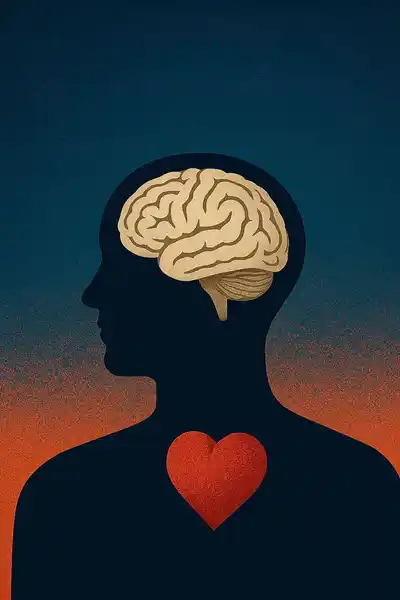
Damasio is not arguing that emotion is always a good guide, or that feeling should overrule thought. A mind flooded by fear or rage decides badly, and he says so. His claim is narrower and more unsettling: that a certain amount of feeling is a precondition for reasoning to reach a conclusion at all. The two systems are not rivals competing for control of the mind. They are a single apparatus, and the prefrontal region where they meet is where a knowing animal becomes a deciding one. Cut the connection and you do not get pure reason. You get Elliot.
05 Conclusion
Phineas Gage lived another dozen years after the iron went through his head. He drifted, worked as a stagecoach driver in Chile for a time, returned to his family in San Francisco, and died in 1860 after a series of seizures. His skull and the tamping iron ended up in a museum at Harvard, where they still sit — an object lesson that took a century and a half, and a clinic full of patients like Elliot, to finally read correctly. What the iron took from him was not his mind. It was the quiet link between what his mind knew and what his body felt about it.
Related books