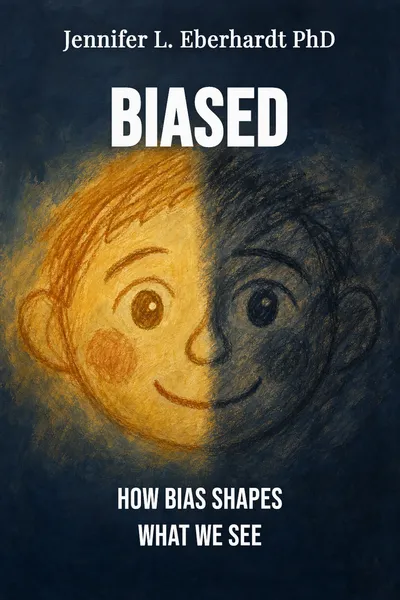
Biased
How bias shapes what we see
Description
On a flight home, Jennifer Eberhardt's five-year-old son looked at a Black man in the cabin and said he hoped the man wouldn't rob the plane. The man looked nothing like a robber. He looked, in fact, a lot like Eberhardt's son. And Eberhardt is a social psychologist at Stanford who has spent her career studying exactly this — the way the mind links Blackness to danger before conscious thought has a chance to weigh in. Her own child, raised by a scholar of bias, had already absorbed the association.
That small moment sits at the center of "Biased," her 2019 book, because it refuses the comfortable story we tell ourselves. Bias is not a flaw belonging to bad people, the villains we can point at and disown. It is a feature of ordinary human cognition, running in the background of good and careful minds, including the minds of people who study it for a living. It shapes who gets pulled over, who gets hired, whose face reads as threatening in a doorway at dusk.
Eberhardt built her argument out of laboratory findings and field data, but also out of scenes — a traffic stop, a classroom, a hiring committee, a neighborhood watch app. The science tells us the mechanism; the stories tell us the stakes. Together they make a case that is harder to wave away than either would be alone, and considerably less flattering to the way we like to think we see.
The question we’re asking : If bias runs beneath awareness in nearly everyone, how does it actually shape what we perceive, decide, and do — and can anything be done about it?What we’ll see : How the mind sorts by category faster than it can reason, and where that sorting turns into consequences no one intended.
Table of contents
01Chapter 1 — A face, a fraction of a second
Eberhardt's early experiments turned on a simple, uncomfortable finding: people associate Black faces with crime so readily that the association runs in both directions. Show subjects a Black face, even subliminally, and they get faster at recognizing degraded images of crime-related objects — a gun, a knife. Prime them with crime words instead, and their attention drifts toward Black faces on a screen. The link is not something people report believing. It is something their eyes and reaction times reveal.
She ran versions of this with police officers, the professionals most likely to act on such perceptions with a weapon in hand. Officers primed with crime-associated words looked longer at Black faces and were more likely to misremember which face they had seen, gravitating toward the more stereotypically Black one. The bias wasn't lodged in stated attitudes. It was lodged in where the eyes went and what the memory kept.

02Chapter 2 — The brain that sorts before it sees
The engine underneath all this is categorization, and Eberhardt is careful not to treat it as a defect. Sorting the world into groups is how cognition manages an overwhelming flood of input. We categorize chairs, dogs, weather, faces. The problem is not that the brain categorizes; the problem is what it has been fed. Bias is category plus content — and the content comes from the world outside the skull, absorbed long before we can consent to it.
This is why the term is "implicit" bias. The associations form through exposure — news coverage that pairs certain faces with certain crimes, neighborhoods sorted by decades of policy, images repeated until they feel like observations. Eberhardt describes how the association between Blackness and criminality has been built and rebuilt across American history, from the imagery of the nineteenth century to the crime reporting of the twentieth. The mind doesn't invent the link. It inherits it.
03Chapter 3 — Where the bias does its damage
The cost of implicit bias is not abstract, and Eberhardt tracks it into the institutions where split-second judgments become permanent records. Policing is the clearest case. Analyzing officer body-camera transcripts from traffic stops in Oakland, her research team found that officers spoke less respectfully to Black drivers than to white drivers — not through slurs, but through subtler markers of formality, warmth, and reassurance — even when comparing stops for the same reasons. The disparity was measurable in the language itself, stop after stop.
Schools carry the same fingerprint. Studies she discusses show teachers responding more harshly to the same minor misbehavior when they believe the student is Black, and reading a second infraction as evidence of a troubling pattern rather than a bad day. The pattern begins early and compounds: a child labeled a discipline problem gets treated as one, and the treatment produces the behavior that confirms the label. Perception hardens into a track.
04Chapter 4 — Bias is not a verdict
Step back from the single biased mind and a different target comes into view. If bias flares under pressure and ambiguity, then the most reliable lever isn't the fantasy of scrubbing every prejudice from every brain — a project Eberhardt treats as neither possible nor the point. The lever is the situation. Redesign the moment in which the biased judgment gets made, and you constrain what the bias can reach, regardless of what any individual privately feels.
Her collaboration with Nextdoor is the neatest illustration. The app had a problem with racial profiling in its "crime and safety" posts. Rather than lecturing users about their attitudes, the company added friction: to report a person as suspicious, you had to describe what they were actually doing, not just what they looked like. That small demand for specifics — behavior instead of appearance — cut racist posts substantially. No one's heart was purified. The path of least resistance was simply rerouted.
05Conclusion
The book returns, in the end, to something like that scene on the airplane. The boy's remark wasn't a confession of hatred; it was a report from a mind that had already been furnished with associations it never chose. That is Eberhardt's most durable point. Bias isn't the property of a guilty few. It is the residue of a shared history running through ordinary perception, hers included, and pretending otherwise only lets it operate undisturbed.
Related books