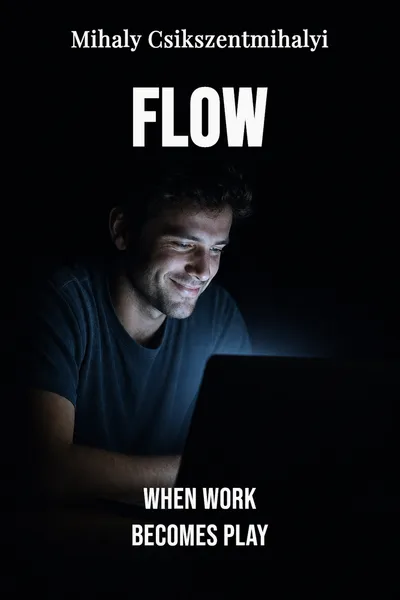
Flow
When work becomes play
Description
In the 1970s, a psychologist at the University of Chicago named Mihaly Csikszentmihalyi started handing people electronic pagers. The devices would buzz at random moments across the day, and each time they did, the person carrying one would stop and write down what they were doing and how they felt. Surgeons, factory workers, rock climbers, chess players, mothers, teenagers — thousands of them, buzzed at their desks and in their kitchens and on mountain faces. Csikszentmihalyi wanted to catch happiness in the act, not remember it afterward. What he found was that the best moments people reported almost never came during rest.
They came during effort. People described their most vivid, absorbing, satisfying moments while doing something difficult and worthwhile — a hard climb, a demanding piece of music, a surgery that went well, a conversation that clicked. The activity was stretching them, and time seemed to fall away. Csikszentmihalyi gave this state a name that stuck: flow. He gathered the research into a 1990 book, Flow: The Psychology of Optimal Experience, which argued that the moments we treasure most are not the ones where we do nothing, but the ones where we are fully used.
That runs against a lot of what we assume about a good day. We tend to picture happiness as a beach, a couch, a screen — the absence of demand. Csikszentmihalyi's data kept pointing the other way. If the finest moments of a life are moments of effort, then the whole business of chasing comfort might be aimed at the wrong target, and the question of how to live well becomes a question about attention, not about leisure.
The question we’re asking : If our best moments come from effort rather than rest, what actually happens inside a mind that is fully absorbed — and can we set it up on purpose?What we’ll see : How a psychologist tracked happiness through a pager, took apart the conditions that produce total absorption, and turned a fleeting state into a claim about how a whole life can be built.
Table of contents
01 Chapter 1 — A surgeon who forgets the room
The people Csikszentmihalyi interviewed kept describing the same thing in different vocabularies. A surgeon spoke of operations so absorbing that he wouldn't notice a chunk of ceiling had fallen onto the floor until the procedure was over. A composer described the music seeming to flow out of him without his willing it. A dancer, a chess master, a rock climber inching up a cliff — all of them reached for the same image, of being carried along by the activity itself. The word that recurred was flow, and it named a state where action and awareness merge, where the self doing the thing seems to dissolve into the thing being done.
What struck Csikszentmihalyi was how ordinary the ingredients were and how consistent the state was across wildly different lives. The rock climber and the surgeon had nothing in common except the quality of their attention in the good moments. Both were doing something hard enough to demand everything they had, with a clear enough sense of what came next that there was no room left for worry, boredom, or the usual background hum of the self monitoring itself. That hum — the running commentary of doubt, self-consciousness, and drift — simply switched off.

02 Chapter 2 — The anatomy of a good moment
Csikszentmihalyi's most useful move was to take flow apart and show that it isn't magic or luck. It has an anatomy, a set of conditions that can be described and, more importantly, arranged. The first is a clear goal. Flow needs to know where it's going. A climber knows the next hold; a musician knows the next bar; a player of a good game knows exactly what winning looks like. When the goal is vague, attention scatters, because the mind has nothing firm to organize itself around.
The second condition is immediate feedback. In flow, the activity tells us right away whether we're doing it well. The note sounds right or wrong; the move works or doesn't; the sentence lands or falls flat. This constant loop of doing and knowing keeps us locked in, because there's no gap in which the mind can wander off to worry about other things. Much of what makes hobbies so absorbing, and much of what makes ordinary jobs so draining, comes down to whether that feedback is quick and clear or slow and murky.
03 Chapter 3 — Why the mind runs on order, not comfort
Behind the practical anatomy sits a stranger, deeper claim about the mind itself. Csikszentmihalyi argued that consciousness has a natural tendency toward disorder, which he called psychic entropy. Left with nothing to focus on, attention drifts toward whatever is unresolved — the argument we lost, the bill we haven't paid, the vague dread of the week ahead. This is why doing nothing so rarely feels restful. An idle mind doesn't fall silent; it fills with noise, and the noise is usually unpleasant.
Flow is the opposite of that drift. When attention is fully committed to a well-structured task, the mind falls into order. There is no spare capacity for the intrusive thoughts, so they don't arrive. Csikszentmihalyi called the counter-state negentropy — order in consciousness — and he made the bold suggestion that this ordering, not pleasure in the usual sense, is what we're really after. We don't enjoy the hard climb because it's comfortable. We enjoy it because, for its duration, our mind is perfectly organized, and that organization feels like relief.
04 Chapter 4 — A life assembled out of good moments
The larger argument of Flow steps beyond any single absorbing hour. Csikszentmihalyi was not really writing a manual for better afternoons; he was making a claim about what a good life is and where it comes from. His answer is uncomfortable in an age that expects wellbeing to be delivered by circumstances — the right salary, the right vacation, the right amount of free time. He argued that the quality of a life is decided instead by how we organize our own consciousness, moment after moment, and that this is largely within our control regardless of what we've been dealt.
The evidence for this ran through his interviews. He kept meeting people in bleak conditions — prisoners, laborers in punishing jobs, people facing serious illness — who had built rich inner lives by finding structure and challenge where none was obvious. And he kept meeting people with every advantage who were bored and adrift. What separated them was not luck but what he called an autotelic personality: the capacity to turn almost any situation into an occasion for engaged, ordered attention, to make the activity its own reward rather than a means to some later payoff.
05 Conclusion
The pagers buzzed thousands of times across those years, and the answer they gathered pointed away from the beach and toward the workbench, the cliff face, the operating table. The best moments of a life, Csikszentmihalyi found, are not the ones we spend waiting for demand to stop. They are the ones where we are stretched to the edge of what we can do, our attention gathered so completely that the anxious background of the self goes quiet, and the activity carries us along.
Related books