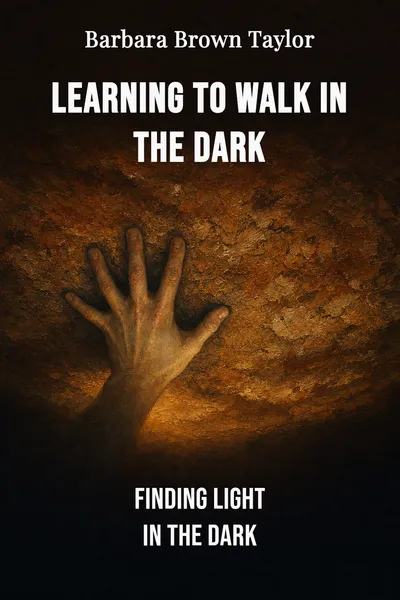
Learning to Walk in the Dark
Finding light in the dark
Description
Barbara Brown Taylor spent years as an Episcopal priest, and for most of that time she preached a religion of light. God was light. Faith was walking toward it. Doubt, fear, grief, the long stretches when nothing seemed to answer — those were the darkness you prayed your way out of. It's a tidy arrangement, and she notices, decades in, that almost nobody actually lives inside it. The nights come anyway. The certainty thins. And the vocabulary she'd been handed had exactly one word for all of it: bad.
So in her 2014 book she does something a member of the clergy is not really supposed to do. She defends the dark. Not as a metaphor she'll quickly redeem, but on its own terms — the literal dark of a cave with the lights switched off, the emotional dark of a marriage or a mood that won't lift, the spiritual dark that the old mystics called by names we've mostly forgotten. Her wager is that we've been running from the wrong thing, and losing something in the running.
What follows is less an argument than a slow reeducation of the senses. Taylor keeps insisting that the parts of life we're taught to fear might be exactly where the interesting things happen — and that a faith built only for daylight is a faith that collapses the first time the sun goes down.
The question we’re asking : What if darkness isn't the absence of faith but one of the places it deepens?What we’ll see : How a priest talks herself, and us, out of a lifelong fear of the dark — and into treating it as a teacher.
Table of contents
01 Chapter 1 — The gospel of full solar spirituality
Taylor gives the mainstream version a name: full solar spirituality. It's the faith that keeps all the lights on. God is good, therefore God is bright; blessing looks like a clear sky and answered prayer; the spiritual life is a matter of accumulating more and more illumination until, presumably, nothing dark is left. It sells well. It fills rooms. And she admits she preached it for years, in part because congregations came looking for it — people arrive at church tired of the dark and wanting to be told the dawn is close.
The trouble is what it does to everyone whose life won't cooperate. If light equals God's favor, then the dark stretches — depression, bereavement, the marriage going quiet, the faith that suddenly feels like talking to the ceiling — have to mean failure. Either you did something wrong, or your belief wasn't strong enough, or God has withdrawn. Solar spirituality, she notices, has no honest place for a bad night. It can only interpret darkness as a problem to be fixed or a sin to be confessed.

02 Chapter 2 — Down into a cave, and what it teaches
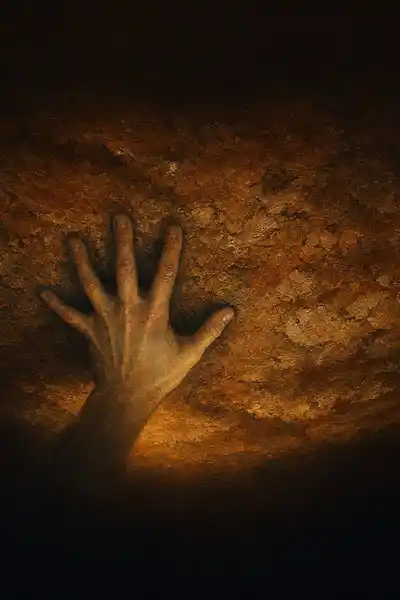
The most vivid stretch of the book is underground. Taylor goes caving, descending into passages where, when the headlamps go off, the dark is total in a way most of us never experience. There's no adjusting to it, no faint grey after a few minutes. It's the absence of light as a physical fact, and her first response is exactly what solar spirituality trained her to feel: a rising animal panic, the body certain that something is wrong.
What she finds, once the panic passes, is that the cave is not empty and not hostile. It's alive with its own logic — blind creatures perfectly at home, water finding its way, formations built over unimaginable spans of time in complete darkness. Nothing down there needed the light she'd assumed all good things required. The dark wasn't the absence of the world. It was a whole world she'd been unequipped to notice because she'd only ever been taught to fear it.
03 Chapter 3 — The long practice of losing the light
From the literal cave, Taylor moves into the darknesses that don't end when you climb out. She reaches back for the old Christian mystics who took this seriously long before she did — above all John of the Cross, the sixteenth-century Spanish friar who gave us the phrase the dark night of the soul. It's a phrase that has drifted, in casual use, into meaning any rough patch. Taylor restores its edge.
For John of the Cross, the dark night was not a punishment or a failure of faith. It was a stage of it. A season in which the familiar comforts of belief go dark — the felt presence of God, the reliable warmth in prayer, the sense that someone is listening — precisely so that a person can learn to love God rather than the comfortable feelings that used to stand in for God. The dark, in this reading, is God's own work, weaning the soul off its need for constant reassurance. What looks like abandonment is closer to being trusted with the silence.
04 Chapter 4 — When faith needs the dark to grow
Step back from the caves and the mystics and a larger claim comes into view. Taylor is really writing about our relationship to certainty. A faith that can only survive in full daylight is a faith that has quietly mistaken its own confidence for God — it needs to feel sure, needs the lights on, needs the answered prayer as proof. The dark threatens it because the dark takes away the proof. And that, she argues, is exactly why the dark is useful: it strips away everything except whatever is real enough to survive without evidence.
This reframes the whole spiritual task. The goal stops being the elimination of doubt and becomes something more durable — a faith that can walk without seeing, that doesn't fall apart the moment the reassuring feelings withdraw. She borrows the image of walking in the dark literally: you go slower, you feel your way, you trust your feet and the ground more than your eyes. It's a humbler kind of movement, and a more honest one, because most of life is in fact lived without knowing what's coming.
05 Conclusion
Taylor never fully makes peace with the dark, and she doesn't pretend to. The book ends not with mastery but with something closer to a truce — a person who has stopped treating nightfall as an enemy and started treating it as weather, a condition of being alive rather than a verdict on how she's living. The priest who once preached the sun has become a guide to the shadows, still a little afraid, walking anyway.
Related books