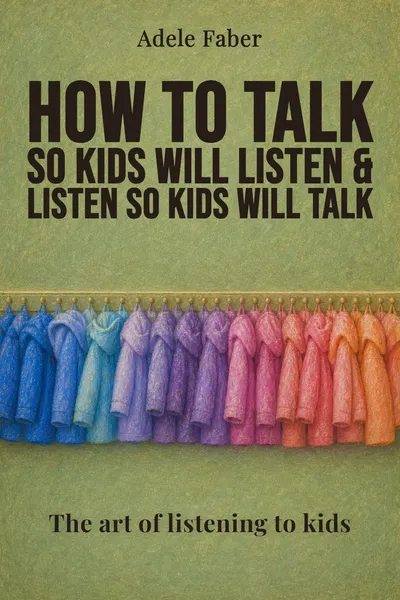
How to Talk So Kids Will Listen & Listen So Kids Will Talk
The art of listening to kids
Description
In the early 1970s, two mothers from Long Island sat in a workshop run by the child psychologist Haim Ginott and heard him say something that reorganized how they spoke to their children. Adele Faber and Elaine Mazlish had come in exhausted, armed with the usual arsenal — the reasoning, the bribing, the threatening, the occasional yelling that every parent recognizes. Ginott's premise was disarmingly simple: a child's feelings are connected to their behavior, and when we deny the feelings, we get the behavior we were trying to avoid. The two women started testing it at home, kept notes, and eventually turned a decade of trial and error into a book.
That book, published in 1980, sold in the millions and never really went out of print. The Boston Globe called it the "parenting bible," which is the kind of phrase that usually kills a book by overselling it. What kept this one alive is that it doesn't traffic in philosophy or theory. It's built almost entirely out of scenes — a kid who won't put on their boots, a teenager who slams a door, a toddler screaming for a cookie before dinner — and it shows, line by line, what to say instead of what most of us say by reflex.
The unusual thing is how little it asks us to change our goals. Faber and Mazlish are not against limits, not against discipline, not selling permissiveness. They are after something narrower and stranger: a way of talking that gets a child to cooperate without the adult having to win. And that turns out to require unlearning most of what feels like good parenting.
The question we’re asking : Why do the sensible, well-meaning things we say to children so often produce exactly the resistance we were trying to prevent?What we’ll see : How a workshop insight became a method for talking to a child as if their inner life were real.
Table of contents
01 Chapter 1 — The words that shut a child down
The book opens with a diagnosis rather than a promise. A child comes home and says the school day was terrible, the teacher was unfair, they hate everyone. Watch what a loving parent does. We reassure — "I'm sure it wasn't that bad." We advise — "Well, maybe if you'd finished your homework." We minimize — "You're just tired." We ask questions like a detective, we defend the teacher, we launch into a story about our own school days. Every one of these responses is well-intentioned. Every one of them, Faber and Mazlish argue, tells the child the same thing: your feeling is wrong, and I'd rather you didn't have it.
The consequence is not a calmer child. It's a child who digs in, who insists harder, who either escalates or goes quiet and stops telling us things. The authors call this the denial of feelings, and they treat it as the single most common mistake decent parents make. It's common precisely because it comes from love — we want the bad feeling gone, so we argue it away. But a feeling that gets argued with doesn't leave. It just loses its audience.

02 Chapter 2 — Feelings first, everything else later
So what does receiving a feeling actually look like? The book's answer is almost embarrassingly concrete. Instead of "you shouldn't feel that way," try naming what the child seems to feel: "That sounds really frustrating." Instead of a barrage of questions, try a sound — "Mmm," "Oh," "I see" — that signals you're listening without hijacking the moment. And instead of explaining why the child can't have the thing they want, try giving it to them in fantasy: "I wish I could make that cookie appear right now. I bet you wish that too."
That last move sounds like a party trick, and parents in the workshops resisted it. But the logic holds. A child screaming for a cookie before dinner doesn't need a nutrition lecture; they need to feel understood. Acknowledging the wish — loudly, generously, without granting it — often does what refusal and reasoning cannot. The child feels heard, and a heard child is far more able to accept a no. The reality doesn't change. The relationship to the reality does.
03 Chapter 3 — The end of the reward-and-punishment reflex
Once feelings are handled, the book turns to the daily machinery of getting things done — the boots, the teeth, the toys on the floor. Here Faber and Mazlish take on the two tools every parent reaches for and quietly dismantle both. Punishment, they argue, doesn't teach a child to behave; it teaches them to resent, to get sneakier, to focus on the punisher rather than on the harm they caused. And it robs the child of the chance to face what they did and make it right, because the debt gets paid in suffering instead of repair.
In place of punishing, they offer a set of alternatives that ask more of the adult and less of the child's fear. Describe the problem: "The milk is spilling." Give information: "Milk turns sour when it's left out." Offer a choice. Say it in a word — "The towel!" — instead of a paragraph of nagging. And when it matters, let the child help solve the problem themselves, which turns a standoff into a shared project. None of these are soft. They're often firmer than a threat, because they hold the child responsible rather than merely scared.
04 Chapter 4 — A grammar of respect that outlives childhood
Read straight through, the book can look like a toolbox — a hundred better sentences for a hundred domestic emergencies. But the tools all point in one direction, and that direction is what makes the work durable. What Faber and Mazlish are really teaching is a stance: treat the child as a full person, with an inner life as real and as worthy of respect as your own. Every specific move — acknowledging a feeling, describing instead of judging, inviting a child to solve the problem — is a downstream consequence of that one commitment.
This is why the method resists being reduced to scripts. A parent who memorizes the lines but keeps the old contempt underneath — the sense that a child is a small irrational creature to be managed — will produce hollow, detectable versions of every technique. Children read tone before they read words. The book works only for adults willing to actually revise their picture of who a child is, and that revision is the hard part, harder than any phrasing.
05 Conclusion
Faber and Mazlish never claimed to have invented anything. They took Haim Ginott's insight — that a child's feelings and behavior are linked, and that acknowledging the first is the way to reach the second — and did the patient work of translating it into sentences an exhausted parent could actually use at 7 a.m. The book endures because it stays at that level, refusing to float up into theory, showing the same kitchen scene done wrong and then done well until the difference becomes instinct.
Related books