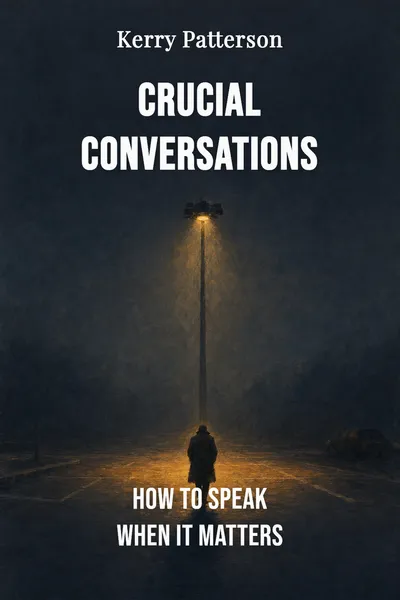
Crucial Conversations
How to speak when it matters
Description
There is a particular kind of conversation we all recognize and most of us dread. The one where a partner asks why we've been distant, and the honest answer sits in our throat while we say "nothing, I'm fine." The one with a boss whose decision we think is wrong, where we nod along and complain later in the parking lot. The one with a friend who owes us money, or a colleague who keeps missing deadlines, or a parent whose comment landed harder than they meant. Kerry Patterson and his co-authors gave these moments a name in their 2002 book: crucial conversations.
Their definition is precise. A conversation turns crucial when three things line up at once — opinions differ, stakes are high, and emotions run strong. Any one alone is manageable. Together they hijack us. The authors, who spent years studying people they called "opinion leaders" — the ones others instinctively trust to handle tension — noticed something odd. These moments matter enormously, they shape marriages and careers and companies, and yet they are exactly the moments we handle worst. We go silent, or we go sharp. We rehearse and avoid, then blurt it out badly.
What the book proposes is that this is not a fixed personality trait. Handling hard talk well is a set of skills, learnable, describable, and testable against the people who already do it. Not smoother rhetoric, not winning the argument — something closer to keeping a conversation open long enough for the truth to get said and heard.
The question we’re asking : Why do the conversations that matter most tend to go worst, and what do the people who handle them well actually do differently?What we’ll see : A tour through what makes a conversation crucial, the inner move that comes before any technique, and the fragile conditions that let honesty survive contact with other people.
Table of contents
01 Chapter 1 — The talks we avoid the most
Patterson's starting observation is uncomfortable: the stakes and our competence run in opposite directions. The higher a conversation matters, the worse we tend to perform. A casual chat about the weather goes fine. A talk about whether one of us should quit our job, or why the same fight keeps recurring, is where we fall apart — going quiet, deflecting, or escalating into something we regret by evening.
The reason is largely physical. When a conversation feels threatening, the body treats it like danger. Blood moves to the large muscles that handle fight or flight and away from the parts of the brain that handle reasoning and nuance. We are, in a real sense, dumber in exactly the moments we most need to be sharp. This is why we so often think of the perfect thing to say an hour after the conversation ended — the moment we were in it, that part of us was offline.

02 Chapter 2 — Start with the heart, watch for safety
The first move happens before you open your mouth. The authors call it "starting with the heart," which sounds softer than it is. The point is to get honest about your own motives. In the heat of a hard talk, our real goal quietly shifts — we start out wanting to solve a problem and end up wanting to win, to be right, to punish, or simply to look good and avoid looking foolish. Once that swap happens, everything we say gets bent toward the wrong target.
The corrective is a blunt question: what do I actually want here? For myself, for the other person, for the relationship? Asking it interrupts the drift. The authors are fond of refusing what they call the "fool's choice" — the belief that we have to pick between being honest and keeping the peace, between telling the truth and keeping the relationship. Most crucial conversations are lost the moment we accept that we can only have one. The skill is holding out for both.
03 Chapter 3 — How to say the hard thing without a fight
Once safety exists, the book gets practical about the words. Two conditions restore a conversation that's tipped over. The first is mutual purpose — the other person needs to believe you're working toward a goal you both share, not steamrolling them toward yours. The second is mutual respect — they need to feel you see them as an equal worth talking to. Lose either and the dialogue shuts. Often a short, sincere apology or a clarification of intent is enough to bring both back.
For that, the authors offer a tool they call contrasting: a two-part statement that clears up a misread. First you name what you don't mean — "I'm not saying this project was a failure, or that you didn't work hard" — then what you do mean — "I do think we need to change how we plan the next one." Contrasting doesn't water down the message; it protects it from being heard as an attack it was never meant to be.
04 Chapter 4 — When a room decides what can be said
Read as a self-help book, Crucial Conversations is a manual of personal technique. But the more interesting claim underneath is that honesty is not really an individual property at all — it's a condition of the space between people. What determines whether the truth gets said in a room is rarely the courage or eloquence of one person. It's whether the room is safe enough for the truth to survive being said.
This is why the authors keep widening the frame from the couple to the team to the whole organization. They point to research in aviation and medicine, where the failure to speak up — a co-pilot who senses the captain is making a fatal error and stays quiet, a nurse who suspects a wrong dose and defers to the surgeon — has cost lives. The problem in those cases was almost never ignorance. Someone in the room knew. What was missing was a set of conditions that made it safe to say so. Silence, at that scale, is measured in bodies.
05 Conclusion
The book returns, again and again, to the same small hinge: the moment a conversation turns from a problem being solved to a person being defended. Everything the authors teach is designed to keep that hinge from turning — to notice our own drifting motives, to watch for the first drop in safety, to lead with facts instead of accusations, to stay curious when everything in the body wants to be certain. None of it is complicated. All of it is hard, because it asks us to stay reasonable at precisely the moments the body has decided to stop being reasonable.
Related books