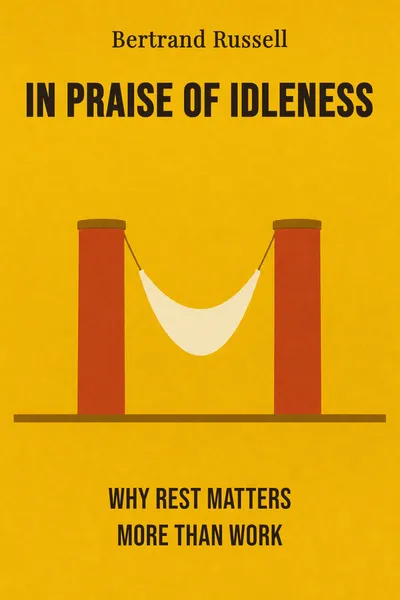
In Praise of Idleness
Why rest matters more than work
Description
In 1932, at the bottom of the Great Depression, with unemployment lines stretching across Britain and the United States and every serious person insisting the world needed more work, Bertrand Russell argued the opposite. His essay, first published that year and reprinted in the 1935 collection that took its name, opened with a confession that sounds almost mischievous from one of the century's most productive minds: he had been raised to believe idleness was a sin, and had come to think that belief had done enormous harm. He meant it. Russell was sixty, a mathematician, a philosopher who had co-written the foundations of modern logic and would later win the Nobel Prize in Literature — hardly a layabout making excuses.
The timing was the whole point. Machines were doing more of the world's labor than ever, yet the moral instinct of the age was to squeeze longer hours out of fewer people while others starved for lack of any hours at all. Russell looked at that arrangement and saw something absurd: a society sitting on a mountain of productive capacity, choosing to distribute it as scarcity. If the pins the world needed could be made in half the time, the sane response was not to make twice as many pins nobody wanted, nor to lay off half the pin-makers. It was to let everyone work less.
What makes the essay endure is that it never reads as a lazy man's manifesto. Russell had a case — moral, economic, historical — and he built it with the same care he gave to logic. The love of work, he suspected, was not a virtue we discovered but a doctrine we were taught, for reasons that had little to do with our happiness. Pull that thread, and much of what we assume about a well-spent life starts to unravel.
The question we’re asking : Why did a serious philosopher, in the middle of a depression, argue that the world needed less work rather than more — and what did he think we should do with the time?What we’ll see : How Russell traces the worship of work to its roots, weighs the arithmetic of a shorter day, and defends leisure as the thing civilization was for in the first place.
Table of contents
01 Chapter 1 — The gospel of work, and who wrote it
Russell begins by picking apart a belief so widespread that we rarely notice it as a belief at all: that work is virtuous and idleness is shameful. He calls it the gospel of work, and his first move is to ask who benefits from it. His answer is uncomfortable. Throughout history, he argues, most people worked hard so that a small minority could be idle, and that minority — the ones who never lifted anything heavier than a pen — spent considerable effort persuading everyone else that labor was noble. The morality of work, in other words, was largely written by people who did none.
He splits work into two kinds, and the distinction is sharp enough to sting. The first is altering the position of matter at or near the earth's surface — the actual physical stuff. The second is telling other people to do so. The second kind is pleasant, well paid, and capable of expanding without limit, since it also includes advising on what orders should be given. It is a joke he makes with a straight face, and the joke has teeth: the closer you sit to the source of the moralizing about hard work, the less of the hard work you tend to do.

02 Chapter 2 — Four hours, and what they would buy
The heart of Russell's argument is a piece of arithmetic he refuses to let anyone dodge. Modern technique, he writes, has made it possible to reduce the labor needed to secure the necessities of life for everyone. He offers a wartime illustration: during the First World War, vast numbers of men were withdrawn from productive work into the armed forces and munitions, yet the general physical well-being of unskilled wage-earners on the Allied side was higher than before or since. The lesson is blunt: a modern economy could keep everyone fed and housed on a fraction of its normal working effort. Science could have maintained that in peace. Instead, the old habit reasserted itself — work long, or don't work at all.
From this he arrives at the number the essay is remembered for. If work were rationally organized and the fruits fairly shared, four hours a day would be enough to entitle everyone to the necessities and elementary comforts of life. Not four hours for some and sixteen for others — four for everyone, with the rest of the day their own. The technology already existed in 1932. What stood in the way was not capacity but distribution, and behind the distribution, the moral conviction that leisure is a reward for the few rather than a right for the many.
03 Chapter 3 — Leisure was always the point
Having made the economic case, Russell turns to the harder question: supposing we had the free time, what would it be good for? Here he becomes, unexpectedly, a historian. Leisure, he argues, has always been essential to civilization — but until now it belonged to a privileged class whose freedom rested on the toil of everyone else. That class produced almost everything we call culture: the books, the sciences, the arts, the very idea of a mind at play with problems for their own sake. The leisured few, whatever their injustices, kept alive the things that made human life worth more than subsistence.
The injustice was that the leisure came at the expense of the many, who got none of it. Russell's proposal is not to abolish leisure as tainted by that history but to democratize it. Modern technique makes it possible to distribute the free time that once belonged only to the aristocrat, without injustice to anyone. To refuse that possibility on the grounds that idleness is bad for the common man is, in his view, a piece of hypocrisy that would be comic if it were not so costly.
04 Chapter 4 — The uses of a life not spent producing
Step back from the four-hour day and Russell's essay is really about a choice every technological society keeps making, usually without noticing. When machines take over a share of human labor, the gains have to go somewhere — into producing more goods, into concentrating wealth, or into giving people back their time. Russell's insistence is that this is a decision, not a law of nature, and that a civilization reveals what it truly values by which option it reflexively picks. His own age picked more production and more unemployment, and he thought that revealed something bleak about who was allowed to decide.
The unsettling part is how little the arithmetic has changed and how completely the outcome has been confirmed. Productivity has climbed many times over since 1935. The four-hour day did not arrive. The gains flowed largely into more output and fewer hands, exactly as Russell feared, while the moral instinct he diagnosed — that a person without a job is a person without worth — has if anything hardened. His essay reads less like a period piece than like a prediction that was quietly ignored.
05 Conclusion
Russell wrote his essay in a decade that seemed to prove him wrong at every turn — depression, rearmament, then a second world war demanding exactly the total mobilization he had questioned. And yet the argument outlived the moment. The Nobel committee honored him in 1950 for writings that championed humanity and freedom of thought, and In Praise of Idleness belongs squarely in that vein: a defense of the ordinary person's right to a life that is more than labor. The confession he opened with — raised to think idleness a sin, come to see the harm in it — turned out to be the seed of a serious moral position, not a witticism.
Related books