
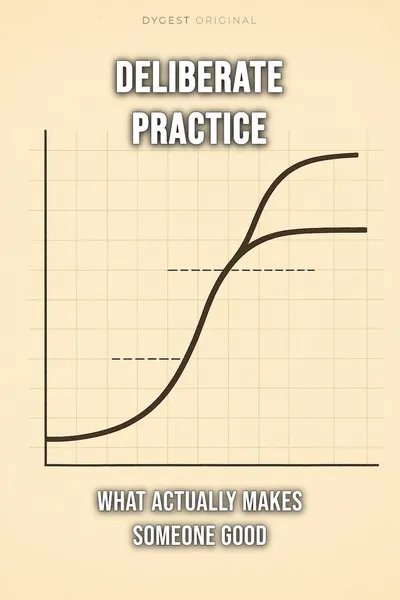
Deliberate practice
What actually makes someone good
Description
The question of why some people become genuinely excellent at something, while others plateau at a comfortable mediocrity despite similar time on the same activity, is one of the older puzzles in psychology. The folk answer is talent some people are naturally gifted, some are not, and the distinction is roughly fixed at birth. This answer is not obviously wrong, but it has never been very useful. It does not account for why talented children sometimes fail to develop their gifts, or why adults with no apparent prodigy markers occasionally reach the top of difficult fields in middle age. The talent story explains outliers. It does not explain the development of expertise.
A different answer emerged, slowly, from the research of a Swedish-American psychologist named Anders Ericsson, who spent forty years studying what actually distinguishes experts from non-experts across dozens of domains. His conclusion reached across studies of musicians, chess players, surgeons, athletes, and memory performers was that the thing that separated the genuinely excellent from the merely good was not talent, not intelligence, and not time spent on the activity. It was a specific kind of effortful, structured practice that most people, most of the time, are not doing.
This kind of practice has a name in the research literature: deliberate practice. It is harder, less pleasant, and considerably less common than the time-spent framing suggests. It is also the single best predictor of expert-level performance the science of expertise has produced in fifty years. The Gladwell popularization the 10,000-hour rule that entered the culture through Outliers in 2008 captured some of this but simplified it into a shape Ericsson himself spent the rest of his life trying to correct. Understanding what deliberate practice actually is has been obscured by the self-help translation.
The question we're asking: what explains the gap between people who plateau and people who keep improving?
What we'll see: Ericsson's violinists, the definition of deliberate practice, the Gladwell misread, and what the science actually supports.
Table of contents
01The violinists at Berlin
The foundational study was published in 1993. Ericsson and his colleagues went to the Berlin University of the Arts and sorted its violin students into three groups: the best performers, the middling performers, and those heading toward teaching careers rather than solo performance. All three groups had been practicing since childhood. All were enrolled in the same conservatory, studying with the same faculty, using the same instruments. The external markers that would typically be invoked to explain differences socioeconomic background, age of starting, access to teachers were roughly controlled by the sampling.
What differed was how the students had spent their practice time over the years. The best performers had accumulated, by age twenty, roughly ten thousand hours of solitary deliberate practice. The middling performers had accumulated about seventy-five hundred. The future teachers had accumulated about five thousand. The ten-thousand number that would later become culturally famous came from this study. But the more important finding was the one Gladwell underweighted: the difference was not just in quantity. The best performers reported that the practice they were doing was qualitatively different. It was harder, more focused, and specifically targeted at the aspects of performance they were worst at.

02The Gladwell misread
Malcolm Gladwell's Outliers, published in 2008, took Ericsson's research and turned it into a book-length argument that expert performance is fundamentally a matter of opportunity and accumulated hours rather than talent. Gladwell wrote well, sold millions of copies, and popularized the ten-thousand-hour figure in a form that was memorable but substantially misleading. Ericsson's research did not claim that ten thousand hours of any kind of practice produces expert performance. It claimed that expert performers had, in specific structured deliberate practice, accumulated roughly that amount. The distinction collapsed in the translation.
The practical consequence of the misread was that millions of readers concluded that if they simply spent enough time on an activity, they would become excellent at it. This is not true, and Ericsson spent the remaining years of his career pushing back against the popularization of his own work. His 2016 book Peak, co-authored with Robert Pool, is in large part a corrective: an explicit statement that time-on-task does not produce expertise, that the structure and intensity of practice matter more than raw hours, and that the 10,000-hour figure was an average across one specific elite sample rather than a universal law.
03What deliberate practice requires
The operational definition of deliberate practice, drawn directly from Ericsson's work, has five components. There must be a specific goal for the practice session that targets an aspect of current performance that needs improvement. There must be full concentration on the task practice done while watching television or socializing almost always fails to meet the standard. There must be immediate feedback that identifies the gap between current performance and the goal. The practitioner must be willing to rework the task based on the feedback, not just repeat it. And the practice must take place in a domain with established methods of improvement a body of accumulated technique that a teacher or coach can transmit.
The last condition matters more than the self-help popularization acknowledges. Ericsson was careful to note that deliberate practice is most effective in what he called well-developed domains: chess, classical music, competitive sports, specific surgical specialties. These are fields where the methods of improvement have been refined over generations, where clear performance metrics exist, and where the path from novice to expert is well mapped. Fields like business management, creative writing, entrepreneurship, and most knowledge work do not meet these criteria. The practice methods are less well established. The feedback is slow and noisy. The deliberate-practice framework applies at best partially.
04The qualifications
Three qualifications have become important since the initial research. The first is that genetic and early-developmental factors matter more than the pure deliberate-practice model suggested. Twin studies in sports, music, and chess have shown that initial aptitude is heritable, that the responsiveness to training itself varies across individuals, and that the same practice regime produces different results in different people. Practice is necessary. It is not sufficient. Ericsson resisted this conclusion more strongly than the evidence justified.
The second qualification concerns age. Deliberate practice in the classical sense depends on a fully engaged neurological substrate, and the developmental window during which skills can be acquired at elite levels appears to be genuinely constrained in some domains. Musicians who begin after age fifteen rarely reach the top tier. Chess grandmasters almost universally start young. Adult-onset learning can produce high competence. It rarely produces the very top. This is not a moral claim about adult learners. It is an empirical observation about what the data show.
05Conclusion
The reason deliberate practice remains worth understanding, even after the Gladwell popularization has been partially discredited, is that it reframes the question of personal improvement in a way the folk theory cannot. If you believe expertise is mostly talent, you will not invest effort in systematic skill development, because effort seems wasted against a fixed ceiling. If you believe expertise is mostly hours, you will invest effort but invest it badly, because you will treat time-on-task as the operative variable. If you believe expertise is mostly deliberate practice, you will invest effort specifically in the structure of the practice, the feedback loop, the targeted weakness and you will improve faster than you would under either of the other framings.