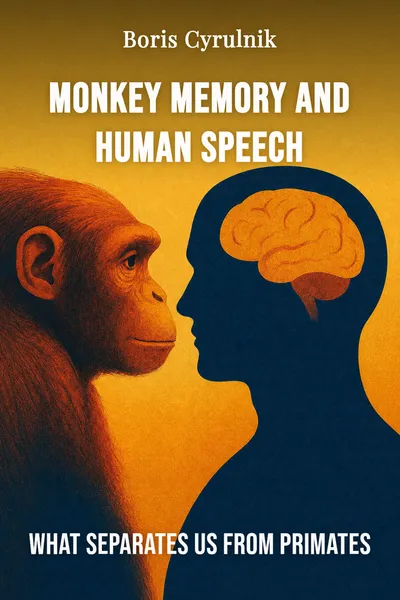
Monkey Memory and Human Speech
What separates us from primates
Description
Boris Cyrulnik spent years watching primates before he ever treated a traumatized child, and the two careers were never as far apart as they look. A neuropsychiatrist who grew up hidden from the Nazis and later rebuilt French thinking about resilience, he kept returning to one stubborn scene: a monkey that remembers, that fears, that mourns, that recognizes a face after months — and yet never tells a single story about any of it. In "Monkey Memory and Human Speech," he sits inside that gap. He refuses the easy flattery that would make us unique by making apes dumb, and he refuses the fashionable move that would dissolve the difference entirely.
The book is built on a quiet provocation. Almost everything we like to claim for ourselves — memory, attachment, emotion, a sense of the other, even rudimentary signs — turns out to exist, in some form, on the primate side of the line. Cyrulnik piles up the evidence patiently, the way a clinician builds a case. A monkey can hold a grudge, protect an infant, read a glance. So the question stops being whether animals think, and becomes something sharper: what exactly do we do with a world that other primates also seem to inhabit?
His answer runs through a single faculty, and he takes his time getting there. Rather than crown us with intelligence or tools, he asks what happens to a creature the moment it can speak of what is not in front of it — the dead, the future, the absent, the possible. That is where he locates the fault line, and it reshapes everything on both sides of it.
The question we’re asking : If primates already remember, feel and recognize, what is actually left that belongs to us alone?What we’ll see : How a psychiatrist who watched monkeys traces the human apart from the ape — and finds the dividing line in an unexpected place.
Table of contents
01 Chapter 1 — The ape that remembers everything but says nothing
Cyrulnik opens where our sense of superiority usually starts to leak: memory. We imagine that remembering is a human achievement, the thing that lets us carry a biography around. But the primates he describes remember with a precision that unsettles that story. A macaque recognizes the keeper who hurt it years earlier. A chimpanzee recalls who shared food and who stole it, and adjusts its alliances accordingly. This is not a vague animal instinct; it is a living archive of faces, debts and dangers, updated constantly and acted upon.
What strikes him most is the emotional weight of that memory. The monkey does not merely store information, it is moved by it. Separation produces something that looks a great deal like grief — withdrawal, loss of appetite, a body that slows down as if the world had gone grey. An infant torn from its mother carries the mark for life, altering how it later parents its own young. Cyrulnik, who had already seen the same scars in human children, found the parallel impossible to wave away.

02 Chapter 2 — The primate under the human skin
Having granted the ape so much, Cyrulnik turns the mirror around. The traits we flatter ourselves with run, in the other direction, straight down into us. We are not a clean break from the primate line; we are a primate that kept most of its equipment and added something. The newborn human arrives helpless, wired to seek a face, to cling, to be soothed by a body — the same attachment machinery that drives a baby monkey toward its mother's fur. Before a single word is possible, the human infant already lives inside a pre-verbal world of warmth, rhythm and emotional exchange.
That inheritance never leaves us. As a clinician, Cyrulnik watched the archaic layer surface constantly: in the way panic bypasses reasoning, in the way a familiar smell or tone can calm a frightened adult faster than any argument. Much of what governs us — fear, bonding, the pull toward the group, the body's response to loss — operates below language, on circuitry we share with our cousins. The human is not a mind riding on top of an animal. The animal is still here, doing most of the work most of the time.
03 Chapter 3 — When the word arrives, the world splits in two
The decisive faculty, for Cyrulnik, is not language as mere signaling — apes signal all the time, with calls, gestures and expressions. It is the capacity to represent what is not present: the dead, the far away, tomorrow, the thing that might have happened and didn't. An alarm call says danger, here, now. A sentence can say the leopard that killed my brother last winter. The first is tied to the moment; the second lifts the speaker out of it entirely. That lift, he argues, is the human event.
Once a creature can name absence, its whole relationship to time changes. The monkey's grief is real but trapped in the present body. The human, by contrast, can mourn someone for decades, speak to the missing, imagine a future that does not yet exist and act to bring it about. Memory stops being a private ache and becomes a story that can be told, corrected, inherited. A past that can be spoken is a past that can be shared — and a shared past is the raw material of culture, history and the long human project of handing things down.
04 Chapter 4 — The animal that lives in sentences
Step back from the clinic and the primate enclosure, and Cyrulnik's point widens. Language is not a tool the human picks up and sets down, the way an ape picks up a stick to fish for termites. It reorganizes the creature that wields it. A being that can name the absent starts to live surrounded by absences — ancestors, gods, nations, promises, regrets — none of which can be pointed at, all of which shape conduct as powerfully as any present danger. The human becomes an animal that spends much of its existence attending to things that are not there.
This reframes what otherwise look like scattered human peculiarities. Why do we grieve so long, plan so far, lie, hope, feel guilt over acts no one witnessed, build institutions meant to outlast our bodies? All of it follows from the same capacity: the absent has become as real to us as the present, sometimes more so. The monkey lives in a world of things. The human lives in a world doubled by words, where the invisible carries decisive weight. Cyrulnik's primates throw this into relief precisely because they have everything we have except that doubling.
05 Conclusion
Cyrulnik ends roughly where he began, with the monkey that remembers and stays silent. Nothing in the book diminishes that animal — if anything, it emerges larger than we usually allow, capable of memory, attachment, mourning and a real inner life. The difference he lands on is not a hierarchy of worth but a hinge. On one side, a creature fully present to its world. On the other, a primate that kept all of that and gained the power to speak of what the world no longer holds, or never held, or might one day hold.
Related books