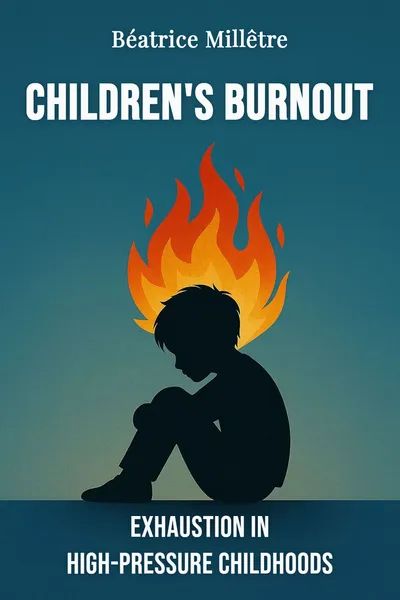
Children's Burnout
Exhaustion in high-pressure childhoods
Description
Burnout used to be an adult word. It belonged to the office, the open-plan floor, the manager who worked seventy-hour weeks until something gave way. For decades the clinical picture stayed there: exhaustion, cynicism, a collapse of performance in people who had pushed themselves past a line they couldn't see. Children were, by definition, supposed to be on the other side of that line. Play, rest, the slow unhurried business of growing up. That was the deal. Béatrice Millêtre, a cognitivist psychologist who has spent years in consultation with young patients, kept running into something that didn't fit the deal — kids who arrived in her office with the exact shape of that adult collapse.
Not a passing mood, not a bad week. Eight-year-olds who no longer wanted to get out of bed. Ten-year-olds with stomachaches every school morning that dissolved by Saturday. Teenagers who had stopped caring about things they used to love, who described a flatness they had no words for. The symptoms lined up, uncomfortably, with the ones adults report when they burn out: depletion that sleep doesn't fix, a creeping detachment, a sense of running hard and getting nowhere. The difference was the age on the file.
So Millêtre set out to name it, because a thing without a name tends to get read as laziness, fragility, or a phase. Her wager is that we've built a childhood that can exhaust the children living inside it — and that we keep misreading the evidence because we're not looking for it in someone so young.
The question we’re asking : Can a child actually burn out — and if so, how would we even recognize it?What we’ll see : How a word borrowed from the adult workplace describes something real in young lives, and where the weight that produces it is quietly coming from.
Table of contents
01 Chapter 1 — A word that wasn't supposed to apply to them
The resistance to the term is understandable. Burnout was defined in the 1970s around the working adult — the committed professional who gives until there's nothing left. To transfer it onto a seven-year-old sounds, at first, like inflation of language, the kind of thing that empties serious words of meaning. Millêtre is careful here. She isn't claiming every tired, grumpy child is in crisis. She's describing a specific state she sees often enough that it needs a name: a durable, deepening exhaustion that ordinary rest no longer repairs.
What makes the comparison hold is the mechanism, not the metaphor. Adult burnout grows out of a chronic mismatch between demand and resource — too much asked, too little given back, over too long a stretch, with no real say in it. A child's life can carry exactly that structure. The demands are academic, social, and emotional; the resources are a nervous system still under construction and a day with almost no slack in it. When the gap stays open month after month, something in the child starts to shut down to protect itself.

02 Chapter 2 — The signs we read as something else
The hardest part of children's burnout is that nearly every symptom has an innocent explanation ready to hand. A child who won't get up is lazy. A child with a Monday stomachache is anxious about a test, or faking. A child who has lost interest in the piano is just going through a phase, or never really liked it. Each reading is plausible on its own. Millêtre's argument is that when several of them cluster in the same child, over weeks, the innocent explanations start to look like a pattern we'd rather not name.
The body usually speaks first. Recurring headaches and stomachaches that have no medical cause but real intensity, sleep that breaks up or refuses to come, appetite that swings — these are the body carrying a load the child can't put into words. Tellingly, the aches often track the calendar. They swell on school days and fade over the weekend, then return on Sunday evening. A symptom that respects the timetable so precisely is telling us where the pressure lives.
03 Chapter 3 — Where the pressure actually comes from
Once the signs are named, the question becomes what's generating them, and here Millêtre resists the easy villain. It isn't usually one cruel teacher or one pushy parent. It's an accumulation — a day so densely packed that there is no air left in it. School, then homework, then the scheduled activity, then the second activity, then screens that stimulate rather than rest. Each piece looks reasonable. Stacked together, with no genuine idleness between them, they leave a developing brain permanently on.
Underneath the schedule sits something subtler: the sense of being continuously assessed. A child today lives inside a near-constant stream of evaluation — grades, rankings, comparisons with siblings and classmates, the felt expectation to perform well across every domain at once. Academic, athletic, social, artistic. The message, rarely spoken but clearly received, is that one's worth is tied to results. For a child who has internalized it, the pressure doesn't switch off when the school day ends. It follows them home and into bed.
04 Chapter 4 — A childhood scheduled like a career
Step back from the individual exhausted child and a larger shape appears: we have organized childhood on the model of a career. The vocabulary gives it away — we speak of a child's "schedule," their "performance," their "results," their need to build a strong "profile." Logics that belong to adult professional life, with its reviews and metrics and competition, have drifted downward into lives that were supposed to be exempt from them. Millêtre's claim that children can burn out is, read this way, less surprising than it first sounds. We gave them the conditions. The syndrome followed.
School is the engine of this model, and not because teachers are harsh. It's because school is the institution through which the culture's demand for early, measurable, comparative performance reaches the child most directly. The timetable that the symptoms track, the grades that supply the running assessment, the ranking against peers — these are the machinery of childhood-as-career. When a child's stomachache clears the moment school is out of view, it is naming the engine precisely.
05 Conclusion
Millêtre began with children who looked, impossibly, like burned-out adults — the depletion, the detachment, the slipping grades in kids far too young for any of it. Giving that picture a name was the whole move, because the name decides what we see. Called laziness or a phase, it stays the child's fault. Called burnout, it becomes a question about the life the child is living and the adults who built it. The stomachache that lifts on Saturday and returns on Sunday evening isn't a mystery once we agree to read it.
Related books