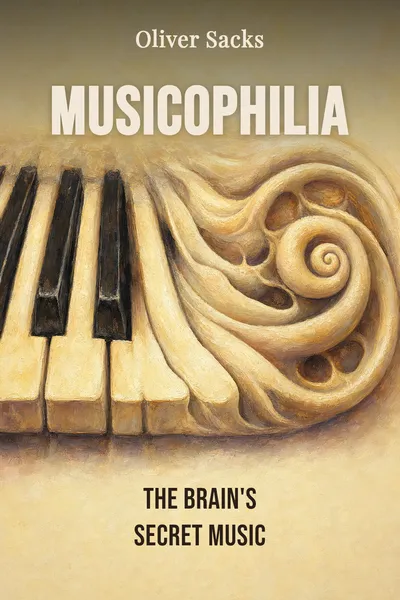
Musicophilia
The brain's secret music
Description
In 1994, a forty-two-year-old orthopedic surgeon named Tony Cicoria was standing at a lakeside pavilion in upstate New York, having just hung up a payphone, when lightning struck. It threw him backward, stopped his heart, and — by the account he later gave Oliver Sacks — left him briefly hovering above his own body before a bystander with CPR training brought him back. He recovered, went back to operating, and assumed the episode was closed. Then, a few weeks later, came something he could not explain: a sudden, ravenous hunger for piano music. Not a taste. A compulsion.
Cicoria bought sheet music, then a piano, then began waking at four in the morning to play. Melodies arrived in his head as if broadcast from somewhere else, and he raced to write them down. A man who had shown no particular musical inclination for four decades was now a composer, driven by an appetite that had switched on in an instant. Sacks, the neurologist who had spent a career listening to patients whose brains had reorganized in strange ways, recognized the shape of the thing at once. Something in the architecture had shifted, and music had come pouring through the gap.
Musicophilia, published in 2007, is the book Sacks built around dozens of cases like this one. He was not writing about musicians or about music theory. He was writing about what music does inside a nervous system — how it lodges there, how it can be lost, distorted, unleashed, or preserved when nearly everything else is gone. His subjects are people whose relationship to sound went wrong, or went strange, and in doing so laid bare a machinery most of us never notice running.
The question we’re asking : What do brains that misfire around music reveal about the place music holds in all of us?What we’ll see : A neurologist's gallery of people whose relationship to sound broke, warped, or survived — and what that says about a brain that may have been musical all along.
Table of contents
01 Chapter 1 — The man struck by lightning
Tony Cicoria's case opens the book because it is so hard to dismiss. Here was a physician, a rational man, describing a near-death experience followed by a musical obsession that reorganized his life. Sacks treats him not as a mystic but as a puzzle. Something happened in Cicoria's brain during those seconds without a heartbeat, and whatever it was, it opened a channel. He began hearing music he had never heard, felt it demanding to be played, and taught himself to render it on an instrument he had barely touched.
What interests Sacks is not whether the lightning caused it — the causal chain is impossible to pin down — but what the transformation shows. A grown man's brain, presumably long past the age when musical aptitude takes root, could suddenly be flooded with it. The capacity had been there all along, dormant, waiting. Sacks calls this kind of episode a form of what he calls sudden musicophilia: the arrival of an intense, involuntary love of music where none had been before.

02 Chapter 2 — When the wiring goes wrong
If Cicoria shows music arriving unbidden, other cases show it warping or vanishing. Sacks devotes long stretches to amusia, the condition in which music simply fails to register as music. For some people this is congenital — they have never been able to carry a tune or recognize one — and for others it comes after a stroke or injury. To a person with severe amusia, a symphony can sound like clattering pots and pans, like noise scraping against noise, tuneless and even painful. One woman told Sacks that music sounded to her like the din of traffic.
This is stranger than deafness. These people hear perfectly well; speech reaches them intact. It is the specifically musical dimension of sound — pitch relationships, melodic contour, harmony — that their brains fail to assemble. That such a narrow function can be knocked out on its own tells Sacks something important: music has its own dedicated circuitry, distinct from the processing of language or ordinary noise. Lose one system and the other can carry on undisturbed.
03 Chapter 3 — The patient who lived in seven seconds
The most haunting case in Musicophilia belongs to Clive Wearing, a distinguished English musician and conductor who, in 1985, contracted a viral encephalitis that devastated his memory. The damage was among the most severe ever recorded. Wearing's conscious awareness lasted only a few seconds; his memory span stretched no further than perhaps seven to thirty seconds before dissolving. He believed, continuously, that he had just this instant woken from years of unconsciousness. He kept a diary in which he wrote, again and again, that he had only now become truly awake, crossing out the previous entry each time as false.
For a man like Wearing, ordinary life had become an unbroken present with no before and no after. He could not remember a conversation from a minute earlier, could not recognize a corridor he had walked down moments before. And yet — this is the astonishment Sacks builds the chapter toward — Wearing could still sing, still play the piano, still conduct a choir. Place music in front of him and he came alive, fluent and expressive, moving through a piece from beginning to end without a fault.
04 Chapter 4 — Why the brain came wired for music
Stepping back from the individual cases, Musicophilia arrives at a claim that runs quietly beneath all of them. Music is not, in Sacks's view, a cultural decoration laid over a practical brain. It is woven into the organ itself, distributed across networks so numerous and so deep that it survives damage that erases language, memory, and identity. We tend to think of ourselves as language animals who happen to enjoy music. Sacks turns this around. The persistence of music in the ruined brain suggests it may be more fundamental than we assume.
The evidence for this is exactly the strangeness of the cases. Amusia shows music has its own dedicated machinery. Clive Wearing shows it can outlast memory. People with dementia who have forgotten their own children's names will sing every word of songs from their youth, their faces lighting with recognition. Parkinson's patients frozen in place can walk when a rhythm is played, their bodies borrowing the beat as a scaffold for movement they cannot otherwise summon. Across condition after condition, music reaches parts of a person that nothing else can touch.
05 Conclusion
Tony Cicoria kept composing. Clive Wearing kept playing until his death in 2020, borne through each piece by the music that held together a life otherwise dissolved into seconds. The children with Williams syndrome kept reaching for song as their first language, and the patients with amusia kept living in a world where the thing that moves the rest of us sounds like nothing at all. Sacks laid these lives side by side not to catalogue oddities but to let them illuminate one another, each case throwing light into a corner of the ordinary experience we never examine.
Related books