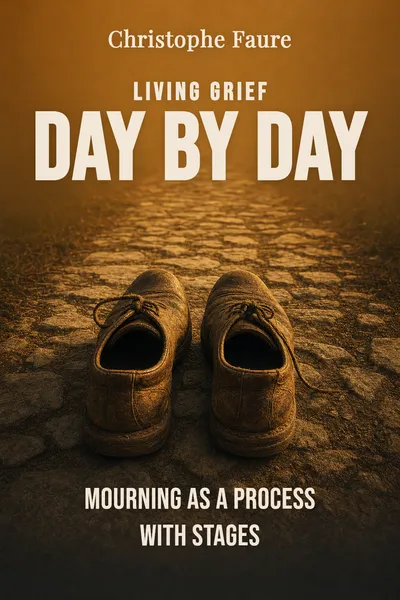
Living Grief Day by Day
Mourning as a process with stages
Description
A psychiatrist who has sat with the dying and the bereaved for decades, Christophe Fauré keeps returning to one observation: almost nobody is prepared for what grief actually does to a person. We expect sadness. What arrives instead is stranger and wider — a disorganization of the whole self that touches sleep, appetite, memory, the sense of time, even the feeling of being sane. People who are grieving often confess, quietly, that they think they are losing their mind. In Living Grief Day by Day, Fauré takes that fear seriously and answers it with something unusual for a book about loss: structure.
His wager is that grief, for all its chaos, is not formless. It moves. It has a direction, a rough sequence, a set of tasks the psyche works through whether we cooperate or not. Fauré draws on his clinical practice and on the long tradition that runs from Elisabeth Kübler-Ross forward, but he is careful about the word 'stages' — not a staircase climbed once, cleanly, but a terrain crossed and recrossed, with detours and relapses that are part of the route rather than failures of it.
What makes the book land is its refusal to console with slogans. Fauré does not promise that time heals or that everything happens for a reason. He describes, precisely and without drama, what a grieving person goes through month by month — and, just as usefully, what the people around them tend to get wrong. The result reads less like a self-help manual than like a map handed over by someone who has walked the ground many times.
The question we’re asking : If grief really does unfold as a process, what are its phases — and does naming them actually make the crossing any easier to bear?What we’ll see : How Fauré charts the long interior journey of mourning, why it rarely follows death alone, and where genuine comfort parts ways from the kind that only looks like it.
Table of contents
01 Chapter 1 — The year nobody warns us about
The first thing Fauré wants to dismantle is the expectation that grief is a matter of weeks. In his consulting room, people arrive six, nine, twelve months after a death, ashamed that they are not 'over it' — convinced that something is wrong with them because the world has moved on and they have not. He tells them, in effect, that they are exactly on schedule. Mourning a central person is the work of a year at minimum, often two, and the early assumption that it should be faster is itself a source of suffering.
The reason it takes so long, in his account, is that the bond with the person did not live in one place. It was woven through daily gestures, shared plans, a particular silence in a particular room, the automatic thought 'I should tell them this.' Each of those threads has to be encountered and slowly rewoven. That is why grief ambushes people months in — a song, a smell, the turn of a season — long after they believed the worst had passed. The anniversaries, the first birthday, the first holiday without them, are not setbacks. They are the terrain itself.

02 Chapter 2 — The territory before acceptance
The sequence Fauré describes is familiar in its broad strokes and more supple in his handling. It opens, almost always, with a kind of anesthesia — shock, numbness, a sense of unreality that can last from the news through the funeral and beyond. Far from a weakness, he reads this as protective: the psyche admits the truth in doses it can survive. People often reproach themselves for feeling nothing at the graveside. That nothing, Fauré explains, is the mind doing precisely what it should.
After the numbness recedes, the real weather arrives, and it is rarely tidy. Denial coexists with lucid knowing; the hand still reaches for the phone to call someone who is gone. Anger surges — at doctors, at the deceased for leaving, at oneself, sometimes at a God one did not know one believed in. Guilt rehearses the unsaid words and the undone visits. Fauré insists these are not detours from grief but its substance, and that anger in particular, so often shamed into silence, needs somewhere to go rather than somewhere to hide.
03 Chapter 3 — Grief is not only about death
One of the quieter arguments of the book is that the same process governs losses we do not usually call grief. A divorce, Fauré notes, puts a person through the identical sequence — shock, denial, anger, the grey trough, slow reorganization — often without anyone granting them the right to mourn, since the other person is still alive and somewhere in the city. The absence of a body, of a funeral, of social permission does not spare the griever. It frequently makes the crossing lonelier.
He extends this to the loss of health after a diagnosis, to forced exile, to the ending of a career that carried someone's identity, to the empty house after children leave. In each case there is an attachment that structured a life, and its rupture triggers the same interior labor. Naming these experiences as grief, rather than as mere stress or disappointment, changes how they can be handled — it dignifies the disorientation and predicts its course.
04 Chapter 4 — What helps, and what only looks like help
Step back from the individual phases and a different question comes into focus: what is a map of grief actually for? Fauré is clear that it is not a timetable to be passed, not a checklist where reaching 'acceptance' earns a certificate. Its value is that it renders an overwhelming experience legible. A person who knows that the grey months are expected, that anger is part of the route, that ambush waves are normal a year out, suffers the grief without the added terror of not understanding it. The framework does not shorten the road; it keeps the traveller from concluding they are lost.
This reframing changes how we accompany the grieving — including the single hardest truth in the book, which is how little the people around them know what to do. Fauré catalogues the well-meant harms: the rush to find silver linings, the 'he's in a better place,' the pressure to be strong, the sudden silence of friends who do not know what to say and so say nothing. Each of these, however kind in intent, communicates that the grief is unwelcome and should be hurried off the premises.
05 Conclusion
The book ends where it began, with the frightened person in the consulting room who believes their grief has gone wrong. Fauré's answer, across every chapter, is that it has not — that the disorganization, the anger, the long grey middle, the waves that return without warning are the process doing its work, not evidence of failure. Acceptance, when it comes, is not the forgetting we were taught to fear but a quieter arrangement in which the lost person is carried rather than chased. The bond changes form. It does not end.
Related books