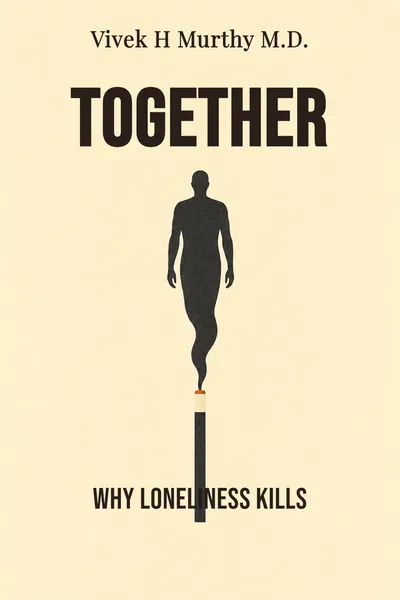
Together
Why loneliness kills
Description
When Vivek Murthy became the nineteenth Surgeon General of the United States in 2014, he expected the country's biggest health questions to be the ones already on the front page: opioids, obesity, diabetes, the slow accumulation of illness in an aging population. So he went on the road, sat in clinics and church basements and union halls, and listened. What he kept hearing underneath the stated problems was something he hadn't put on his agenda. People weren't only sick. They were alone. The word came up everywhere, in the voices of teenagers and CEOs and people who, by every visible measure, seemed surrounded.
Murthy left office in 2017 and wrote Together, published in 2020, to name what he'd heard. His argument is blunt for a physician: loneliness isn't just a sad mood or a personal failing. It behaves like a health condition, with measurable effects on the body, and it sits underneath a great deal of what we treat as separate crises — depression, anxiety, addiction, even cardiovascular disease. He cites work suggesting that chronic loneliness carries a mortality risk comparable to smoking, and that the feeling has been quietly spreading for decades, well before any phone made it convenient.
What makes the book more than a diagnosis is that Murthy refuses to treat connection as a luxury we get to once the real work is done. He treats it as the work — as something a person, a workplace, and a society can deliberately build or quietly dismantle. The book moves from the exam room outward, and it asks us to look again at a feeling most of us would rather not admit to having.
The question we’re asking : If loneliness is as common and as dangerous as Murthy argues, why have we treated it as a private embarrassment rather than a public health issue?What we’ll see : How a Surgeon General came to see isolation as a medical and civic emergency — and what he believes actually rebuilds connection.
Table of contents
01 Chapter 1 — The doctor who kept hearing the same word
Murthy opens with his own arc, because the realization wasn't theoretical. As a young physician, he watched patients recover faster when someone visited them, and decline when no one did. He noticed that the people who came back to the hospital again and again were often the ones who went home to empty apartments. It registered as a pattern he couldn't quite file anywhere, because medicine didn't have a column for it. You can chart blood pressure. There's no line on the intake form for whether anyone is waiting at home.
The listening tour as Surgeon General turned the pattern into a conviction. In community after community, Murthy found that loneliness wasn't confined to the people we picture when we hear the word — the widowed, the elderly, the isolated rural farmer. It showed up in high-achieving students, in new parents, in successful executives who confessed that the busier and more admired they became, the less anyone actually knew them. He recounts meeting people who could list hundreds of contacts and still tell him, quietly, that there was no one they could call at two in the morning.

02 Chapter 2 — A body that reads isolation as danger
The most persuasive part of Murthy's case is physiological, and it's where his training carries weight. Loneliness, he explains, is not a character trait but a signal — the social equivalent of hunger or thirst. Just as hunger evolved to push us toward food, loneliness evolved to push us back toward the group, because for our ancestors, separation from the tribe was genuinely life-threatening. The feeling is a built-in alarm, and like any alarm, it's supposed to be uncomfortable enough that we act on it.
The trouble starts when the alarm never switches off. Murthy walks through what chronic loneliness does in the body, drawing on researchers like the late John Cacioppo, whose work he leans on heavily. Sustained isolation keeps the body in a low-grade state of threat: elevated stress hormones, higher inflammation, disrupted sleep, a cardiovascular system that never fully stands down. Over years, that wear accumulates. This is how a feeling becomes a mortality statistic — not through sadness alone, but through the steady physical cost of a stress response that has nowhere to discharge.
03 Chapter 3 — Three circles, and the smallest one we forget
Having established the danger, Murthy turns to what actually rebuilds connection, and he resists the easy answer that we simply need more people around us. Quantity, he argues, isn't the cure; we can be lonely in a crowd and grounded with very few. He borrows a useful distinction, describing loneliness as having layers — an intimate circle of one or two people who truly know us, a relational circle of friends we share life with, and a collective circle of community and shared purpose. We can be rich in one and starving in another, which is why the busy networker and the new parent can both feel hollow.
The intimate circle is the one Murthy worries we most often neglect, precisely because it's slow and unglamorous. It doesn't scale, it can't be optimized, and it asks for the one resource modern life guards most jealously: unhurried, undistracted time. He's candid that this is where his own struggle lived, and he treats the rebuilding of close ties not as something that happens automatically but as a practice — showing up, being honest about needing people, letting yourself be known rather than merely admired.
04 Chapter 4 — What a culture organized around self-reliance gets wrong
Where the book widens is in Murthy's refusal to leave the problem on the individual's shoulders. If loneliness were simply a matter of personal effort, it wouldn't have been climbing for decades across an entire society. He points instead at the architecture of how we now live — the long erosion of the institutions that once threw people together without anyone planning it. We've moved more often, worked longer and more remotely, joined fewer clubs and congregations, and built a culture that prizes self-reliance so highly that needing other people can feel like failure.
That cultural ideal is his real target. Murthy argues that a society which treats independence as the highest virtue quietly punishes the admission of need, and in doing so manufactures isolation at scale. The lonely individual is then told to fix it privately — make more friends, download an app, try harder — which loads a structural problem onto people least equipped to solve it alone. He's essentially making a public health argument: just as we don't ask individuals to single-handedly clean the air they breathe, we shouldn't expect them to rebuild a social fabric the wider culture has thinned.
05 Conclusion
Murthy ends roughly where he began, back in the human scale of the exam room and the kitchen table. For all the talk of mortality statistics and civic infrastructure, his closing emphasis is on the reachable: the conversation we don't rush, the friend we finally call, the meal shared without a screen. The science gives the urgency, but the remedy stays stubbornly ordinary, and he seems to find that reassuring rather than disappointing. The same biology that makes isolation dangerous also means that small, genuine contact registers in the body as relief.
Related books