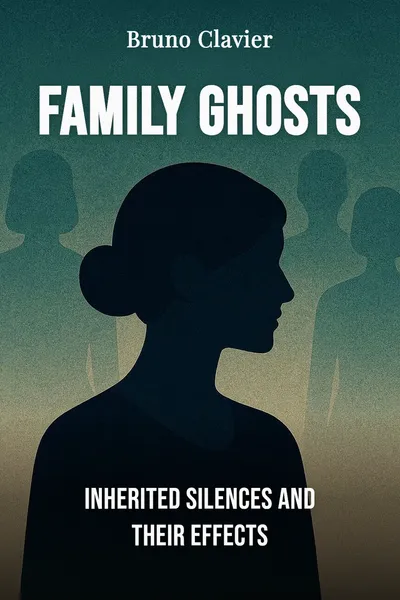
Family Ghosts
Inherited silences and their effects
Description
A patient walks into a consulting room with a fear that makes no sense. A woman who panics every time she passes a particular kind of building, though nothing has ever happened to her there. A man who at a certain age falls into a depression he can't account for, only to discover later that his grandfather died at exactly that age, under circumstances the family never discussed. For the psychoanalyst Bruno Clavier, these are not coincidences and not quite personal problems either. They are, in his word, ghosts — not the kind that rattle chains, but the kind that live inside a lineage and surface, sometimes generations later, in a descendant who has no idea they are carrying something.
Clavier's book, Family Ghosts, takes this intuition and gives it a clinical frame. Drawing on a tradition that runs through Freud and was sharpened by the analysts Nicolas Abraham and Maria Torok in the 1970s, he argues that what a family refuses to speak about does not disappear. A death kept quiet, a shameful secret, a trauma too heavy to put into words — these get sealed off, passed down, and lodge in a later member of the family like a tenant nobody rented to. The symptom belongs to the descendant. The cause belongs to someone else, often someone already dead.
What makes the idea unsettling is how ordinary the mechanism turns out to be. Every family has its silences, its subjects that make the room go quiet, its relatives who are never mentioned. Clavier's claim is that these silences are not neutral. They do something. They travel.
The question we’re asking : How can a trauma that was never spoken, sometimes from a person we never met, show up decades later as our own symptom?What we’ll see : How a strand of psychoanalysis traced our inexplicable fears and repetitions back to the unspoken wounds of those who came before us.
Table of contents
01 Chapter 1 — The symptom nobody could explain
Clavier begins where any analyst begins: with people who are suffering in ways that don't add up. A phobia with no origin story. A recurring nightmare that seems borrowed. An anxiety that attaches to a date, an age, a place, with a precision that feels designed rather than accidental. The classical approach would look for the cause in the patient's own history — a childhood event, a forgotten scene. But sometimes the search comes up empty. The patient has done the work, dug through their own past, and the symptom still has no roots in the soil they can see.
It is in these dead ends that Clavier starts looking upward, into the generations. He describes patients whose private torments turn out to echo something that happened before they were born: a sibling who died in infancy and was never spoken of, a wartime episode wrapped in shame, a suicide recoded by the family as an illness. The descendant inherits not the memory — they have none — but the charge around it. They feel the weight without the story. They carry the effect of a wound that was never theirs.

02 Chapter 2 — What crosses the generations unspoken
The mechanism Clavier describes has a long lineage of its own. Freud had already noticed that patients repeat what they cannot remember — that the unprocessed tends to return in action rather than in words. But the idea that it could jump across people, from parent to child to grandchild, was developed most sharply by Nicolas Abraham and Maria Torok, two analysts working in Paris in the 1960s and 1970s, whose work gave Clavier his central vocabulary. They proposed that a secret kept within one generation could install itself, intact and unspeakable, in the unconscious of the next.
The vehicle for this transmission is not genetics. It is the relationship itself — the thousands of small signals that pass between a parent and a child without ever being named. A mother who tenses whenever a certain subject nears. A father whose warmth switches off at a particular word. A household where some rooms of the past are simply locked, and the children learn, without being told, never to try the handles. Children are exquisitely tuned to these silences. They register the shape of what is missing and organize themselves around it.
03 Chapter 3 — The crypt and the phantom
To name what he is describing, Clavier leans on two images borrowed from Abraham and Torok, and they are worth taking seriously because they do real work. The first is the crypt. When something is too unbearable to grieve — a loss steeped in shame, guilt, or horror — it is not mourned and not forgotten. It is walled off. The person builds, inside themselves, a sealed chamber where the ungrievable thing is kept intact, neither alive nor laid to rest. It stays frozen, outside the normal flow of a life, preserved exactly as it was at the moment it became unspeakable.
The second image follows from the first. What leaks out of that sealed chamber, into the next generation, Clavier calls the phantom. The phantom is not the dead person; it is the gap they left, the un-mourned loss, passing into a descendant who never knew the deceased and cannot name what haunts them. The phantom speaks through symptoms that seem foreign to the person's own life — through words that don't fit, fears that arrive from nowhere, repetitions that feel scripted by a hand that isn't theirs. It is, Clavier writes, the work of a dead person's secret operating inside the living.
04 Chapter 4 — Naming what was never said
Step back from the individual cases and a larger claim about families comes into view. Clavier's work suggests that a family is held together not only by what it shares but by what it conceals — that silence is itself a structure, with its own weight and its own descendants. Every lineage carries subjects that make the room go quiet, relatives who are never mentioned, episodes that have been quietly edited out. What his clinical frame insists on is that these edits are never clean. Something always remains, looking for a place to surface.
This reframes what repair can mean. If the trouble is a wound, the instinct is to heal it; if it is a secret, the response is to find it out. But Clavier's claim is more precise: the damage lies in the unsaid, so the repair lies in the saying. What transforms a phantom is not a cure but a word — the moment the buried thing is finally given language, pulled out of the crypt and into speech, and attached at last to the person it actually belonged to. The symptom loosens not because the past is undone, but because it is finally addressed to the right person, in a sentence that can at last be spoken.
05 Conclusion
We come back to the patient with the fear that made no sense — the panic in front of a building, the depression that arrived on schedule. In Clavier's frame, these were never random malfunctions of a private mind. They were messages, forwarded across a generation or two, from someone whose grief was never allowed to be grieved. The symptom was the envelope. The work was learning to read what was inside, and to say it aloud to the person who had been carrying it without knowing why.
Related books