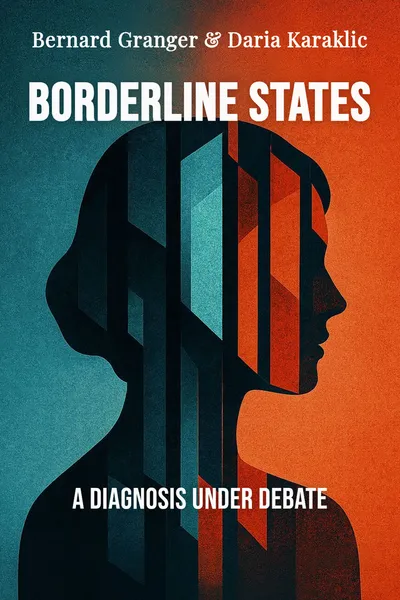
Borderline States
A diagnosis under debate
Description
In 1938, an American analyst named Adolph Stern reached for a word to describe a group of patients who kept slipping out of his hands. They were not psychotic, not quite — they held onto reality. But they were not the garden-variety neurotics his training had prepared him for either. They swung, they clung, they fell apart in session and reassembled by the next. Stern called them a "border line group," patients living on the frontier between two territories psychiatry thought it understood. The name stuck, which is a little strange, because almost everything else about the category has been fought over ever since.
Nearly a century later, borderline personality disorder is one of the most studied, most prescribed-around, and most argued-about diagnoses in the manual. It affects an estimated one to two percent of the general population and a far larger slice of people who end up in psychiatric care. It carries a suicide rate that psychiatry takes very seriously. And yet clinicians still disagree about what it is — a personality structure, a mood problem, a trauma response, or a label that says more about the observer than the observed. In their book Borderline States, Bernard Granger and Daria Karaklic take this quarrel head-on.
What makes the subject worth the trouble is that the fight is not academic. Behind every line drawn on a diagnostic chart is a person in genuine distress, and the words we choose shape the care they get — or don't. The borderline patient has been dismissed as manipulative, feared as untreatable, and, more recently, recognized as someone who can actually get better. We follow that arc from a contested name to a set of treatments that work.
The question we’re asking : Is borderline personality disorder a real clinical entity, a blurred catch-all, or something in between — and does the answer change how it gets treated?What we’ll see : How a frontier metaphor became a diagnosis, what it names in the lives of those who carry it, why specialists still can't agree on its edges, and where that leaves the people seeking help.
Table of contents
01 Chapter 1 — A category that never sat still
The word "borderline" began as a confession of uncertainty. Stern used it in 1938 to mark patients who resisted the two great buckets of early psychoanalysis — neurosis and psychosis. For decades the term floated in analytic circles, meaning roughly "on the edge of psychosis," a diagnosis of exclusion more than a positive description. It named what a patient was not. Granger and Karaklic trace how this fuzzy inheritance shaped every later attempt to pin the concept down.
The turning point came in 1980, when the third edition of the American Diagnostic and Statistical Manual, the DSM-III, did something the analysts never had: it turned borderline into an operational checklist. Instead of a psychodynamic hunch, the diagnosis became a list of observable criteria a clinician could count. This was part of a much larger shift in psychiatry toward reliability — the idea that two doctors examining the same patient ought to reach the same verdict. Borderline personality disorder entered the official nomenclature, and with it, a measure of legitimacy it had never quite enjoyed before.

02 Chapter 2 — Nine criteria and a world of pain
Strip away the history and the modern diagnosis rests on a cluster of nine criteria, of which a patient must show at least five. The list reads like a map of a particular kind of suffering: frantic efforts to avoid abandonment, real or imagined; unstable and intense relationships that swing between idealization and contempt; an unstable sense of self; impulsivity in ways that are potentially self-damaging; recurrent suicidal behavior or self-harm; emotional instability; chronic feelings of emptiness; intense, hard-to-control anger; and transient, stress-related paranoid thinking or dissociation.
Granger and Karaklic are careful to render what these criteria feel like from the inside, rather than listing symptoms as a clinician might. The emotional instability is not ordinary moodiness — it is a reactivity so fast and so strong that a minor slight can trigger hours of anguish. The emptiness is not boredom but a hollow that follows a person around. The fear of abandonment can turn an ambiguous text message into a crisis. These are not character flaws dressed up in medical language; they are, the authors insist, genuine and often agonizing experiences.
03 Chapter 3 — The quarrel over where to draw the line
Here is where the authors earn their title. The very existence of borderline personality disorder as a distinct entity is contested, and the objections come from several directions at once. Granger and Karaklic lay them out without pretending the debate is settled. One camp argues the diagnosis is too heterogeneous to be useful: two patients can share only five of nine criteria and therefore have almost nothing in common, which makes the category a bag of loosely related troubles rather than a single condition.
A second objection concerns overlap. The borderline picture shades into mood disorders, into post-traumatic reactions, into other personality patterns. Some researchers have argued it belongs on the bipolar spectrum; others see it as a trauma syndrome, pointing to the high rates of childhood abuse and neglect in patient histories. If the symptoms can be reassigned to other, better-established diagnoses, the skeptics ask, why keep the frontier label at all? The authors weigh these claims seriously while noting that the longitudinal evidence tends to show borderline running a course of its own.
04 Chapter 4 — A disorder that holds a mirror to psychiatry
Step back from borderline specifically and the controversy starts to look like a stress test for psychiatry as a whole. The discipline has long wrestled with a basic problem: unlike cardiology or oncology, it mostly lacks biological markers that confirm a diagnosis. There is no blood test for a personality disorder. Diagnoses are built from clusters of behavior and experience, which means the line between one condition and the next is drawn by committee, by convention, and by whatever the current manual happens to say. Borderline is simply the case where this uncomfortable truth is hardest to hide.
Granger and Karaklic use the disorder to illuminate that larger difficulty. The questions critics aim at borderline — is it too heterogeneous, does it overlap too much with its neighbors, does the label stigmatize — could be aimed at many psychiatric categories. What makes borderline a useful mirror is that it sits at the intersection of mood, trauma, personality and relationship, refusing to stay in any single column. It exposes the seams in a classification system that pretends, for practical reasons, to carve nature at its joints. The frontier metaphor turns out to describe not just the patients but the state of the knowledge.
05 Conclusion
The arc that began with Adolph Stern's frontier metaphor ends, in Granger and Karaklic's account, somewhere surprisingly hopeful. For decades borderline carried a reputation for being untreatable, which quietly justified a lot of therapeutic giving-up. That reputation has not survived the evidence. Structured psychotherapies developed over the past few decades — dialectical behavior therapy, mentalization-based treatment, and others built specifically for this patient group — have shown that symptoms ease, crises grow rarer, and many people improve markedly over time. Medication plays a supporting role at best; the real work is relational and skills-based. The contested category, it turns out, is also one of the more responsive ones.
Related books