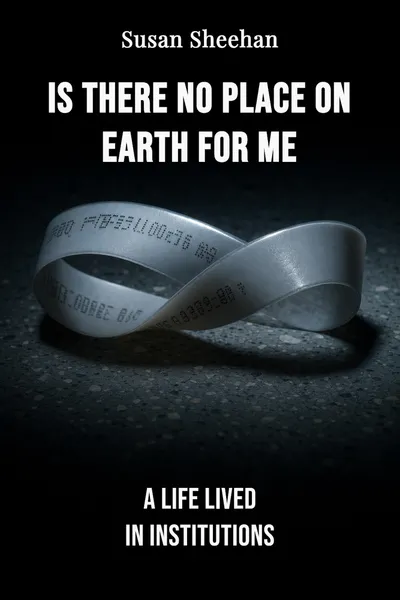
Is There No Place on Earth for Me
A life lived in institutions
Description
In the spring of 1978, a woman in her early thirties was admitted for the umpteenth time to Creedmoor Psychiatric Center, a state hospital in Queens. Susan Sheehan, a reporter for the New Yorker, was there watching. She had asked the hospital for permission to follow a single patient closely — not the calmest, not the most photogenic, but a representative one. The staff pointed her toward a woman Sheehan would call Sylvia Frumkin, a pseudonym chosen to protect a real person whose diagnosis was schizophrenia and whose adult life had been spent moving in and out of psychiatric wards. Sheehan followed her for months, then reconstructed the years before, and turned the result into a book whose title comes from something Sylvia herself wrote in a moment of despair.
What Sheehan found was not a dramatic breakdown followed by a cure. It was a loop. Sylvia would arrive at a hospital acutely psychotic, receive treatment, stabilize enough to be discharged, land in a halfway house or back with her family, deteriorate again, and return. The medical record ran to thousands of pages across a dozen institutions. Insulin-coma therapy, electroshock, and a long parade of medications had all been tried on her since adolescence. None of it added up to a life outside the system.
Sheehan's book became a landmark of reporting precisely because it refused to explain Sylvia away. It did not offer a villain or a tidy diagnosis of what went wrong. It simply stayed close enough, for long enough, to show what a life inside psychiatric institutions actually looks like from the inside — the boredom, the paperwork, the small hopes, the returns.
The question we’re asking : What does it mean to spend a life not in a home but in a system of institutions that treats each crisis as if it were the first?What we’ll see : A closely reported life that loops through wards, records, and treatments, and what that loop reveals about how we care for serious mental illness.
Table of contents
01 Chapter 1 — The revolving door of Creedmoor
Creedmoor in the late 1970s was a large, underfunded state hospital, the kind of place the deinstitutionalization movement was supposed to have made obsolete. Its patient population had shrunk dramatically over two decades, from a peak of around six thousand to a fraction of that, as states emptied the big asylums with the promise that community care would take over. The promise had not been kept. What remained was a building full of people the community had no room for, staffed by workers who were often stretched thin and sometimes indifferent, and cycled through by patients like Sylvia who kept coming back.
Sheehan uses the word that everyone in the field used: the revolving door. Sylvia had been hospitalized dozens of times. Each admission followed roughly the same arc. She would arrive floridly psychotic — talking in rushes, convinced she was a famous singer or that a doctor was in love with her, unable to sit still. She would be medicated, sometimes restrained, gradually calmed. After weeks or months she would improve enough to be discharged into some fragile arrangement outside. And within a matter of weeks or months she would be back.

02 Chapter 2 — A file thicker than a childhood
To understand how Sylvia arrived at Creedmoor, Sheehan went back through the record — and the record was staggering. It began when Sylvia was a teenager, when the behavior that had made her a difficult, bright, intense child tipped into something her family could no longer manage. The signs of serious mental illness had appeared young, and from adolescence onward her life was punctuated by hospitalizations that grew more frequent and more prolonged.
Sheehan reconstructs a family that was neither cruel nor negligent, just overwhelmed. Sylvia's parents loved her and had no idea what to do with her. Her sister grew up in the shadow of a sibling whose crises absorbed the household's attention. The family moved between hope and exhaustion, between believing the next treatment would finally work and bracing for the next collapse. There was no map for any of it, because in the 1960s and 70s the understanding of schizophrenia was itself in flux, and the advice families received shifted with whatever theory was ascendant.
03 Chapter 3 — The medicine that kept changing its mind
The most quietly devastating thread in Sheehan's book is the treatment history. Because Sylvia's illness had spanned decades, her body carried a record of psychiatry's changing methods. In her early years she had been subjected to insulin-coma therapy, a treatment then in decline in which patients were dosed into repeated comas in the hope of jolting the mind back to order — a procedure that later disappeared entirely, judged dangerous and useless. She had received electroshock. And once antipsychotic drugs arrived, she was moved through a long succession of them.
The drugs were the real workhorses of her adult treatment, and Sheehan shows both their power and their limits. When the right medication was given at the right dose, Sylvia could stabilize remarkably. When it was wrong — too much, too little, the wrong combination, switched too abruptly — she could tip back into psychosis. And the calibration was often careless. Sheehan documents medication decisions made in haste, dosages changed without close monitoring, drugs stopped and started in ways that no careful clinician would defend.
04 Chapter 4 — When the ward is the only address
Step back from Sylvia's particular story and a larger picture comes into focus. Her life was shaped by a mental-health system built to respond to crises rather than to sustain a person between them. It could admit her, medicate her, and discharge her with real efficiency. What it could not do was follow her — hold a coherent picture of who she was across a decade, notice patterns, keep one thread of care unbroken. Sylvia fell through the gaps because the whole architecture was made of gaps.
Deinstitutionalization was supposed to fix this. The great state hospitals had been genuinely grim, and emptying them was framed as liberation: patients would live in the community, supported by local clinics and group homes. But the community infrastructure was never funded to match the ambition. What happened instead was that people with serious illness were released into a patchwork too thin to hold them, and the hospitals became not homes but way stations they kept returning to. Sheehan's Sylvia is the human evidence of a policy that dismantled one system without building the next.
05 Conclusion
The title comes from Sylvia herself — a line she wrote in anguish, asking whether there was any place on earth for her. Sheehan never answers it, because the honest answer at the time was that there wasn't one, not really: not a home she could keep, not a clinic that followed her, not a treatment that stayed steady. There was only the loop, and the ward at the center of it. When the book ends, Sylvia is neither cured nor lost. She is simply still inside the system, as she had been for most of her life, waiting for the next turn of the door.
Related books