

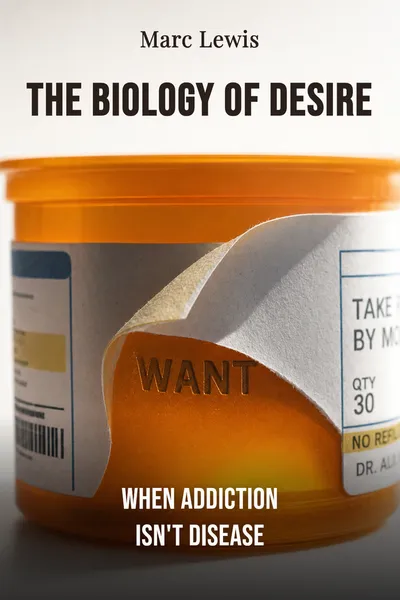
The Biology of Desire
When addiction isn't disease
Description
Marc Lewis knows the inside of an addiction the way few neuroscientists do. Before he studied the brain for a living, he spent years in his twenties putting whatever he could find into his own — opiates, stimulants, hallucinogens, prescription pills stolen from hospital cabinets. He got clean in his late twenties, went back to school, and eventually became a developmental neuroscientist who studies how the brain changes over time. In 2015 he published The Biology of Desire, a book that does something unusual: it uses the tools of neuroscience to argue that addiction is not a disease at all.
That claim lands harder than it sounds. For decades the reigning story in medicine, in rehab centers, in public-health campaigns, has been that addiction is a chronic brain disease — a hijacking of neural circuitry that the addict is powerless to control. It is a compassionate story, meant to replace an older one about weakness and moral failure. Lewis, who has been the addict and now studies the brain, thinks the disease model gets the biology right and the meaning wrong. The same brain changes it points to, he argues, are what any brain does when it learns to want something badly.
So the book braids two threads that rarely sit together: the wet detail of dopamine and the desire circuit, and the lived arc of people who fell into addiction and, mostly, climbed back out. The stakes are not academic. How we name the thing shapes what we expect from the people caught in it, and what they come to expect from themselves.
The question we’re asking : If addiction really does change the brain, why isn't calling it a disease the honest conclusion?What we’ll see : How the neuroscience of ordinary wanting reframes what addiction is, told through the people who lived it.
Table of contents
01Chapter 1 — A neuroscientist who used, then quit
Lewis writes from a position most researchers can't claim. As a young man he was, by his own account, an addict — restless, self-medicating, chasing chemical relief through a chaotic decade that included overdoses and a break-in to steal drugs from a lab. He describes the appeal not as pleasure exactly but as a fix for a self that felt unbearable. What the substances offered was a shape for the day, a promise that the next hour would be different from this one. That craving, he insists, was not alien to him. It was the most intimate thing he knew.
When he finally stopped, in his late twenties, nothing about it resembled the treatment of a disease. There was no cure administered from outside. What happened was closer to a change of self — a shift in what he wanted, in the story he told about his own future, in the relationships that started to matter more than the next high. He returned to university, trained in developmental psychology and neuroscience, and spent the following decades studying how brains grow, adapt and reorganize across a lifetime.

02Chapter 2 — What the brain actually does when it wants
To make the case, Lewis walks through the machinery of desire itself. At its center sits the ventral striatum, and within it a structure called the nucleus accumbens, the hub where the neurotransmitter dopamine does its work. The popular image has dopamine as the pleasure chemical, the reward we feel when something good happens. Lewis, following a line of research associated with Kent Berridge, corrects this. Dopamine is not about liking. It is about wanting — the anticipatory pull toward a goal, the motivational lean forward before the thing is even obtained.
This distinction matters enormously. In addiction, the wanting swells while the liking often shrinks. The drug delivers less and less pleasure, yet the craving for it grows sharper, more automatic, harder to interrupt. That divergence isn't a malfunction unique to drugs. It's how motivation works in general: the brain learns to fire in advance of a reward, tagging the cues that predict it, so that a smell, a street corner, a time of day can trigger the pull on their own. The circuit is doing precisely its job. It has simply been trained on the wrong target.
03Chapter 3 — Five people, one machinery
The argument would stay abstract if Lewis didn't ground it in lives, and the spine of the book is five case histories he tells in close, unhurried detail. There is a young woman who tumbles into heroin, a man whose drinking swallows a career, a woman whose relationship to opiates begins with prescribed pills, a student caught in stimulants and self-punishment, and others whose paths differ in every particular. What unites them is not a shared pathology but a shared shape: each found in a substance an answer to a specific ache, and each let that answer take over the machinery of wanting.
Told this way, addiction stops looking like an invading illness and starts looking like a solution that outgrew the problem it solved. The heroin quiets an unbearable anxiety; the drink softens a self that feels exposed; the pills manage a pain, physical or otherwise, that had no other outlet. In every case the drug does something the person needed done. That it later becomes the problem does not erase the fact that it began as relief — and Lewis wants us to sit with that, because a disease has no meaning, while these choices, however trapped, always do.
04Chapter 4 — Why calling it a disease changes the ending
Step back from the five stories and the stakes of the naming come into focus. The disease model was adopted for humane reasons: it lifted the burden of shame, replaced the language of vice with the language of medicine, and opened the door to treatment and insurance coverage. Lewis grants all of this. His worry is what the model quietly implies. If addiction is a chronic brain disease, then the addict is, by definition, a patient — someone to whom the condition happens, whose brain has been hijacked, whose agency is compromised. That framing offers relief from blame at the price of relief from possibility.
Because a disease is something you have, not something you do, the disease model can subtly script a passive ending. You manage it forever, you are never fully recovered, you remain one drink from disaster for life. For some people that vigilance is protective. For others, Lewis argues, it becomes a self-fulfilling identity — a story in which change is not really available, only containment. If the brain that got addicted is a damaged brain, why would you trust it to lead you out?
05Conclusion
Lewis ends where his own life once was: at the point where wanting turns. He does not pretend the road out is short or reliable, and the people in his book carry their scars and their relapses with them. What he offers instead is a different account of the machinery — one in which the very plasticity that makes a brain vulnerable to addiction is also what makes it capable of growing past one. The dopamine, the striatum, the narrowing of attention: all real, all doing precisely what evolution built them to do. Only the target went wrong.