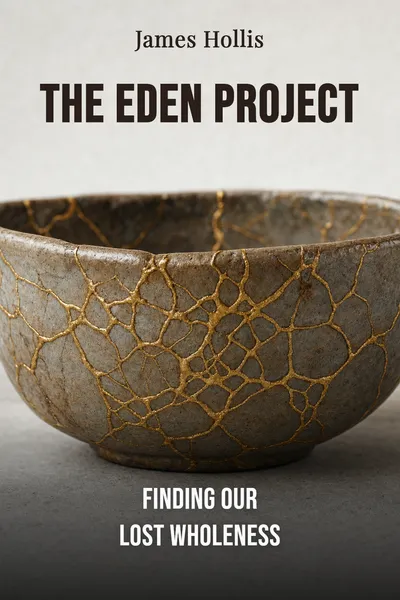
The Eden Project
Finding our lost wholeness
Description
There is a particular disappointment that arrives around the middle of a life that looked, from the outside, like it was going well. The relationship that was supposed to complete us has settled into something ordinary. The career that was supposed to make us whole pays the bills and leaves a strange emptiness at the end of the day. Nothing has failed, exactly, and yet a quiet question keeps surfacing: is this it? The Jungian analyst James Hollis wrote an entire book about that question, and about why it feels less like a personal failing than like a rumor we were all born carrying.
His book is called The Eden Project, and the title is doing heavy lifting. Hollis takes the old story of a garden we were expelled from and reads it not as theology but as psychology. Before we had language, before we had a self, we floated in a state of total connection — held, fed, undivided from the world around us. Then we were born into separateness, and we have been trying to get back ever since. The trouble, Hollis argues, is that we spend most of our lives looking for that lost garden in the wrong places: in a partner, a job, a belief, a person we ask to carry a longing no person can carry.
What makes the argument worth following is that Hollis refuses the easy consolations. He does not promise that the garden can be regained, and he does not treat the longing as a mistake to be cured. He treats it as the engine of a life, provided we learn to point it somewhere other than at each other. The book is an invitation to grow up in a specific and demanding sense — to stop waiting for rescue and to become the thing we were waiting for.
The question we’re asking : Where does the ache for wholeness actually come from, and why does aiming it at other people almost always end in disappointment?What we’ll see : How Hollis reads an ancient story as a map of the modern psyche, and what he asks of anyone willing to follow it.
Table of contents
01 Chapter 1 — The paradise we lost before we could name it
Hollis starts before memory. In the womb, and in the earliest weeks of infancy, there is no boundary between the self and what surrounds it. Warmth arrives without asking, hunger is met before it becomes fear, and there is no gap between wanting and receiving. This is the original condition, and Hollis, following Jung, insists we never entirely forget it — not as an image, since we had no images yet, but as a feeling-tone that colors everything afterward. It is the sense that somewhere, once, we were whole.
Then comes the fall, and Hollis is careful about what he means. The fall is simply consciousness. To become a self is to become separate, to discover that the world is not an extension of us and will not always answer. Every child learns this in a thousand small betrayals: the delayed feeding, the closed door, the parent who is tired. None of these are cruelties. They are the ordinary texture of growing up, and they are also, cumulatively, an expulsion. We are put out of the garden not by sin but by the simple fact of becoming a person.

02 Chapter 2 — The person across the table is not the answer
The place we most often take the Eden project is into romantic love, and Hollis is unsparing about why. When we fall for someone, we are rarely seeing them clearly. We are seeing a screen onto which we project the lost wholeness — the person who will finally understand us without words, hold us without conditions, return us to the garden. The intensity of early love is largely the intensity of that projection. For a while it works, because the other person is standing in the exact spot where our deepest need is pointing.
But projections have a shelf life. Sooner or later the real person emerges from behind the screen: they get tired, they misunderstand, they have needs of their own that collide with ours. Hollis describes the predictable disappointment that follows, the sense of having been misled, though nobody misled us. We asked another human being to be the answer to a longing that predates them by decades and belongs to a garden they never lived in. When they fail — and they must fail — we often conclude we chose wrong, and go looking for a truer version of the same impossible rescue.
03 Chapter 3 — The wound as a summons, not a verdict
If love cannot return us to Eden, and neither can work, status, or belief, the obvious move is despair. Hollis refuses it, and this refusal is the moral center of the book. The wound of separation, he argues, is not a defect to be repaired but a summons to be answered. The very gap that hurts is the space in which a self can grow. Had we never been expelled from the garden, we would never have become anyone at all.
Here Hollis leans on Jung's idea that the psyche is oriented toward growth the way a plant is oriented toward light. There is in us a drive toward becoming more fully ourselves, and it does its work precisely through discomfort. The disappointments that follow every failed Eden project are not evidence that we chose badly. They are the psyche's way of taking back a projection and returning its energy to us, where it can finally be used for something. Each disillusionment, painful as it is, is an invitation to grow up a little more.
04 Chapter 4 — The pilgrimage nobody can take for us
Step back from the particulars and Hollis is describing a single, decisive turn that separates a half-lived life from a whole one. The turn is from outer to inner — from expecting the world, in the shape of a lover or a career or a creed, to deliver the wholeness we lost, to accepting that the only place it can now be found is within our own developing self. He calls the lifelong version of this turn a pilgrimage, and the word matters, because a pilgrimage is something no one can undertake on our behalf.
This reframing quietly changes how we read almost everything. Disappointment, in Hollis's account, stops being proof that we chose the wrong partner or the wrong path and becomes information — a projection returning home, energy asking to be reclaimed. Boredom and restlessness stop being problems to be solved with more novelty and become the psyche signaling that we have stalled. Even our attractions and obsessions become legible, because they point, if we read them honestly, straight at what we are still trying to outsource. The Eden project is not something to escape. It is something to notice at work in us and to redirect.
05 Conclusion
The book ends where it began, at that middle-of-life question — is this it? — but the question has changed its meaning. It is no longer a complaint about what the world failed to provide. It is the first honest word of a pilgrimage, the moment we stop waiting to be let back into the garden and start walking somewhere on our own feet. Hollis does not pretend the walk is pleasant or that it arrives anywhere final. He simply insists it is the only walk worth taking.
Related books