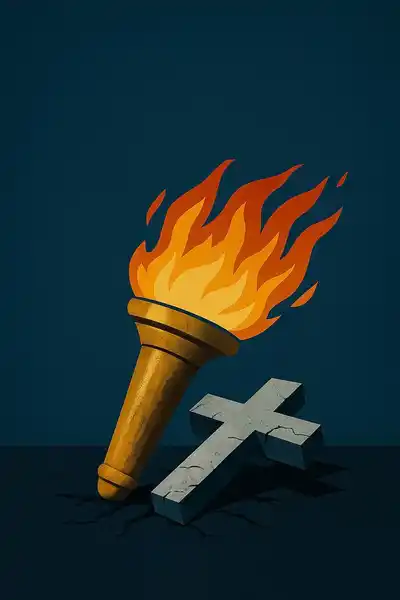
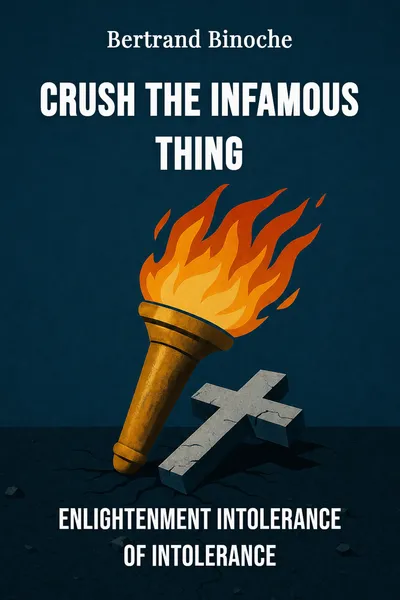
Crush the Infamous Thing
Enlightenment intolerance of intolerance
Description
For the last fifteen years of his life, Voltaire ended a great many of his letters with three words in abbreviated form: écrasez l'infâme. Crush the infamous thing. He signed off that way to friends and strangers, to philosophers and aristocrats, sometimes shortening it further to a cryptic écr. l'inf. so the censors would have to work for it. The phrase ran through his correspondence like a private watchword, a password between those who understood what he was after. It was not a throwaway line. It was, by the 1760s, something close to a program.
The question that program hides is the one Bertrand Binoche sets out to answer in his book of the same name. Crush what, exactly? And crush it how? We tend to file Voltaire and his century under the heading of tolerance — the Enlightenment as the great campaign for letting people believe what they want, worship as they please, speak without fear of the stake. That story is true enough to be useful and simple enough to mislead. Because the men who wrote most movingly about tolerance were also, a lot of the time, calling for something to be destroyed.
Binoche's wager is that the contradiction is not an embarrassment to explain away but the heart of the matter. The Enlightenment was intolerant of intolerance, and that sentence is less of a tidy paradox than it looks. Working out what the philosophes wanted to crush, why they thought crushing was compatible with tolerating, and where the line fell turns out to reorganize how we read the whole century — and, as it happens, a good deal of our own arguments too.
The question we’re asking : When the Enlightenment fought religion in the name of tolerance, what exactly did it mean to crush — and what did it quietly refuse to tolerate?What we’ll see : How a battle cry against the Church reveals that tolerance has always carried an edge it would rather not talk about.
Table of contents
01 Chapter 1 — The slogan Voltaire signed his letters with
Écrasez l'infâme arrives in Voltaire's letters around 1760 and does not leave. He was already in his sixties, installed at Ferney near the Swiss border, close enough to slip across if the authorities in France lost patience. From there he ran what amounted to a one-man campaign, pamphlets and letters and interventions, and the slogan was its banner. Binoche takes the phrase seriously as a phrase — not as rhetorical heat but as a precise instruction that happens to leave its object unnamed.
That blank is deliberate, and it is also a problem. Readers have filled it in different ways for two centuries. Some took l'infâme to mean the Catholic Church specifically, the institution that had burned the Protestant Jean Calas on a broken wheel in Toulouse in 1762 on evidence Voltaire spent years demolishing. Some took it more broadly, as Christianity as such. Others read it as superstition, fanaticism, the whole apparatus of priestly power over frightened minds. The word infâme itself carried a legal weight the modern ear misses: in the old law, infamy was a formal status, a stripping of civic standing.

02 Chapter 2 — What the infamous thing actually was
To crush something you have to know its edges, and Binoche spends real effort reconstructing what the philosophes actually had in their sights. The target was not belief in the privacy of a person's head. Voltaire, Diderot, d'Holbach and the rest were, to varying degrees, unbothered by what their neighbors chose to think about the afterlife. What they could not abide was religion as a public power: the capacity of a church, backed by a state, to decide who could hold office, who could marry, who could be buried in consecrated ground, and who could be broken on a wheel for the wrong confession.
The Calas affair is the case that organizes everything. In 1762 a Protestant merchant in Toulouse was accused of murdering his son to stop him converting to Catholicism — the son had in fact killed himself — and was executed after a trial soaked in sectarian suspicion. Voltaire took up the case, got the verdict overturned in 1765, and turned a judicial horror into the pivot of his campaign. The infamous thing was not an abstraction. It was a court that could kill a man because of what he worshipped, and a crowd that wanted it to.
03 Chapter 3 — The tolerant who would not tolerate
The word tolerance did a lot of heavy lifting in the century, and Binoche is careful to show it was never as generous as its reputation. Even John Locke, whose Letter Concerning Toleration of 1689 is the founding text, drew hard lines: he would not extend toleration to atheists, on the grounds that a man who feared no God could not be trusted to keep an oath, and he was wary of Catholics as agents of a foreign power. Toleration, from the start, came with a list of exceptions. The question was never whether to exclude but whom.
Voltaire's own famous plea, the Treatise on Tolerance written in the wake of Calas in 1763, follows the same grammar. It is a magnificent argument for not killing people over doctrine, and it is also an argument with an inside and an outside. The tolerant society tolerates those who are willing to tolerate. It does not, and in its own terms cannot, tolerate the fanatic who would burn his neighbor. The fanatic sits outside the circle by definition, because he has refused the one condition of membership.
04 Chapter 4 — When tolerance meets its own edge
Step back from the eighteenth century and the shape Binoche has traced turns out to be general. No order of tolerance is unconditional. Every one of them, however liberal, draws a boundary and names something beyond it that it will not abide — and it usually names that thing as the intolerant, the fanatic, the enemy of the open society. The Enlightenment did not stumble into this. It discovered the structure and stated it plainly, which is why its slogan still unsettles us. Écrasez l'infâme is tolerance showing its teeth.
The twentieth century gave the paradox a name. Karl Popper called it the paradox of tolerance: a society that tolerates without limit, including tolerating those who would destroy toleration, will be destroyed by them, so unlimited tolerance is self-defeating. The tolerant are therefore entitled, perhaps obliged, to refuse tolerance to the intolerant. This is Voltaire's logic restated for an age of totalitarian movements. It is not a resolution of the difficulty. It is the difficulty, accepted and formalized.
05 Conclusion
Voltaire died in 1778, received back into Paris as a hero after decades of semi-exile, still crushing the infamous thing to the end. The Calas verdict had been reversed, the Treatise on Tolerance had circulated across Europe, and the slogan he abbreviated to dodge the censors had outlived the censors. He got much of what he wanted: a world where killing a man over his confession came to seem not pious but barbaric. The infamous thing, in his precise sense — religion as a power to persecute — did lose most of its grip.
Related books